The Institute holds lectures and symposiums.
Please see below for a record of past events.
The 52nd
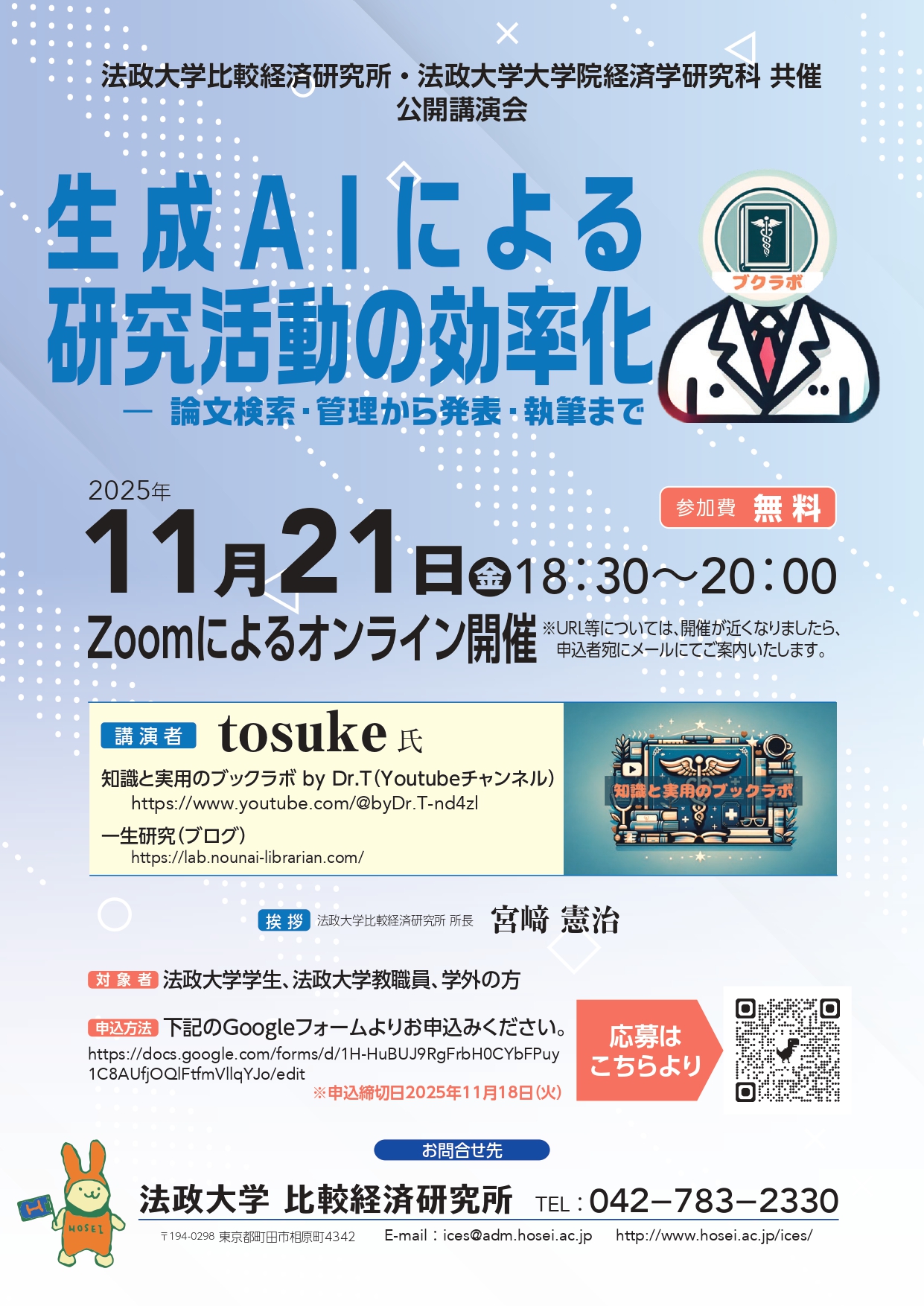
The Institute for Comparative Economic Studies held a public lecture.
| Date and Time | Friday, November 21, 2025, 18:30-20:00 |
|---|---|
| Schedule | The URL and other information will be sent to applicants by e-mail to |
| Lecture |
|
| Co-sponsored by |
Graduate School of Economics, Hosei University |
The 51st
The Institute for Comparative Economic Studies held a public lecture.
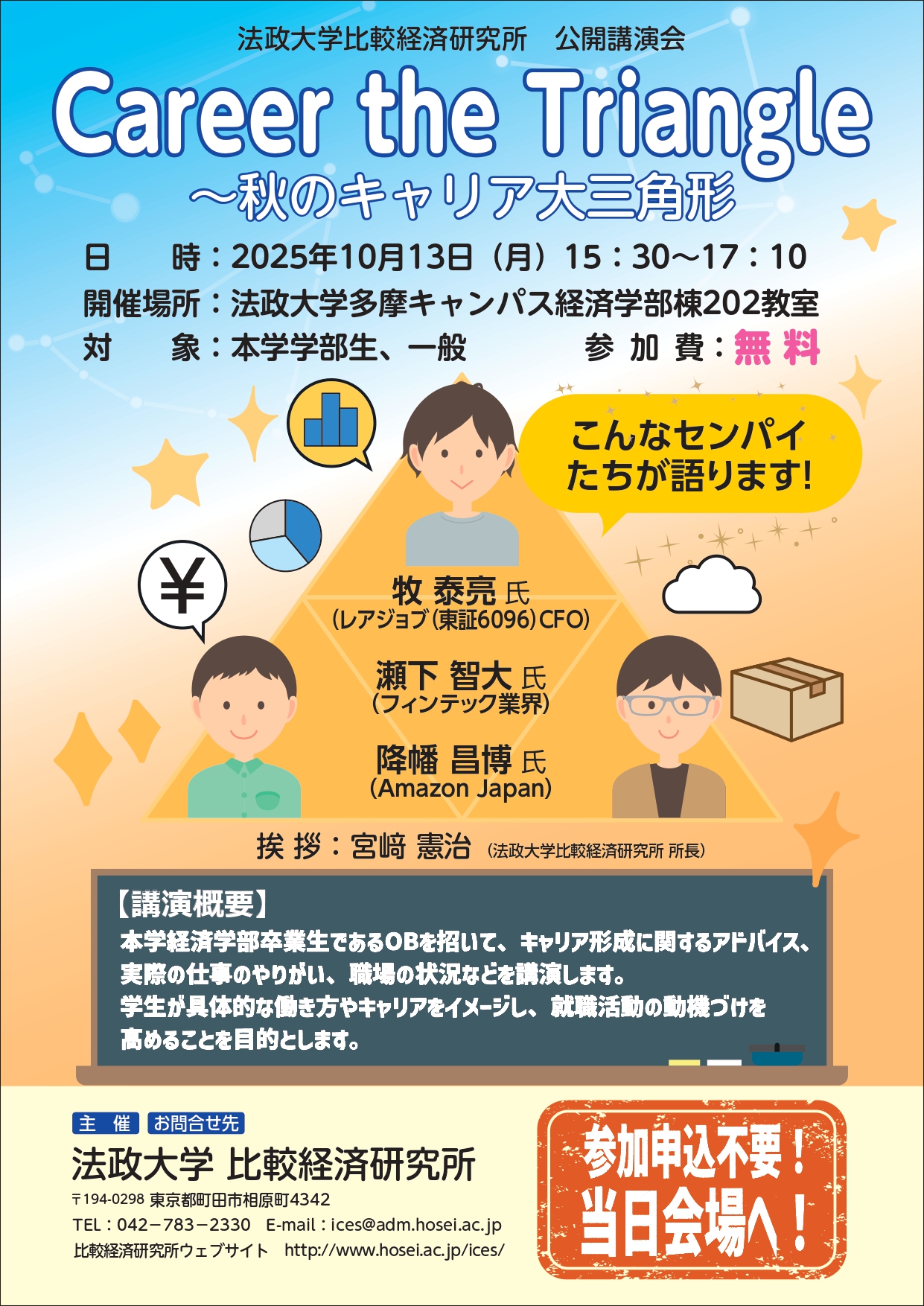
| Date and Time | Monday, October 13, 2025, 15:30-17:10 |
|---|---|
| Schedule | Room 202, Faculty of Economics Building, Hosei University Tama Campus |
| Lecture |
|
The 50th
The Institute for Comparative Economic Studies held a public lecture.
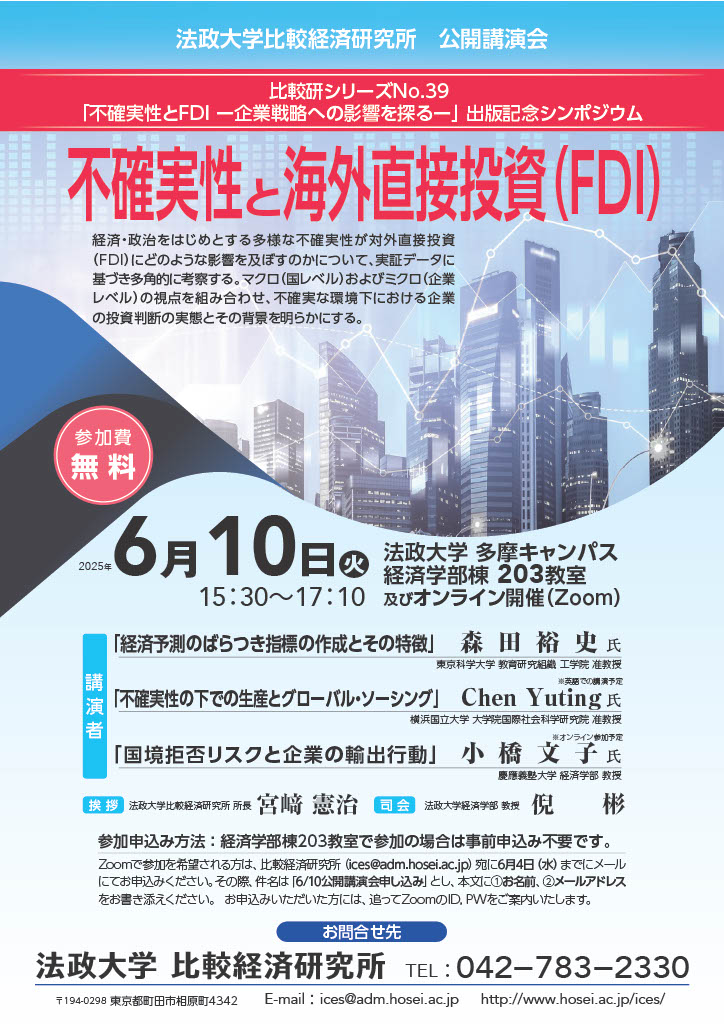
| Date and Time | June 10, 2025 (Tue) 15:30-17:10 |
|---|---|
| Schedule | Room 203, Faculty of Economics Building, Hosei University Tama Campus and online (Zoom) |
| Lecture |
|
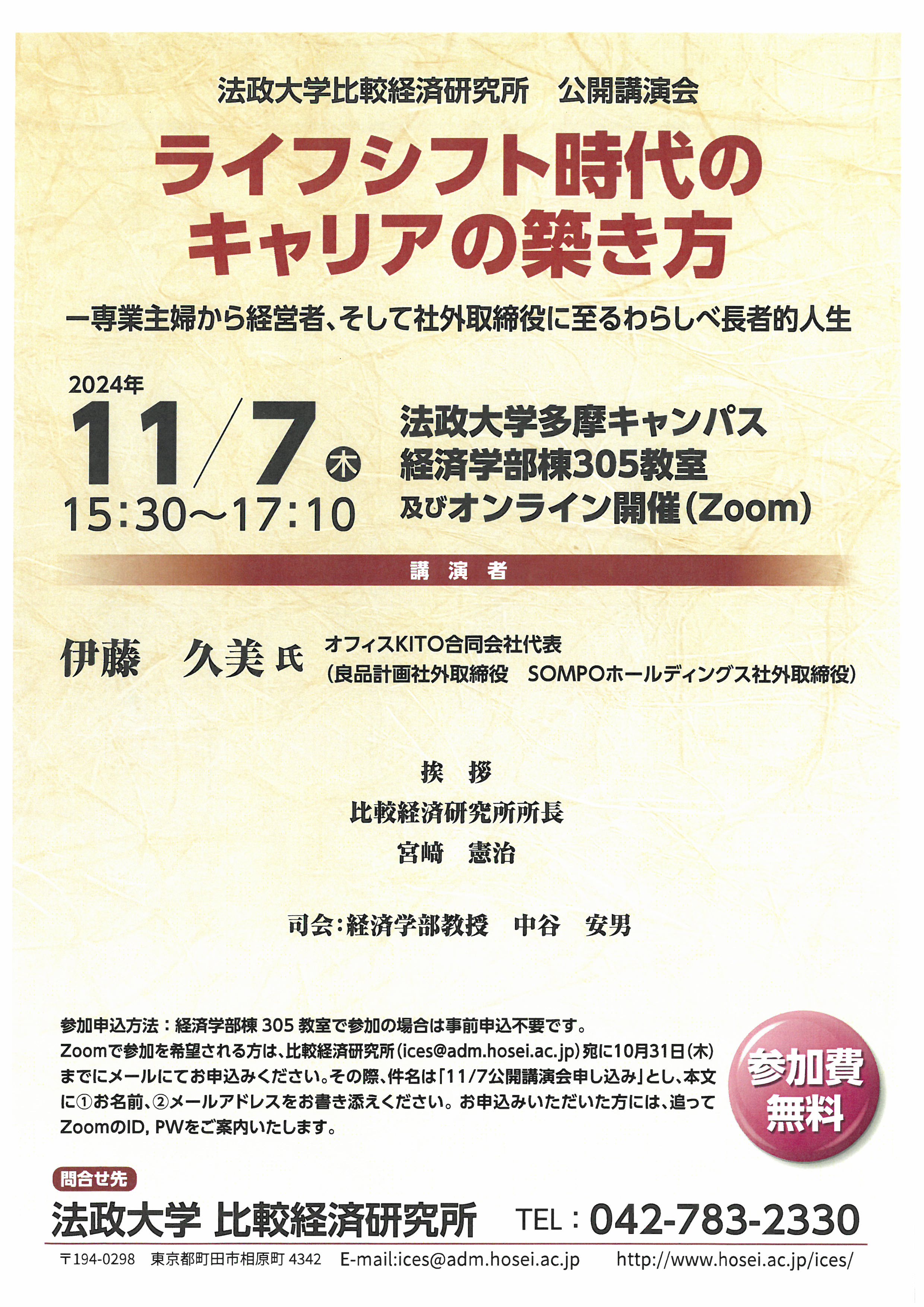
The 49th
The Institute for Comparative Economic Studies held a public lecture.
| Date and Time | November 7, 2024 (Thursday) 15:30-17:10 |
|---|---|
| Schedule | Room 305, Faculty of Economics Building, Hosei University Tama Campus and online (Zoom) |
| Lecture |
|
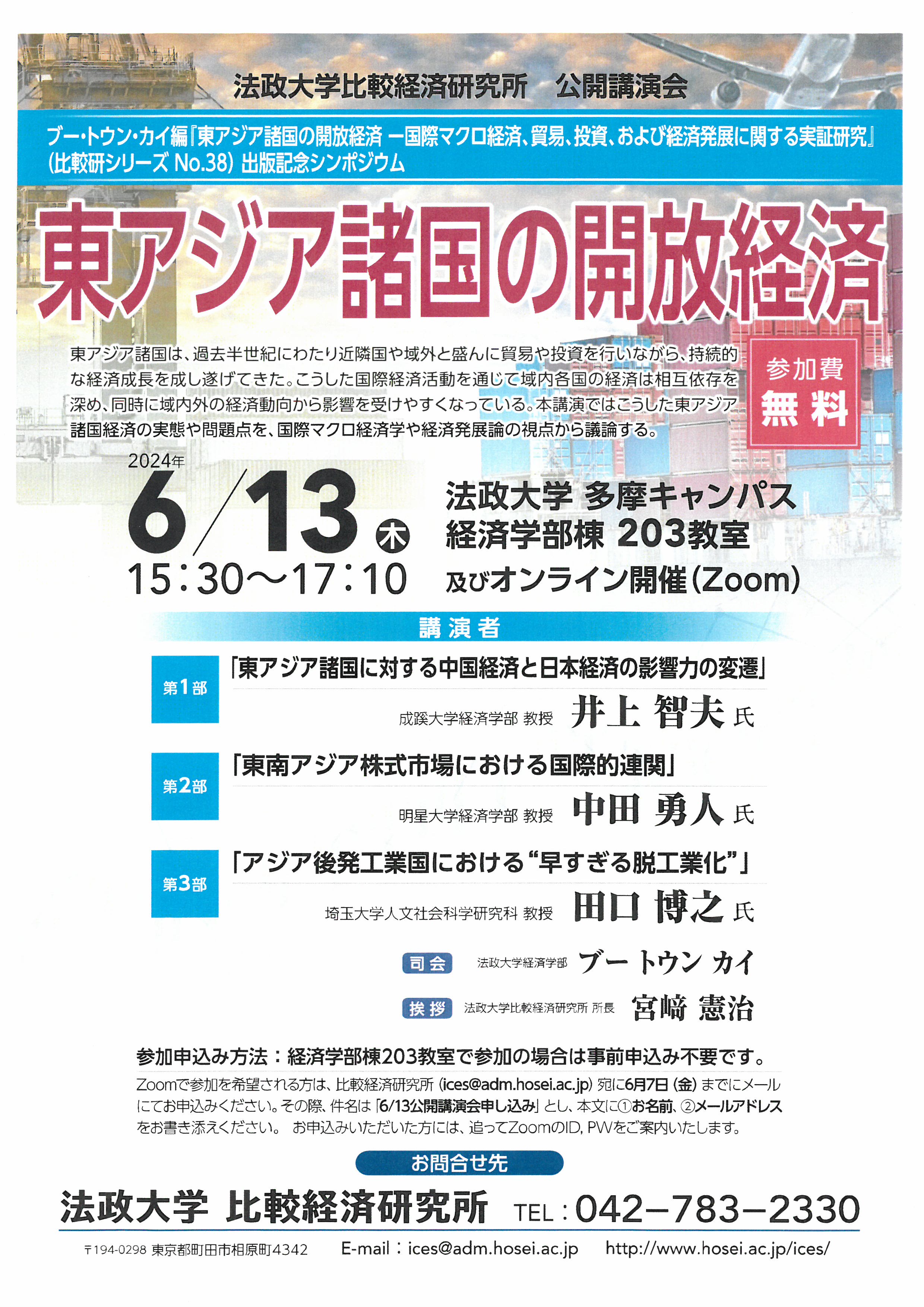
The 48th
Over the past half century, East Asian countries have achieved sustained economic growth through active trade and investment with neighboring countries and outside the region. Through these international economic activities, the economies of the countries in the region have become more interdependent and, at the same time, more susceptible to the economic trends in and outside the region. This lecture will discuss the actual conditions and problems of these East Asian economies from the perspectives of international macroeconomics and economic development theory.
| Date and Time | Thursday, June 13, 2024, 15:30-17:10 |
|---|---|
| Schedule | Room 203, Faculty of Economics Building, Hosei University Tama Campus and online (Zoom) |
| Lecture |
|
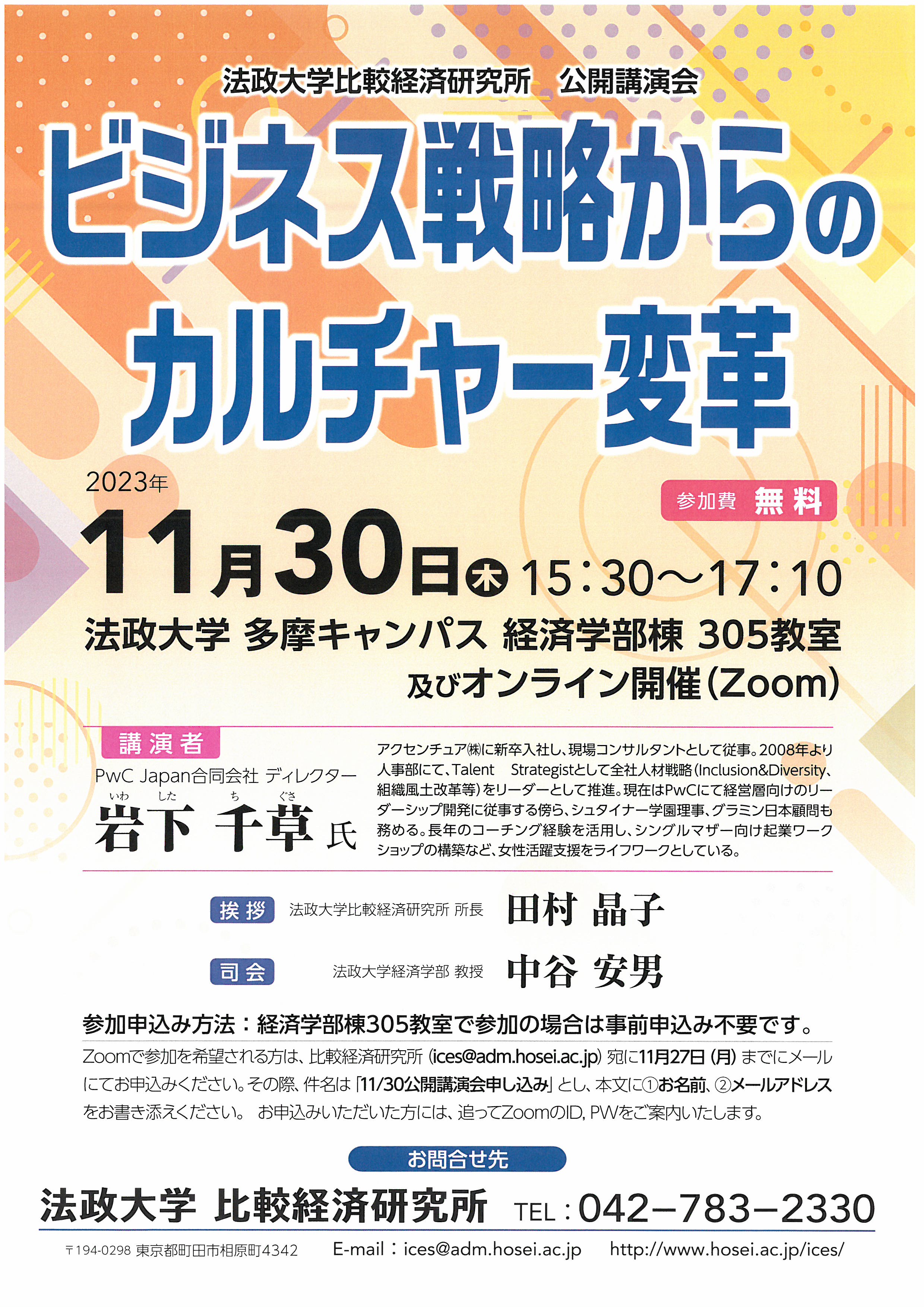
The 47th
The Institute for Comparative Economic Studies held a public lecture.
| Date and Time | Thursday, November 30, 2023, 15:30-17:10 |
|---|---|
| Schedule | Room 305, Faculty of Economics Building, Hosei University Tama Campus and online (Zoom) |
| Lecture |
|
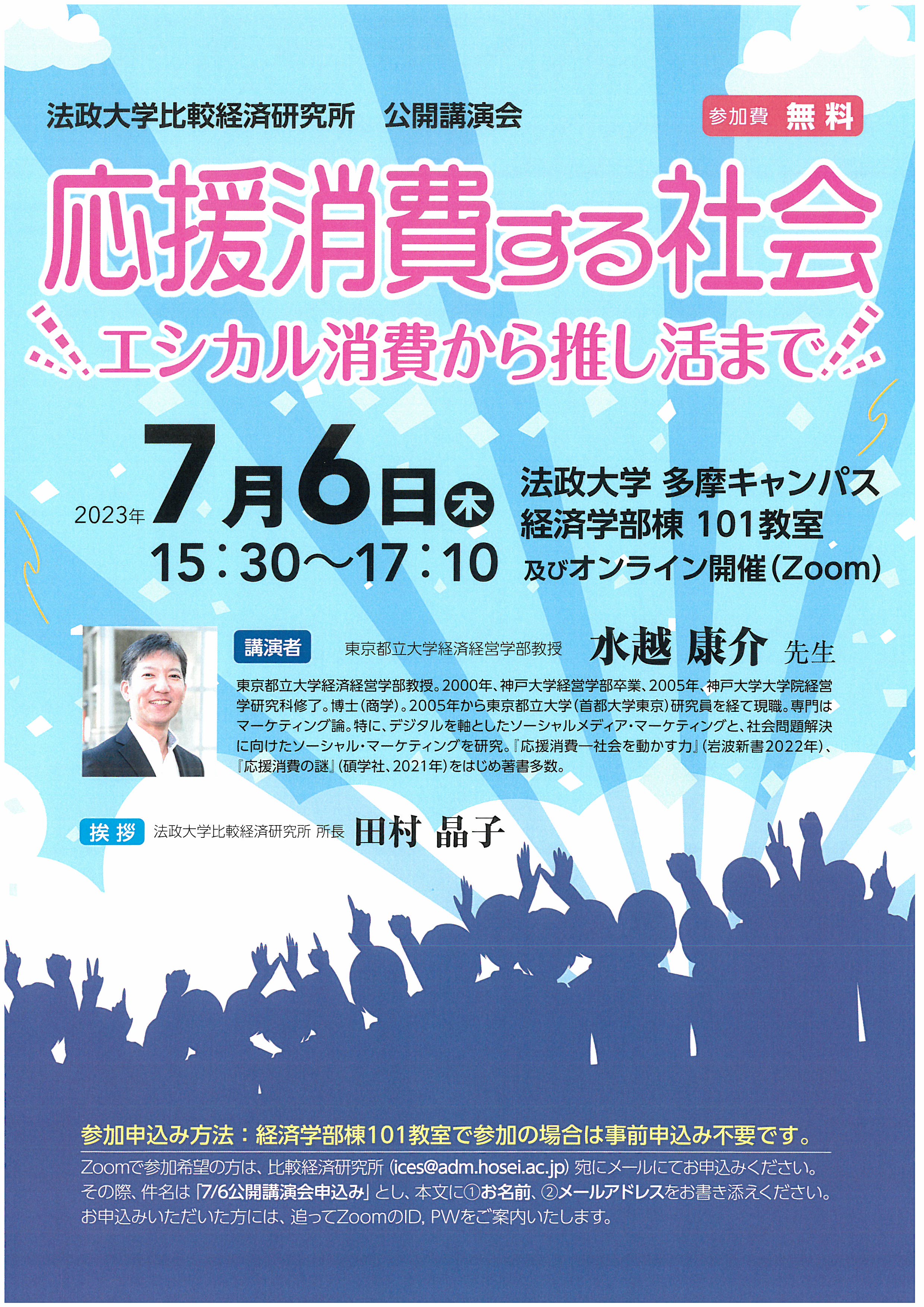
The 46th
The Institute for Comparative Economic Studies held a public lecture.
| Date and Time | Thursday, July 6, 2023 (15:30-17:10) |
|---|---|
| Schedule | Room 101, Faculty of Economics Building, Hosei University Tama Campus and online (Zoom) |
| Lecture |
|
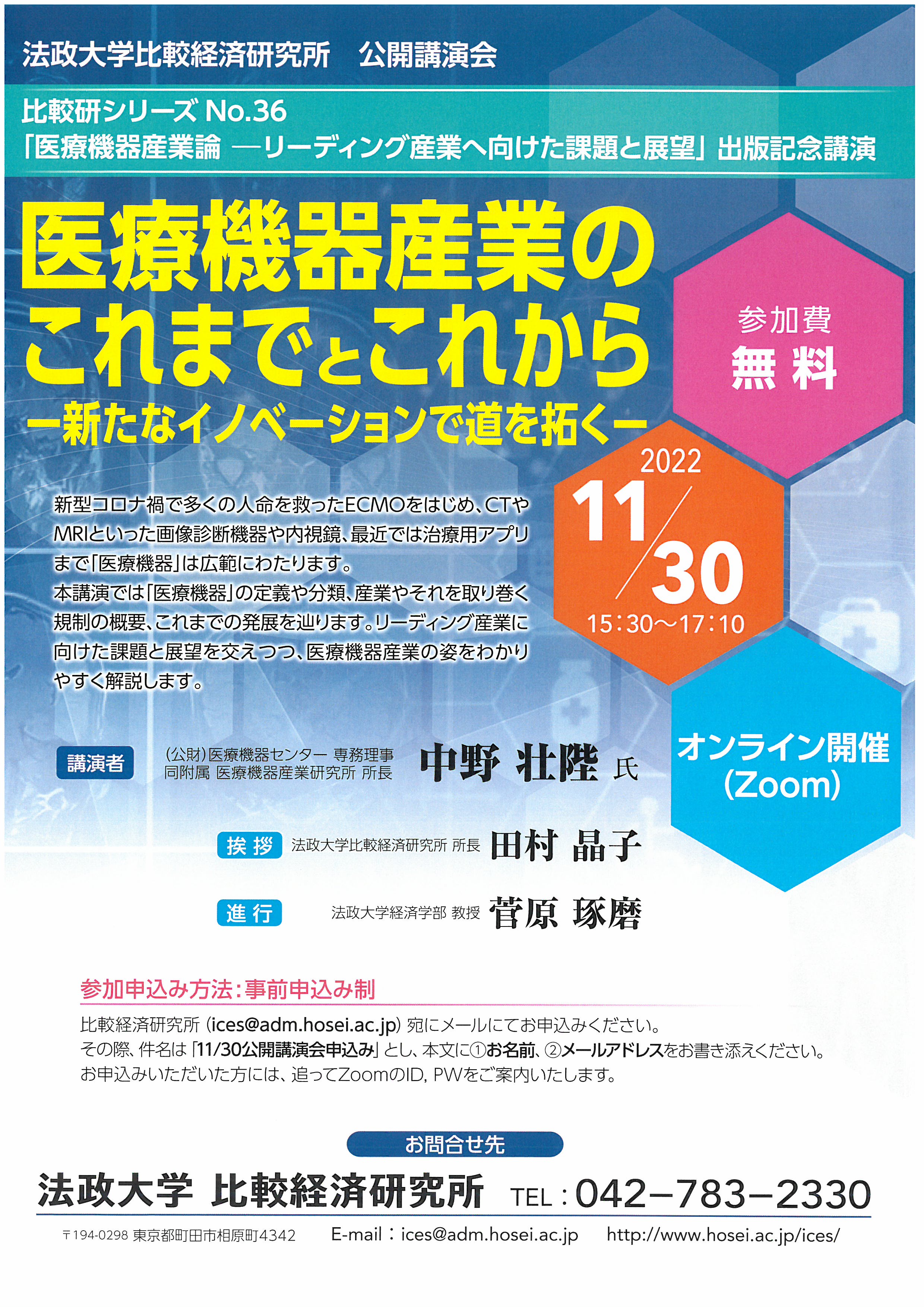
The 45th
Starting with ECMO, which saved many lives with the new coronary disaster, "medical devices" range from diagnostic imaging equipment such as CT and MRI, endoscopes, and more recently, therapeutic applications.
This presentation will trace the definition and classification of "medical devices," an overview of the industry and regulations surrounding it, and its development to date. The presentation will provide an easy-to-understand overview of the medical device industry, including the challenges and prospects for becoming a leading industry.
| Date and Time | Thursday, November 30, 2022, 15:30-17:10 |
|---|---|
| Schedule | Online (Zoom) |
| Lecture |
|
The 44th
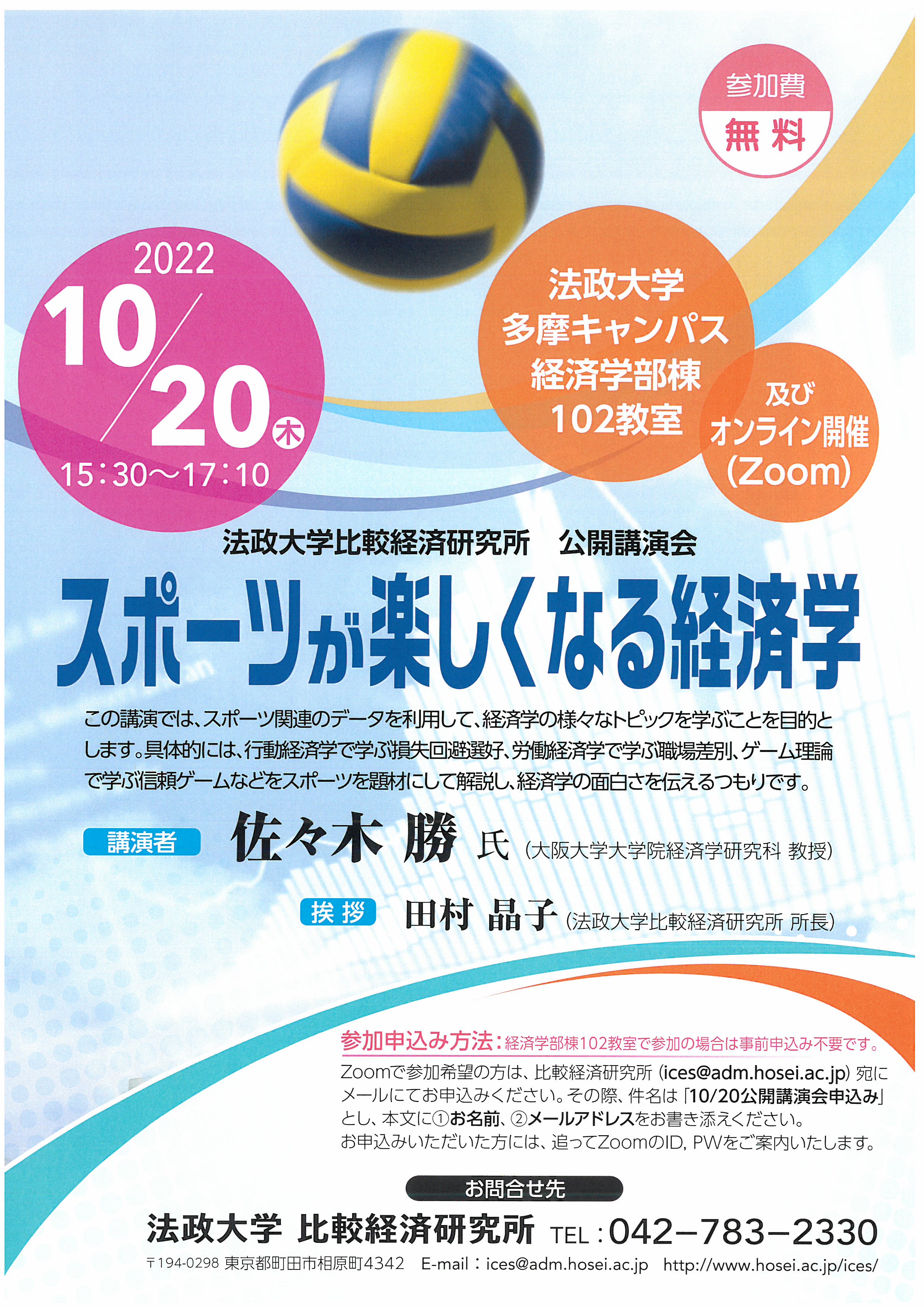
The aim of this talk is to use sports-related data to learn about various topics in economics. Specifically, I intend to explain loss aversion preferences studied in behavioral economics, workplace discrimination studied in labor economics, and trust games studied in game theory, using sports as a subject matter to convey the fun of economics.
| Date and Time | Thursday, October 20, 2022, 15:30-17:10 |
|---|---|
| Schedule | Room 102, Faculty of Economics Building, Hosei University Tama Campus and online (Zoom) |
| Lecture |
|
The 43rd
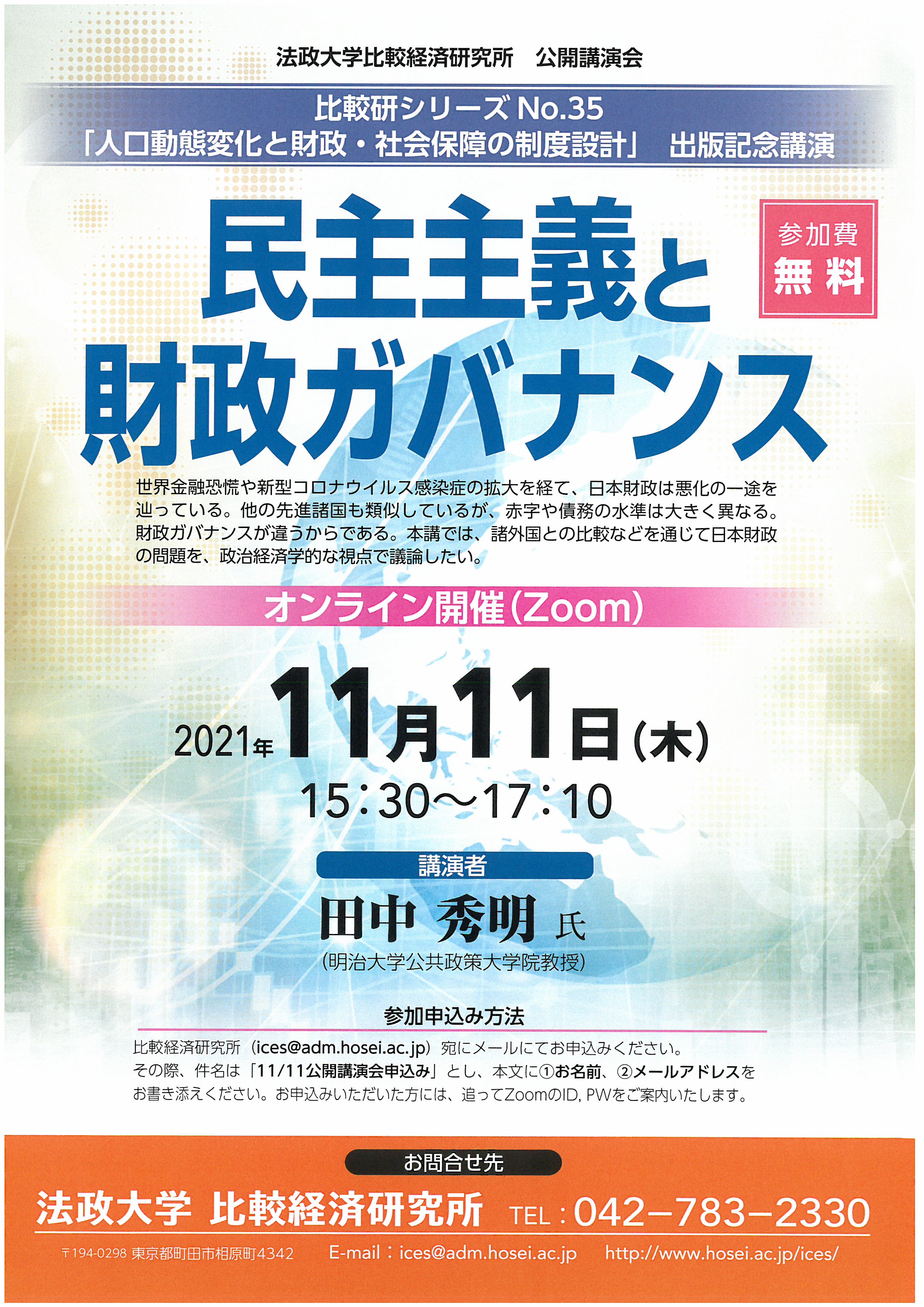
Japan's finances have continued to deteriorate after the global financial depression and the spread of the new coronavirus infection.
Other advanced economies are similar, but their deficits and debt levels are very different. This is because they have different fiscal governance.
In this lecture, I would like to discuss the problem of Japanese public finances from a political economy perspective through comparisons with other countries.
| Date and Time | November 11, 2021 (Thursday) 15:30-17:10 |
|---|---|
| Schedule | Online (Zoom) |
| Lecture |
|
The 42nd
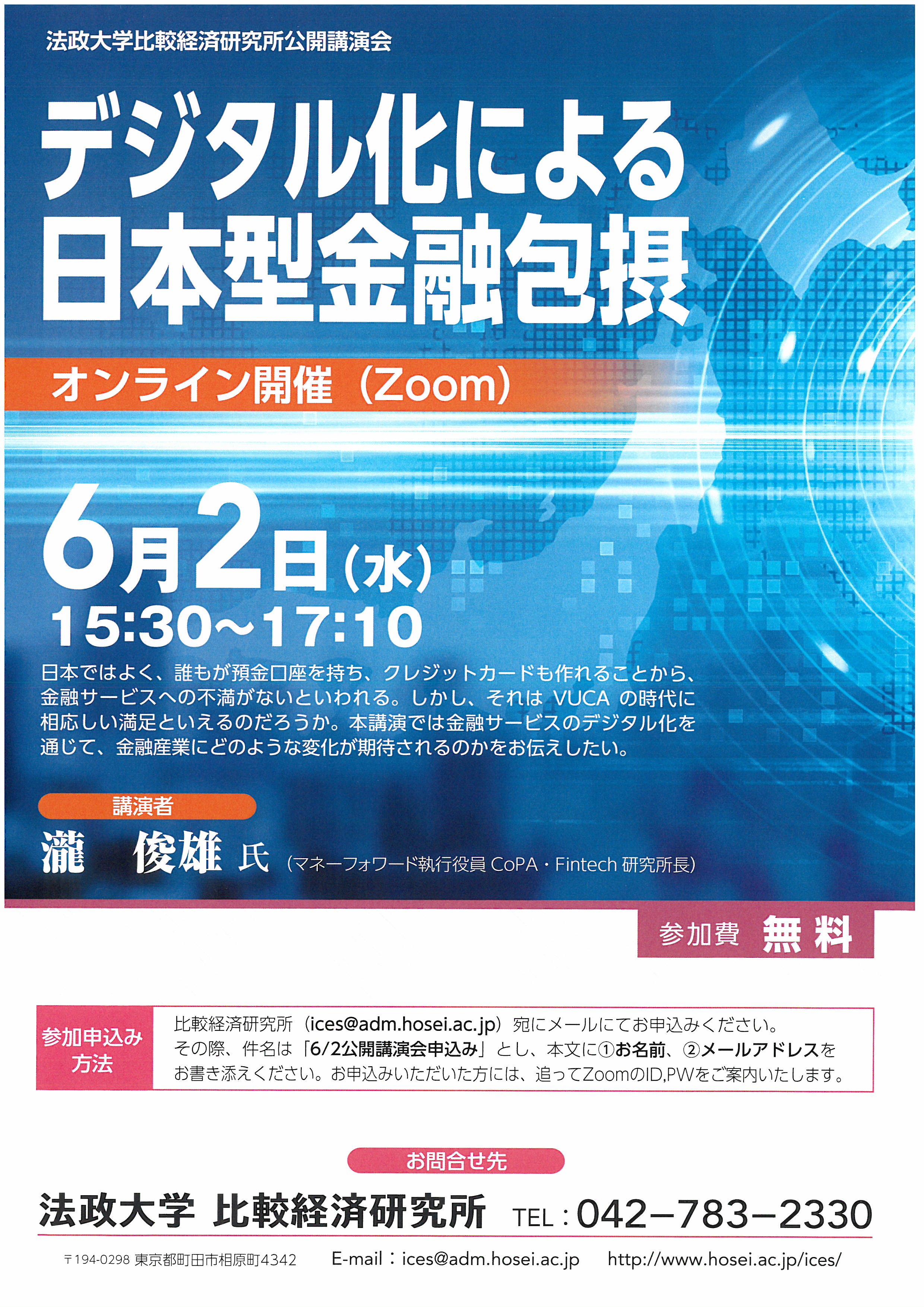
~In Japan, it is often said that there is no dissatisfaction with financial services because everyone has a bank account and can get a credit card. However, can this be considered satisfaction appropriate in the age of VUCA? In this presentation, I would like to convey what kind of changes are expected in the financial industry through the digitalization of financial services. ~Mr. Tadashi Kato, CoPA, Executive Officer, Money Forward, Inc.
Toshio Taki, Executive Officer of Money Forward and General Manager of CoPA and Fintech Research Institute, will give a lecture.
| Date and Time | Wednesday, June 2, 2021, 15:30-17:10 |
|---|---|
| Schedule | Online (Zoom) |
| Lecture |
|
The 41st
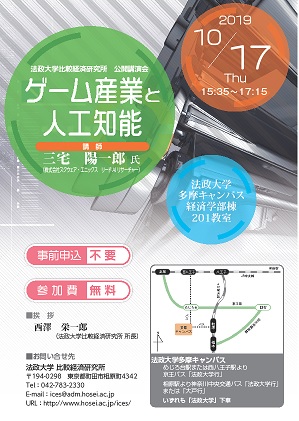
Lecture titled "Game Industry and Artificial Intelligence" by Yoichiro Miyake, Lead AI Researcher, Square Enix Co.
| Date and Time | Thursday, October 17, 2019, 15:35-17:15 |
|---|---|
| Place | Room 201, Faculty of Economics Building, Hosei University Tama Campus |
| Lecture |
|
The 40th
The perspective of "how to effectively use limited resources" is a major question at the heart of economics, and both the normative perspective of resource allocation and the feasibility of resource allocation are important in the analysis of government decision-making and the design of economic policies and institutions.
This presentation will present and analyze models of government decision making and examine the outcomes of current economic policies that have received much attention in recent years, providing important topics for discussion and analysis.
| Date and Time | Tuesday, June 25, 2019, 15:35-17:15 |
|---|---|
| Place | Room 201, Faculty of Economics Building, Hosei University Tama Campus |
| Lecture |
|

International Symposium
International Symposium on Agro-Environmental Payments for Biodiversity
| Date and Time |
Tuesday, March 5, 2019 13:00-17:30 |
|---|---|
| Place |
Room F309, Fujimizaka Building, Hosei University Ichigaya Campus |
| Details |
March 5, 2019 (Tuesday)
Wednesday, March 6, 2019
For inquiries, please contact
Institute for Comparative Economic Studies, Hosei University
|

The 39th
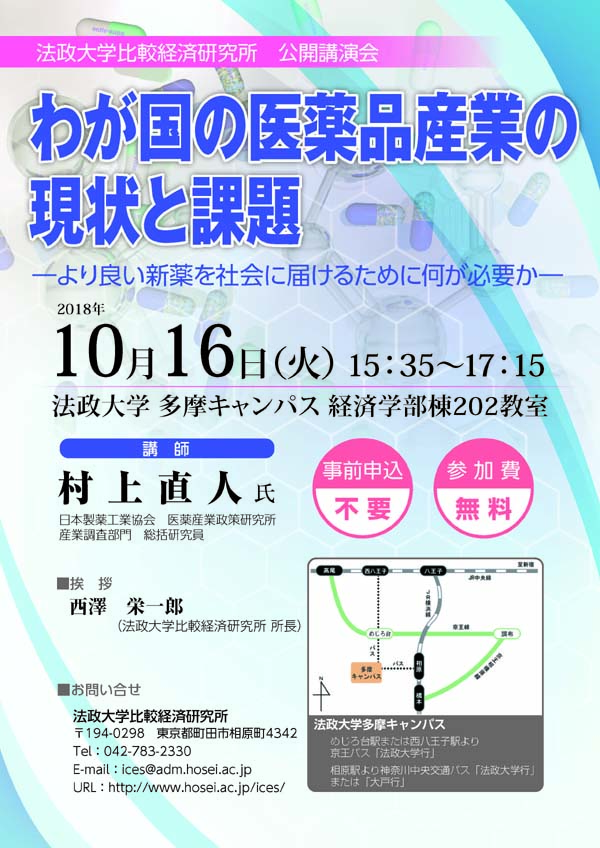
The domestic pharmaceutical industry, which is under strong pressure to curb drug costs due to concerns about securing financial resources for social security in the face of the declining birthrate and aging population, must continue to make sufficient investments necessary to survive the borderless competition for new drug development to ensure access to medicines necessary to maintain and improve the health of the population, which poses a major We are faced with a challenge. In this presentation, we would like to introduce our industry's position in the external environment (facts) and the future that our industry should aim for, and we would like to exchange views with the audience on the direction that our industry should take.
| Date and Time | Tuesday, October 16, 2018, 15:35-17:15 |
|---|---|
| Place | Room 202, Faculty of Economics Building, Hosei University Tama Campus |
| Lecture |
|

Free Public Lecture by a Research Fellow of the Institute of Comparative Economics at Hachioji Gakuen City University (Ichojuku)
OGURO Kazumasa, a full-time researcher at the Institute, will give a lecture at Hachioji Gakuen Toshi University (Ichojuku).
Issues Concerning Japan's Public Finances: What are the Hints for Fiscal Restructuring?
Japan's fiscal situation is extremely severe, with the country's outstanding government debt (as a percentage of GDP) at over 200% of GDP and continuing to rise cumulatively. One hot topic in the compilation of the government's fiscal 2018 (initial) budget was the fact that social security-related expenses reached a record high of 33 trillion yen, and the cost of social security benefits financed by national and local public expenditures and insurance premiums is on track to reach about 120 trillion yen. At present, the Bank of Japan's monetary policy has kept long-term interest rates under control and reduced debt interest expenses, but there are indications that even large-scale monetary easing has its limits. What are the hints for fiscal rehabilitation?
| Date and Time | Wednesday, October 3, 2018 13:30-15:00 |
|---|---|
| Place | Seminar Room 1, Gakuen City Center Capacity 56 (first-come, first-served on the day) *There is no charge for this course. No reservation, registration or application is required. |
| Link :: Hosei University Peer Net |
The 38th
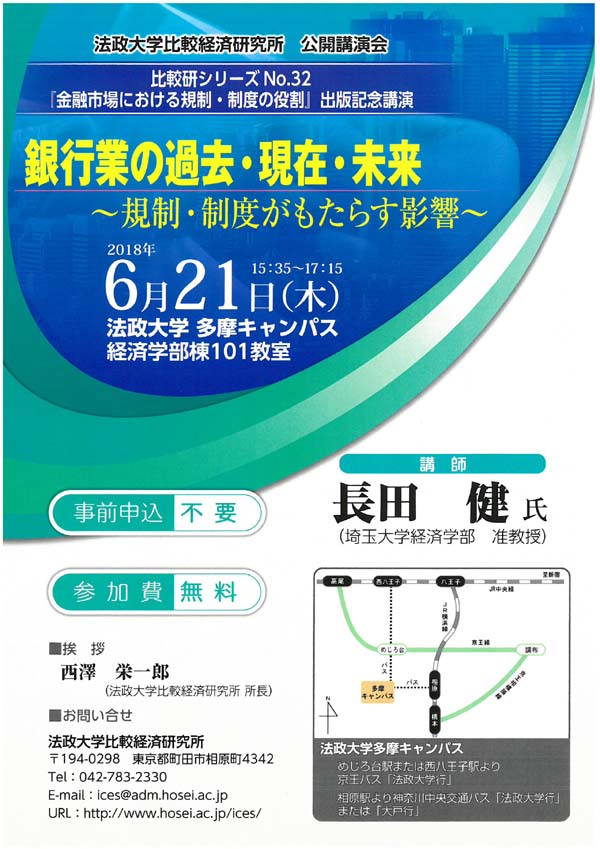
Recently, the banking industry's predicament has been widely reported. Amid negative interest rate policies, a declining population, and the advancement of fintech, Japanese banks are at a historical turning point. It has been almost 150 years since commercial banks were established in Japan. Perhaps surprisingly, the banking industry only reigned as the center of the Japanese economy and finance for about 50 years after World War II. Much of the rise and fall of the banking industry was brought about by regulations and institutions. In this lecture, I would like to summarize the history of Japanese banks and consider their future.
| Date and Time | June 21, 2018 (Thursday) 15:35-17:15 |
|---|---|
| Place | Room 101, Faculty of Economics Building, Hosei University Tama Campus |
| Lecture |
|

The 37th
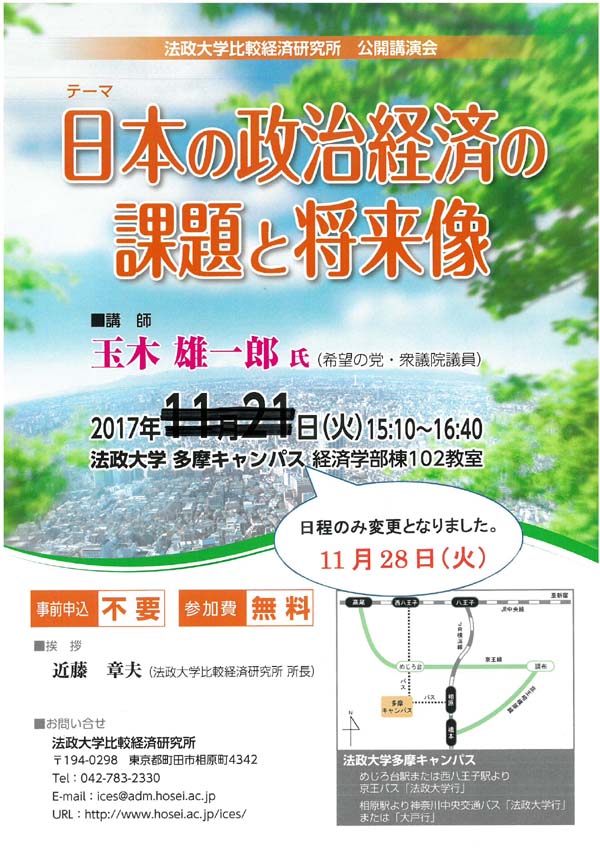
With economic globalization, declining population, falling birthrates, and aging society, the Japanese economy and public finances are facing major challenges, and politics, which is the "center of gravity" for growth and distribution, is also facing great difficulties. New growth strategies such as big data, IoT, and population intelligence are being developed, but what philosophy should we adopt to rebuild Japan in the future, including measures to address the declining birthrate and support child rearing, as well as fiscal reconstruction, social security reform, and rehabilitating the safety net? We will explore the essence of these questions together with up-and-coming politicians.
| Date and Time | Tuesday, November 28, 2017, 15:10-16:40 *The schedule has been changed (as of 2017.11.10) |
|---|---|
| Place | Room 102, Faculty of Economics Building, Hosei University Tama Campus |
| Lecture |
|

(Research Fellow, Institute for Comparative Economic Studies) at Hachioji Gakuen Toshi University (Ichojuku)
Free Public Lecture
OGURO Kazumasa, a full-time researcher at the Institute, will give a lecture at Hachioji Gakuen Toshi University (Ichojuku).
Issues Surrounding Japan's Public Finances: What are the Hints for Fiscal Rehabilitation?
Japan's fiscal situation is extremely severe, with the country's outstanding government debt (as a percentage of GDP) at more than 200% of GDP and continuing to rise cumulatively. One hot topic in the compilation of the government's fiscal 2018 (initial) budget was the fact that social security-related expenditures reached a record high of 33 trillion yen, while social security benefits, which are financed by national and local public expenditures and insurance premiums, are on track to reach approximately 120 trillion yen. Currently, the Bank of Japan's monetary policy is keeping long-term interest rates under control and reducing interest expenses on debt, but there are indications that even large-scale monetary easing has its limits. What are some hints for fiscal restructuring?
| Date and Time | Wednesday, October 3, 2018 13:30-15:00 |
|---|---|
| Place | Seminar Room 1, Gakuen City Center Capacity 56 (first-come, first-served on the day) *There is no charge for this course. No reservation, registration or application is required. |
| Link :: Hosei University Peer Net |
The 36th
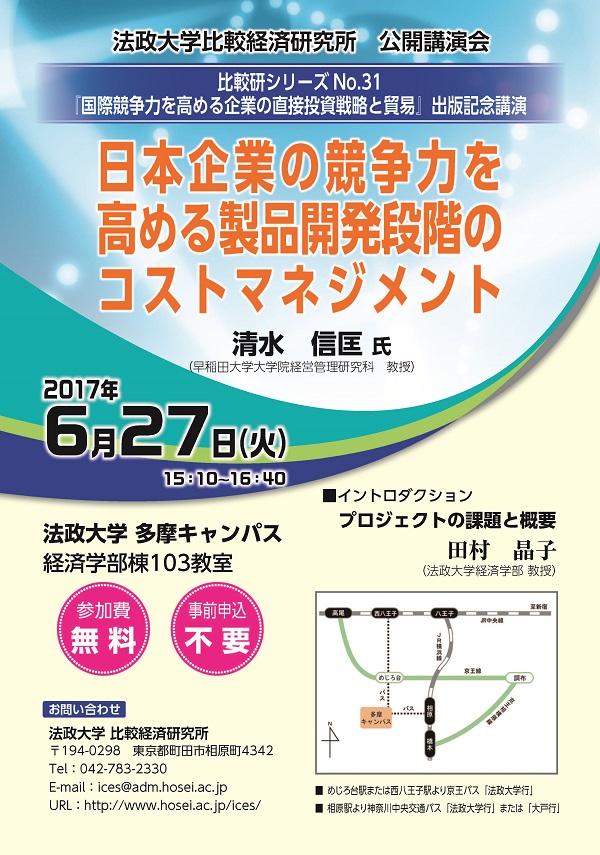
| Date and Time | Tuesday, June 27, 2017, 15:10-16:40 |
|---|---|
| Place | Room 103, Faculty of Economics Building, Hosei University Tama Campus |
| Lecture |
|
Symposium
STAMP (System Theory Based Accident Model) Research Discussion
With rising incomes around the world, the wave of motorization is becoming increasingly global, and the promotion and development of the automotive industry by developed as well as less developed countries is becoming more and more active. In recent years, "safety" and "environment" have become key issues in automotive development. These keywords have become indispensable for the improvement of automobile competitiveness in developed countries and for the catch-up and competitiveness of the less developed countries that are following in their footsteps. This time, we would like to hold a research discussion session on STAMP (System Theoretic Accident Model and Processes), which has been the focus of much attention, especially in the area of automobile safety.
STAMP is an accident model focusing on interaction and control, based on the proposition by MIT Prof. Nancy Leveson that "software reliability alone does not increase safety. Its effectiveness has been proven in the aerospace, aviation, and medical fields, and in recent years, it has been attracting attention in the automotive field as well.
This year's symposium will provide a forum for research discussion between Dr. John Thomas of MIT (Massachusetts Institute of Technology), who is conducting STAMP research, and researchers from Japanese universities and industrial associations, in order to deepen understanding of the latest theory.
| Date and Time | Friday, December 2, 2016 9:00 - 11:00 No registration required (Primary language will be English) |
|---|---|
| Place | Hosei University Ichigaya Campus, Boissonade Tower 25th Floor, Conference Room B (seats around 40) |
| Organized by | Hosei University Educational Corporation Faculty of Economics BABA Toshiyuki PJ |
| Co-sponsored by | Institute for Comparative Economic Studies, Hosei University, KONDO Akio PJ, Japan MOT Society, Keijiro Araki PJ, Kyushu University, National University Corporation |
- Grant-in-Aid for Scientific Research, Grant-in-Aid for Scientific Research (B) "Research on the metal mold industry in India and Brazil: technological formation, development stage, competitiveness, and comparative verification with other regions" (Representative: BABA Toshiyuki (Hosei University))
- Grant-in-Aid for Scientific Research (B) "An Economic Geographical Study on the Technological and Human Linkages and Agglomeration Effects in Science-based Industries" (Representative: Akio KONDO Akio (Hosei University))
- Grant-in-Aid for Scientific Research, Kiban Kenkyu (S), "Proposal and Practical Application of High-Quality Software Development Methodology Based on Architecture-Oriented Formal Methodology" (Rep: Keijiro Araki (Kyushu University))
(Research Fellow, Institute for Comparative Economic Studies) at Hachioji Gakuen Toshi University (Ichojuku)
Free Public Lecture
SHINOHARA Ryusuke, a full-time researcher at the Institute, will give a lecture at Hachioji Gakuen Toshi University (Ichojuku).
Economic and Social Issues Deciphered by Strategic Thinking: Game Theory and Its Applications
Game theory is an academic discipline that analyzes interdependent relationships among economic agents, such as corporate competition, international trade, and labor-management contractual issues, and examines how each economic agent behaves as a result of such interdependence and how such behavior affects economic society. In recent years, game theory has been applied to various economic analyses and plays an important role. In this lecture, we will discuss "What is game theory?" and "How is it applied to economic analysis?" and "How is game theory applied to economic analysis? The faculty member in charge of this course specializes in strategic behavior analysis of public goods supply, and applies game theory to this analysis. The lecture will include the results of the faculty member's research.
| Date and Time | Wednesday, November 2, 2016 15:20-16:50 |
|---|---|
| Place | Seminar Room 1, Gakuen City Center
|
| Link :: Hosei University Peer Net |
Institute for Comparative Economic Studies, Hosei University, Public Lecture
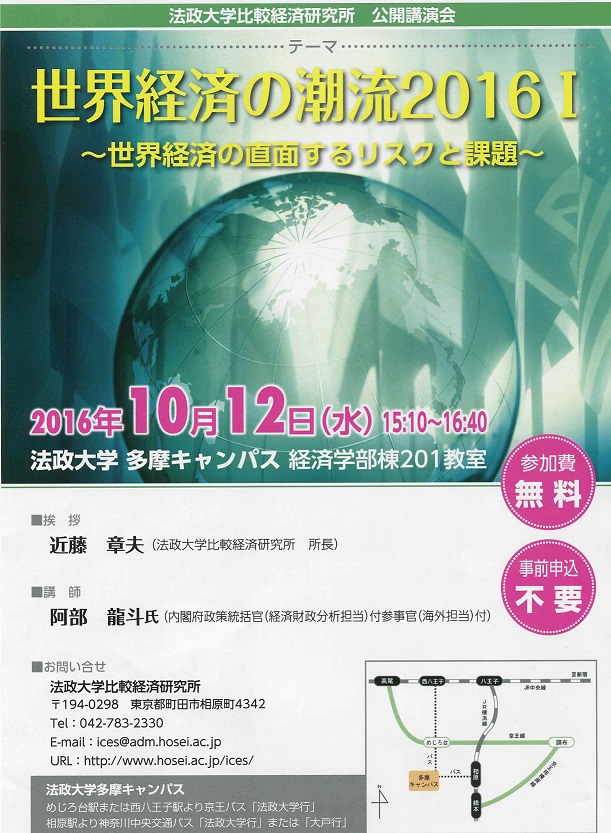
The Cabinet Office releases "Global Economic Trends" twice a year, which analyzes trends in the world economy and the economic and fiscal policies of various countries. In "Global Economic Trends 2016 I," released in August this year, the report examines the factors behind the slowdown in global economic growth after the global financial crisis, identifies risks that could weigh on global economic growth, and discusses specific issues and measures for the global economy to regain its recovery. This presentation will focus on key points from the report in looking at the current and future global economy, including the Chinese economy and the issue of the U.K. leaving the European Union.
| Date and Time | October 12, 2016 (Wednesday) 15:10-16:40 |
|---|---|
| Place | Room 201, Faculty of Economics Building, Hosei University Tama Campus |
| Greetings | KONDO Akio, Director, Institute for Comparative Economic Studies, Hosei University |
| Lecture |
|
The 34th
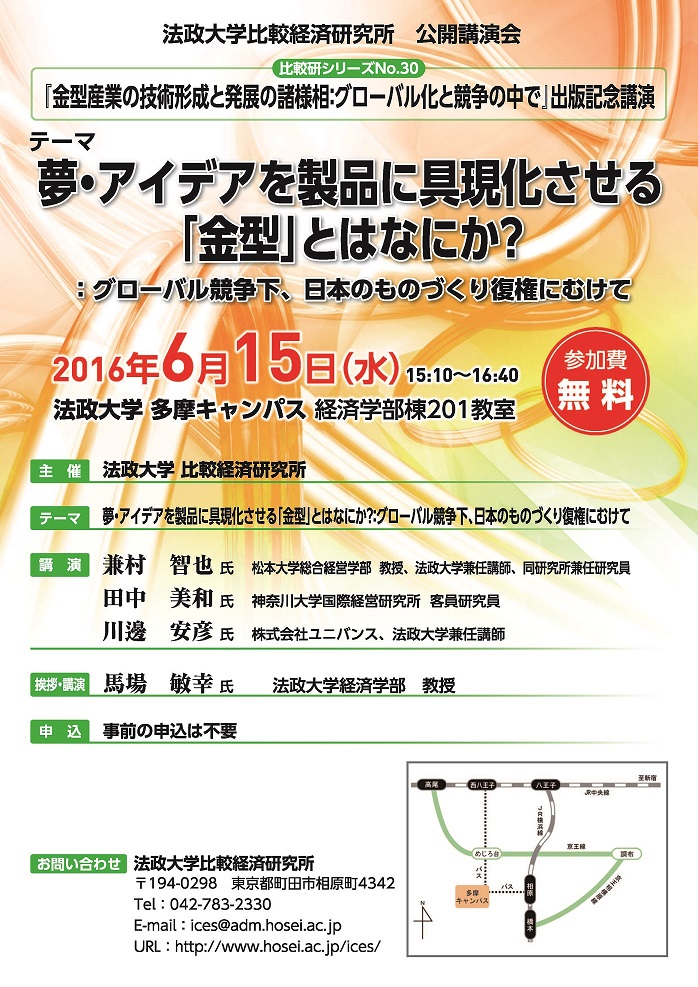
| Date and Time | Wednesday, June 15, 2016, 15:10-16:40 |
|---|---|
| Place | Room 201, Faculty of Economics Building, Hosei University Tama Campus |
| Greetings | BABA Toshiyuki, Professor, Faculty of Economics, Hosei University |
| Lecture |
|
The 33rd
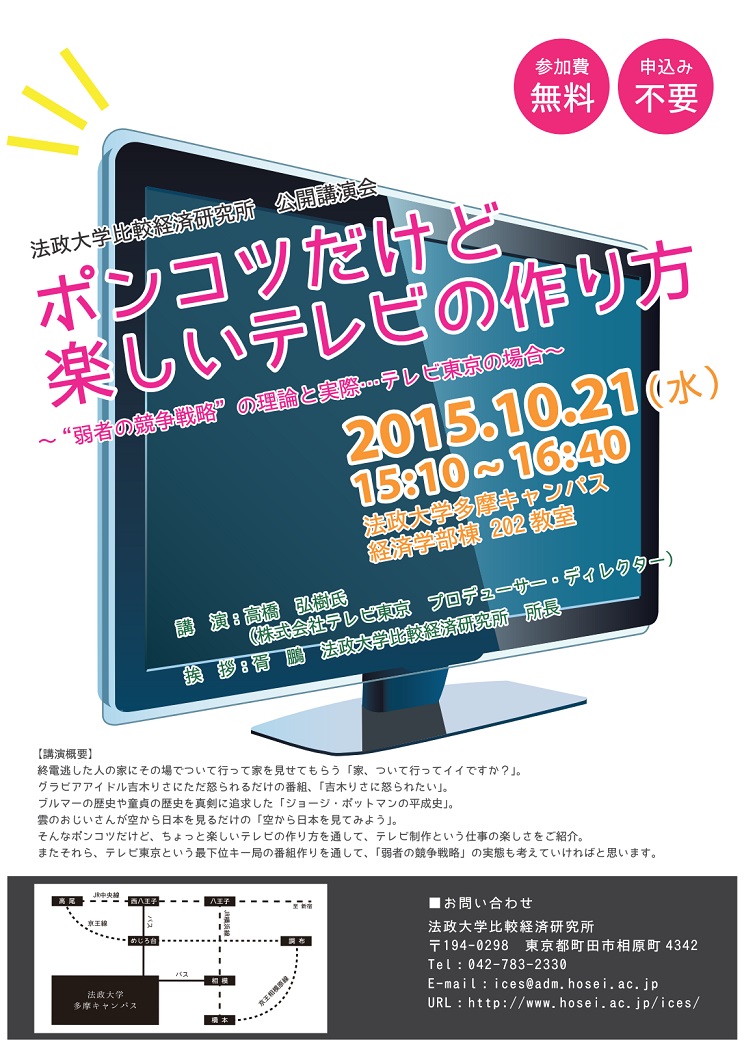
| Date and Time | Wednesday, October 21, 15:10-16:40 |
|---|---|
| Place | Room 202, Faculty of Economics Building, Hosei University Tama Campus |
| Greetings | XU Peng, Director, Institute for Comparative Economic Studies |
| Lecture |
|