

Friday, January 31
I was interviewed by the Hosei University Newspaper Society. The topic was the growing economic disparity among students. Since the second division (evening division) was abolished, it is no longer possible for students to attend the university while working. Students are forcing themselves to balance work and coursework, but as a result, an increasing number of students are failing to graduate in four years and are staying in school. Hosei University used to be a university that students with financial difficulties and students from rural areas could attend. There are some things that can be done now, such as increasing the number of on-demand courses that allow students to study online regardless of their location, creating day and evening courses, and allowing students to take courses in the School of Correspondence Education with restrictions. I hope to make Hosei University a university of choice for students from rural areas who have difficulty in coming to Tokyo by making these features unique to Hosei University, just as we did in the past.
Afterwards, I participated in the debriefing session of the "Manabi Program," a six-month staff training program, where 11 staff members wrote policy proposals to solve the problems of their departments, and today each gave a seven-minute presentation, receiving tough questions and critiques. It was a tense and brilliant program.
The first entrance ceremony will be held on September 9. The university will also dispatch a lecturer. Students will be able to come and go as well.
Thursday, January 30
I had a meeting with Mr. Yasuhiro Ooi, an alumnus of TUAT and Senior Managing Director of Tokyo Metropolitan Television, regarding a TV interview with Tokyo Governor Yuriko Koike. Mr. Oi is not only an alumnus, but also an alumnus of Masaji Nobayashi's linguistics course, which I took in my first year at the university and featured in the book "Freedom, the Plaza" (2016, Hosei University Press). Though it was a liberal arts course, like a seminar, the alumni remained close until later, and it looks like a TV interview with Tokyo Governor Yuriko Koike will happen in April.
The HOSEI2030 Special Subcommittee on Campus Restructuring was then held. In addition, a meeting of deans was held.
January 29 (Wednesday)
Executive Trustee and Executive Trustee Roundtable Meetings were held.
In the evening, I attended the presentation ceremony of the Asahi Shimbun's Obutsu Jiro Prize as a judge. The presentation ceremony was held in conjunction with the Asahi Prize, the Asahi Sports Prize, and the Obutsu Jiro Award. The Obutsu Jiro Prize went to Hajime Kurokawa for his book "Tsurumi Shunsuke Biography. I worked with Shunsuke Tsurumi when I was a member of the first Asahi Shimbun Book Review Committee. Not only did I hear various stories from him at committee meetings, but he also invited me to dialogue and roundtable discussions with him. I met her older sister, Kazuko Tsurumi, at symposiums and other events, and after she entered a facility for the elderly in Kyoto, I had the opportunity to have a conversation with her. I have also reviewed their books. I have also reviewed their books. She is their younger sister, Ms. Akiko Uchiyama, who is now 90 years old. When I introduced myself, including how I met Shunsuke and Kazuko, she said, "Well, we have a connection. My husband has been taking care of me. She was the wife of Mr. Shozo Uchiyama, Professor Emeritus of Hosei University. Professor Uchiyama taught civil and labor law at the Faculty of Law. Even after his retirement from Hosei University, his seminar students continued to visit his house, and when Mr. Uchiyama passed away, his seminar students expressed their gratitude to him for everything he had done for them. When Dr. Uchiyama passed away, the seminar students thanked him for everything he had done for them. In "Biography of Shunsuke Tsurumi," Akiko's writings are often quoted, and it is very interesting to read about the different side of the Tsurumi family from the common people, which was also the family of Shunsuke, Kazuko, and Akiko's grandfather, Shimpei Goto. The second son and daughter were treated completely differently from the eldest son and daughter, and Akiko grew up next door to the maid's room. Nevertheless, her mother relied on Akiko, and Akiko took care of her mother and took care of her end of life.
January 28 (Tuesday)
A meeting of the institute's directors was held. Afterwards, a DVD for students graduating in March was recorded. The Executive Trustee and Trustee meetings were held at the Japan University Accreditation Association (JUAA).
January 26 (Sunday)
The annual Hosei University Alumni Association "All Hosei New Year's Celebration" was held at the Grand Nikko Tokyo Daiba "Palais Royal." Not only were more than 1,000 people in attendance, but more than 100 alumni in their 30s participated. Chief Cabinet Secretary Yoshihide Suga and Hokkaido Governor Naomichi Suzuki were also in attendance, and Masatake Yamanaka, Director General of the Samurai Japan Training Committee, gave a very meaningful special lecture on sportsmanship.
January 25 (Saturday)
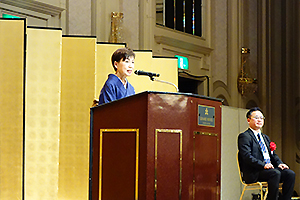
A celebration was held for those who passed the CPA examination. This year, 34 students passed the exam, 16 of whom are current students. This is a testament to the efforts of the teachers who have guided the students.
January 24 (Friday)
A meeting of school principals was held.
Afterwards, a member of the Science Council of Japan secretariat came to the room and explained the activities of the Science Council of Japan over the past year. Since last year, I have been serving as the chairperson of the external evaluation committee of the Science Council of Japan, which evaluates the activities of the Science Council of Japan over the past year and reports its findings at the Science Council of Japan General Assembly in April. The Science Council of Japan is an important organization that sets the direction of Japanese academia, and although it is located in the Cabinet Office, it is independent.
Later, a representative from the Tokyo Metropolitan Government's Bureau of Life and Culture visited the room. He explained about the Tokyo Arts and Culture Council, which he was to assume.
January 22 (Wed)
Executive Trustee and Executive Trustee Roundtable Meetings were held.
January 20 (Monday)
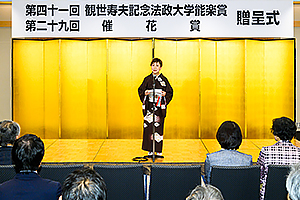
A preparatory committee meeting for the opening of the HOSEI Museum was held. After that, the HOSEI2030 Steering Committee meeting was held. Later, at the Hyatt Regency Tokyo in Shinjuku, there was a presentation ceremony for the 41st Hosei University Nohgaku Prize in commemoration of Hisao Kanze and the 29th Yohka Prize, both sponsored by the Hosei University Nohgaku Research Institute. The university's Nohgaku Research Institute was established in 1952, and the Hosei University Nohgaku Prize was established in 1979, followed by the Honorable Hisao Kanze Memorial Hosei University Nohgaku Prize in 1979, and the Honorable Shoka Prize in 1988. This year's Nohgaku Prize winners were Noritoshi Yamamoto of the Okura school of Kyogen and Nohgaku researcher Kenji Kobayashi, while the Hyoka Prize went to Michishige Udaka of the Kongo school of Shite.
Noritoshi Yamamoto, who lives in Machida City, seems to have many local fans, and I was told by the leader of his association that his fans have organized kyogen performances that have attracted large audiences. He said that the greatest appeal of Kyogen is its "indescribable aloofness and funnyness." I was intrigued by Kenji Kobayashi's book, "Painted Nohgaku: A Cultural History Interwoven with Performing Arts and Paintings" (2019, Yoshikawa Kobunkan), which led to his winning this prize, and which explores the relationship between Nohgaku and picture scrolls, picture books, screens, and ekagami (picture books) of the Middle and Early Modern periods. I will definitely try to read it. The congratulatory address was delivered by Mr. Robert Campbell, former deputy director of the National Institute of Japanese Literature and the director of the National Institute of Japanese Literature. Mr. Michinari Udaka is a Noh performer who has mastered the three fields of "Noh," "English," and "Noh mask mask artistry," and performs at the interface of these three fields. Mr. Diego Pellecchia, a member of the International Noh Institute, read the congratulatory address. Mr. Udaka was in the hospital that day, so his eldest son, Tatsushige, accepted the award. He read the awardee's greeting written by Mr. Michinari, which was so beautiful that when I mentioned it to Mr. Tatsushige, he gave me a draft of the speech that he had retyped. I would like to share it widely in some way.
Friday, January 17
A meeting of the board of directors of a company outside the university was held. Afterwards, I was invited by the person in charge of public relations to talk about the branding process of TUAT. The idea of TUAT branding is of great interest to companies. It is not just a matter of raising awareness, but also of guiding business decisions. In a global company, employees around the world must be aware not only of profits, but also of their contribution to society. Moreover, speed is required in making decisions and taking action. What kind of value creation are you working for? Companies are also looking for ways to have a firm grasp of this.
January 16 (Thursday)
After an overnight stay on the plane, he arrived at Haneda around noon and entered the President's office. After making decisions and holding meetings, the deans' meeting and the deans' round-table meeting followed.
January 15 (Wed)
Each of us departed. I took a boat to the airport with Paul Waley, a British professor at the University of Leeds, who told me that his grandfather's brother was Arthur Waley, known as the first translator of "The Tale of Genji" into English.
January 14 (Tuesday)
On the second day, four researchers from Japan and Italy spoke on the theme of "The future of past heritage," four researchers from Japan, Italy, and the UK spoke on the theme of "Water cities and surrounding space," and four researchers from Japan, Italy, and the UK spoke on the theme of "Inhabitants of global cities: Economy, culture and governance. The titles are all in English because the lectures, presentations, and discussions were conducted in English. We are now in the age of information exchange and discussion in English in Edo studies as well. Professor Emeritus Jinnai sometimes changes to Italian in the middle of a lecture. Perhaps he enjoys speaking Italian more.
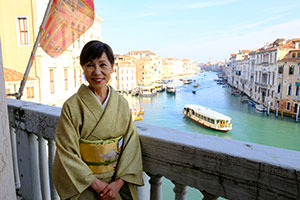
During the daytime, I cannot go out to the city at all, but from the terrace of the university hall, I can see the widest canal in Venice and its branch points. Especially in the evening, the canals are illuminated not with fluorescent light but with red light like that of a lantern or candle, which is truly beautiful. It is as serene and sad as the Tokyo nights depicted by ukiyoe artists of the Meiji era. Dinner was served at an outside restaurant every night. There were no cabs, so we walked all the way, crossing many bridges on the way to and from the restaurant, which was also a path of historical learning. The last three days were the first sunny days in a long time. Usually it rains easily, and I heard that in November the water rose to a level not seen in 50 years, flooding the hotel where we were staying. The symposium also discussed the risk of flooding in the age of global warming, which Tokyo and Venice share. The symposium will be published in Japanese and English.
January 13 (Monday)
The two-day International Conference Tokyo and Venice as Cities on Water: Past Memories and Future Perspectives was held at the Baratto Hall of the University of Venice Ca' Foscari. Tokyo and Venice as Cities on Water: Past Memories and Future Perspectives) was held over two days at the Baratto Hall of the University of Venice Ca' Foscari. The conference was sponsored by the Faculty of Languages and Comparative Culture and the Faculty of Economics of the University of Venice, and the Edo-Tokyo Research Center of Hosei University, with Toshiba Corporation as a co-sponsor. The Japanese Consulate in Milan, the Japan Cultural Institute in Rome, and the Italian Studies Association also cooperated.
First, Vice President Lippiello of the University of Venice and Consul General of Japan in Milan, Mr. Yuji Amamiya, delivered remarks on behalf of the University of Venice, followed by my own remarks on behalf of Hosei University. Then came greetings from Mr. Masuo Nishibayashi, Director of the Japanese Cultural Institute in Rome, followed by greetings from the Dean of the Faculty of Business Administration at the University of Venezia. Professor Emeritus Donatella CALABI of IUAV University gave a keynote speech on the theme of Venice and the sea, and I gave a keynote speech on Waterside culture in Edo. After that, five researchers from Japan and Italy gave presentations on the theme of Memory of place, memory of water, and four researchers from Japan and Italy gave presentations on the theme of Cities on water in cartography and geography.
January 12 (Sun)
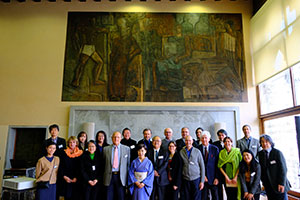
After an overnight stay on the plane, they arrived in Venice a little after 9:00 in the morning. Professor Rosa Caroli of the University of Venice met us at the airport. We took a boat from the airport to the hotel, which reminded me of my first visit to Venice about 20 years ago, when I arrived early in the morning and took a boat across the misty sea to the hotel's riverbank. It was beautiful to see seagulls lined up one by one on the piles in the spray of the waves. Shortly after arriving at the hotel, we began a walking field trip before the symposium with Professor Emeritus Hidenobu Jinnai and other researchers from the Edo Tokyo Research Center. Professor Emeritus Jinnai guided us around the city so that we could see the overall structure of the city. Among other things, we learned not only about the canals, but also their relationship with the sea. In the evening, there was a dinner hosted by the University of Venice.
January 11 (Saturday)
The Hosei University Supporters' Association, an organization of the university's parents, held its New Year's party, as it does every year. I spoke about the HOSEI Museum, which will open this year. Panels of the museum were also displayed at the event. In the evening, I left for Paris via Venice to give a lecture at the University of Venice (officially called Università Ca' Foscari di Venezia).
January 9 (Thursday)
The Asahi Shimbun newspaper interviewed me about why Edo culture is attracting so much attention. They said they will compile an article focusing on the late Ms. Hinoko Sugiura, and there is a movement to look back on the Edo boom in the 80s and at that time.
A scheduling meeting for the next fiscal year was then held.
January 8 (Wed)
The Executive Trustee meeting was held. The Executive Trustee roundtable meeting was then held on different themes for each of the three types of meetings.
January 7 (Tuesday)
The Japan Association of Private Colleges and Universities held its Trustee meeting and New Year's reception.
January 5 (Sun.)
On the third and fourth days of the New Year, I worked on several manuscripts I had been asked to write, prepared materials for a lecture at the University of Venice to be held on January 13th, and made overall proofreading for the paperback edition of my book "Nuno no Chikara" (The Power of the Cloth), and wrote the afterword for the book. As usual, New Year's Day is a work day.
Today, I appeared on the TBS Sunday Morning New Year's special program, which has become an annual tradition. The theme of this year's program was "Deepening Divide, Unhappy Times. The New Year began with the news that the U.S. had killed Iran's Soleimani military commander. A war may be brewing. The special program consisted of three parts: 1) "World Turmoil," 2) "The Rise and Fall of the U.S. Hegemony and the Global Divide," and 3) "Is Infantilization the Key to Global Turmoil?" The program consisted of three parts. To briefly summarize my remarks, I stated that (1) refugees need support for economic independence, (2) the state has lost its redistribution function, and (3) localism is necessary to increase self-sufficiency and solidify a foothold in order to break free from the insecurity. He also mentioned the need to introduce localism to get off the ground.