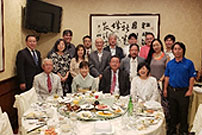
October 31 (Wed)
The Executive Trustee will hold a meeting. This was followed by two round-table discussions on two different themes over lunch. Later, Trustee OZAWA Kazuhiro of the Hosei University Student Co-op and some Co-op staff members came to explain the annual activities of the Co-op. After a series of cafeteria withdrawals, the Co-op got Forest Garden back on track. We must work together to further improve the quality of the cafeteria environment for students.
October 30 (Tuesday)
Mr. Masaru Sato visited us. He had a talk with "Masaru Sato's New Culture" for "President" magazine. This was the second time for me to have an interview with Mr. Sato. As usual, I was overwhelmed by the speed and scale of the discussion. He is a special advisor to Doshisha University (in charge of Tokyo) and an expert on universities. He is also interested in Hosei University. I am looking forward to seeing the finished product.
October 28 (Sun)
The trilogy discussion on the future of the International Institute of Japanese Studies, "Once again, what is 'International Japanese Studies'? -The past, present, and future of the International Institute of Japanese Studies" was held. The second director of the Institute, Professor Tsutomu Hoshino, the third director, Professor Makoto Abiko, the current director, Professor Masashi Oguchi, and Josef Kleiner gathered. The concept of International Japanese Studies, created by Hosei University, has spread to various universities. The University's research institutes have encompassed the diversity of Japan, including Okinawa, Ainu culture, folklore and ethnology, comparative studies with China, Buddhist art, and Edo studies. It is time to summarize the methods and characteristics of the University's international Japanese studies in English and disseminate them to the world.
October 25 (Thursday)
A self-assessment meeting of the graduate school organization was held. The theme was "Substantiation of Coursework in Graduate Education: Creation of a Systematic Curriculum". The keynote speaker was Professor Katsuhiro Musashi of Doshisha University, who spoke about the curriculum design of the doctoral program at Doshisha University's Graduate School of Policy Science. The major is characterized by its interdisciplinary and comprehensive nature, with courses divided into "corporate," "international," "public," and other categories, rather than by academic field of study. Coursework also includes a special course on research design, a special course on quantitative analysis, a special course on qualitative analysis, and a special research course, which are basic lectures that everyone must take. In addition, systematic guidance is provided for doctoral dissertations. D. dissertation is supervised by three faculty members (a primary reviewer and a secondary reviewer). There are graduate schools in our university that provide multiple supervisors. It is certainly effective. As for self-assessment, the committee submits the results of self-assessment to the university-wide Internal Quality Assurance Promotion Council, which inspects the worksheets and requests revisions. Such organizational rules are important. In the past, graduate schools everywhere conducted instruction in a manner that depended on individual faculty members, with each faculty member responsible for his or her own graduate student advisor. However, this method resulted in differences in the intensity and quality of instruction from faculty member to faculty member. It is necessary to increase the systematic guidance of doctoral dissertations by multiple faculty members.
Professor NIIKURA Takashi of the Graduate School of Business Administration, Hosei University, also gave a lecture on "Reforms in the Doctoral Program of the Graduate School of Business Administration: 'Multiple Supervisors' and 'Step System. Not only the multiple advisor system, but also the basic curriculum and the setting of steps allow students to complete their dissertations in stages. This is also an important method. Various innovations are being made in individual majors. While exchanging this information, the organization as a whole should be responsible for the necessary changes.
Listening to the keynote speeches and discussions, I thought that we must first recognize that the global universalization of graduate schools is taking place. In addition to training researchers, international students who wish to work in Japan and working people who wish to master their intellect are enrolling in graduate schools, leading to a variety of careers. If this is the case, it is also necessary to acquire knowledge skills at the undergraduate level, such as research and writing, at the master's level. In addition, the needs of graduate school students and the needs of working people should be reassessed, the quality of faculty members should be visualized, and rules should be established for allocating faculty members' effort between undergraduate and graduate schools. There are many things that need to be done to reform graduate schools, but above all, we must pay attention to the changing role that graduate schools are expected to play.
There was a meeting of the Asahi Education Council.
There was an explanation of the General Incorporated Association of University Sports (UNIVAS) from the Sports Agency. The time has come for university sports to collaborate. Further transparency is needed.
October 24 (Wed)
Executive Trustee meeting, Executive Meeting, and HOSEI2030 Steering Committee meeting were held.
October 23 (Tuesday)
The meeting was held prior to the meeting with the Sports Agency and to discuss the content of the lecture to be given at the alumni/faculty meeting. In the evening, I had dinner with the panelists and Kao Foundation officials to discuss the public symposium "Considering the Family in the Future," which will be held on November 20. After my speech, I will be joined by Hiroshi Harashima, professor emeritus at the University of Tokyo, and Noriko Hashitani, anchor and lecturer at Rikkyo University. Mr. Harashima and I have been friends for decades, having worked together in various capacities. Ms. Hashitani is the main anchor of Sunday Morning, so we have also worked together many times. I was somewhat pleased to learn that Mr. Hashitani is very close to Kaku Yo Chun, President of Rikkyo University.
Friday, October 19
In the morning, he held a meeting of school principals with the principals of the three affiliated schools.
In the afternoon, there was a "Symposium on University Reform and the Future of Higher Education" organized by the Japan Association of National Universities. I introduced the proposal of the Japan Association of Private Universities, "Future Vision of Private Universities Leading the Future: University Reform and Human Resource Development of Private Universities for the Year 2040," followed by Professor Hiroshi Kito, President of the University of Shizuoka and Vice President of the Association of Public Universities, who presented the proposal of the Association of Public Universities, "Public Universities that Professor Hiroshi Kito, President of the University of Shizuoka and Vice President of the Association of Public Universities, then introduced the proposal of the Association of Public Universities, "Public Universities to LEAD the Times: Direction and Possibilities for Discussion on the Future Plan of Public Universities," and finally, Professor Kyosuke Nagata, President of the University of Tsukuba and Vice President of the Association of National Universities, introduced the proposal of the Association of National Universities, "The Future of National Universities in Higher Education.
This was followed by a 100-minute panel discussion among the three panelists. The moderator was Ryuichiro Nishikawa, NHK commentator, and commentators included Shinichiro Yokoyama of the Nikkei Shimbun, Yasuhisa Hirohama, chairman of the Japan Association of Small Business Entrepreneurs, and Junko Murata, president of the Osaka Public High School Principals Association. There were so many discussions that it is impossible to go into all the details, but the focus was on the new quality assurance of university education and how to address the gap between the national and private sectors in this time of drastic social change. It was a very interesting discussion that highlighted a variety of issues.
October 18 (Thursday)
The Global Strategic Headquarters meeting and the Dean's meeting were held.
Afterward, we had a dinner party to celebrate the publication of "Inishie no Koika: Waka to Han Sho no Sekai" (Inishie no Koika: The World of Japanese Poetry and Chinese Poetry, Chikuma Shobo) by Peng Tan, a doctoral student in the Graduate School of Humanities (concurrently lecturer in the Faculty of Social Sciences) of Rikkyo University. She has already published three books on comparative culture between Japan and China. Her Japanese is beautifully written and she has many more themes to write about. I am looking forward to seeing his work.
October 17 (Wed)
In the morning, I went to the Ministry of Education, Culture, Sports, Science and Technology (MEXT).
The Central Council for Education (Chukyo-kan), established under the Ministry of Education, Culture, Sports, Science and Technology (MEXT), submitted a "Draft Report on the Grand Design for Higher Education Toward 2040". The Chukyo Council's subcommittee on universities was to hear opinions on the draft report from the National Governors' Association, the Association of National Universities, the Association of Public Universities, the Japan Association of Private Universities, the Japan Association of Private Universities, Keidanren, Keizai Doyukai, and various other higher education organizations. This was the day of the hearing. The Japan Association of Private Colleges and Universities had already received a briefing from the Ministry of Education, Culture, Sports, Science and Technology (MEXT) by the Policy Research Section Meeting, which I chair, and then compiled and submitted the opinions of the section meeting members, the president, vice presidents, and others. I gave a summary of those opinions in the stipulated 10 minutes and responded to questions. One of the opinions expressed was the item, "The statement that the government should organize through national student surveys and university surveys and publish them in a list so that they can be compared should be deleted. The reason for this is that universities themselves should be the main actors in disclosing information, and the role of the government should be to support and encourage the disclosure (publication) of information. The questions from the Chukyo Council members focused on this point. They said that this statement was made because universities do not actively disclose information. We must check with the member universities of the Japan Association of Private Universities, and if so, we must urge them to disclose this information.
After that, I went to a meeting of the Executive Trustee of the University.
I left the board meeting in the middle of the meeting and moved on again. This time, I will be speaking at the Private University Forum 2018 "Future Vision of Private Universities Leading the Future: University Reform and Human Resource Development of Private Universities for the Year 2040" organized by the Japan Association of Private Universities, together with Mr. Hiroshi Yoshimoto, Director General of the Higher Education Bureau, MEXT, and Mr. Takeshi Okamoto, Vice President and Chairman of the Education Affairs Committee, Keidanren (Japan Business Federation). I took the stage together with Mr. Takeshi Okamoto, Vice President of Keidanren and Chairman of the Education Affairs Committee. At first I gave a 30-minute presentation on the future vision compiled by the Federation of Private Universities. This was followed by a panel discussion moderated by Mr. Teisuke Kitayama, President of the Central Council for Education, Mr. Susumu Takahashi, a member of the Council on Economic and Fiscal Policy and the Council for the 100-year Life Era, and Mr. Kaoru Kamata, President of the Japan Association of Private Universities (President of Waseda University) and Mr. Osamu Murata, Vice President of the Federation (President of Kwansei Gakuin University), and Mr. Takashi Matsuoka, President of Doshisha University.
During the discussion, issues that confront us today, such as why universities have not taken the initiative in recurrent education over the past 30 years, came up one after another.
October 16 (Tuesday)
A diversity symposium was held as a training program for the university's staff.
Professor YOKOUCHI Masao of the Faculty of Business Administration, Director of the Student Counseling and Support Office, spoke about the current status and challenges of the university's support for students with disabilities under the theme of "How should the university respond to diversity in human resources? Mr. Haruo Sugita, an employee seconded to OIST's special subsidiary "Orenji Forest," gave a very concrete explanation of how the employment of people with disabilities is promoted and what kind of work they are doing onsite. We hope that students will be aware of the Orenji Forest employees who support the university by working in the cleaning and gardening groups, enclosing materials, contributing to the local community, and so on.
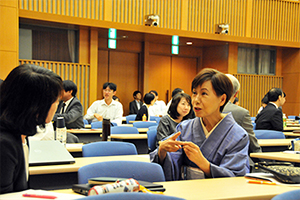
Then, Ms. Yukie Usuba of Mirailo Inc. gave a lecture on "Universal Manners. As a hearing-impaired person, she spoke clearly, concretely, and beautifully about what kind of awareness and behavior are necessary for communication. First of all, what kind of people seek universal manners? The elderly, people with disabilities, and children under 3 years old. The elderly are the most numerous, accounting for 28% of the population. In total, we found that about 40% of society needs universal manners. There were a number of striking phrases. The message was "Disability is not a person but an environment (adapted to healthy people)," and "Even if hardware cannot be changed, our hearts can be changed. The message was conveyed that we should start by changing ourselves. The best way to promote universal manners is to be neither indifferent nor nosy. The best way is to say, "Is there anything I can do to help? First, ask what the person needs. On the other hand, when they offer to help themselves, they present options rather than impose them. This is an essential foundation for the university, which has made a diversity declaration, to promote such a way of life to coexist with diverse people.
On this day, note-taking students who actually support hearing-impaired students at TUFS assisted Yukie Usuuba with her questions. Ms. Usuuba was thrilled, saying, "It was very easy to understand. It was a wonderful symposium. We thank the Diversity Promotion Committee and Chairperson Emiko Takeishi for organizing it.
In the afternoon, after meetings and preliminary briefings for various meetings at the university, the meeting moved to Arcadia Ichigaya, where the Executive Trustee and Trustee meetings of the Japan Association of Private Universities and the Policy Center Planning Meeting were held in rapid succession. It was decided to set up a project to intensively discuss the issues of work style reform and employment rules.
October 15 (Monday)
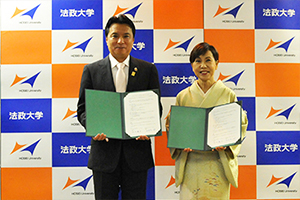
Koganei City Mayor Shinichiro Nishioka visited us. The ceremony was held to mark the signing of a comprehensive partnership agreement between Koganei City and Josai University.
Koganei City is home to the University's Faculty of Science and Engineering, Faculty of Computer and Information Sciences, and Faculty of Bioscience and Applied Chemistry. Mayor Nishioka also attended this year's Hakone Ekiden (relay race) in Koganei City to cheer for the university's success. We have already established a cooperative relationship through events and the use of the library by Koganei citizens, but we would like to further expand this relationship in the future.
October 14 (Sun)
Before leaving for Yonago Airport, we stopped by "Izumi Hasegawa's" family home, "Izumi Hasegawa's Inari Shrine," which she had negotiated and guided us to during our previous visit to Los Angeles. Ms. Izumi Hasegawa is a tourism ambassador for Matsue City. I was able to meet Ms. Yoko Hasegawa, Izumi's sister. She founded a women-only company and gave up her position as president, and now travels around the country giving lectures on information morality education for children.
On the way to the airport, I saw two interesting sights. One was a field of ginseng in the town of Yatsuka, which is called "Radish Island. Originally an island, it is now connected by a bridge. Ginseng has been cultivated here since the Edo period and was a source of income for the clan. The method of cultivation is exactly the same as seen in an Edo period illustration, where a roof is made of straw. Plastic does not work well, and straw is still needed today, but it is becoming harder to obtain.
Another scene is the Eshima Ohashi Bridge, known as the "sticky slope. It is a steep slope with no view of the other side, and was used in a car commercial. According to Matsue City Hall, there was a video made by students of Hosei University, which was used in some kind of commercial. The people from Matsue City Hall provided us with transportation to and from the site, which was a good learning experience for us. Thank you very much.
October 13 (Sat)
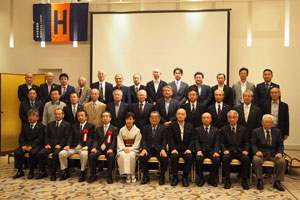
I went to Matsue City to give a lecture. I was asked by Matsue City to give a lecture to commemorate the 150th anniversary of the Meiji era. Dr. Kenjiro Ume, who served as president and prime minister of Hosei University (or its predecessor), is an honorary citizen of Matsue City, and is called the "father of civil law" and considered one of the great figures in the region. Therefore, he spoke about the relationship between Ume and Hosei University under the title of "Ume Kenjiro for Hosei University. In conjunction with this lecture, the Chugoku block meeting of the Alumni Association, the Shimane Prefecture Alumni Association general meeting, and a reception were held. Because of the involvement centered on Ume Kenjiro, an agreement with Matsue City is currently under consideration. On this day, while having dinner with Mayor Masataka Matsuura, we discussed environmental issues in Matsue City and private schools in the Edo period.
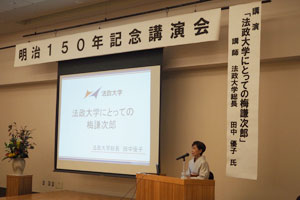
Ume became the first "prime minister" of Hosei University in 1903, when the school's name was changed to Hosei University by the Technical School Ordinance, after serving as the principal of the Japanese-French Law School. In 1904, Kenjiro Ume applied for and was approved for the "Qing Foreign Students' Law and Politics Rapid Completion Course," which brought more than 2,000 foreign students to Hosei University. Furthermore, at the request of Hirobumi Ito, Ume went to Korea to work as a legal advisor to the Korean government, reforming the court system and formulating the Civil Code and Commercial Code. Umeh died in Seoul during this period, but it seems that he was aware that Korea was more civilized than Japan and that Japan had emulated Korea.
What is even more noteworthy is that Umeh refers to "progress" as moving closer to an ideal. It is not as if the people of the Meiji era were only aiming for Westernization. It seems that they were thinking about what should be the ideal in creating a new society, and they saw law as a very concrete and realistic way to reach that ideal. By considering not only the three founders but also Kenjiro Ume as well, the history of Hosei University, which has been involved in "creating a new society and its rules with ideals," becomes even clearer. The future globalization of the university should be considered as part of this history.
In the evening, the Alumni Association of Shimane Prefecture, led by Mr. Yoji Tsugano, a Councilor of TUAT, organized a variety of attractions and made it a very productive and enjoyable time. I was surprised to see how much talent the alumni of the same generation had. I would like to express my heartfelt respect and gratitude for their hospitality.
October 11 (Thursday)
The audit firm conducted a hearing with the Chancellor and Trustees. Universities are subject to multiple audits on various scales, including internal audits by the university's audit office, audits by auditors, and audits by the audit corporation.
October 10 (Wed)
Executive Trustee, Trustee, and Executive Board meetings were held.
October 9 (Tuesday)
We interviewed President Kaku Yang-Chun of Rikkyo University for HOSEI ONLINE. President Kaku is a graduate of the Faculty of Economics at Hosei University. In high school, he wanted to become a doctor, but he was attracted to economics, which has a great influence on the world. To study "Capitalism," he chose Hosei University, which at the time was home to many of the most renowned Marxian economists. President Kaku's lively speech, with an expression that says, "I can't help but be interested in learning," drew me in rapidly. He joined the graduate school of Rikkyo University because his advisor left Hosei University when he graduated from the undergraduate program. His story is interesting, and we look forward to seeing his article in HOSEI ONLINE, which will be published on November 1.
October 7 (Sun)
The Tokyo Metropolitan Area Parents' Round-Table Meeting was held by the Alumni Association of Josai, and I spoke for an hour about the recent situation of the university and the future changes in Japan.
October 6 (Saturday)
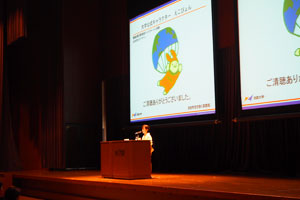
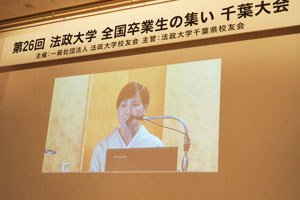
This year's "National Alumni Gathering" was held in Chiba Prefecture, sponsored by the Alumni Association. More than 800 alumni gathered at Tokyo Bay Makuhari Hall. The President's speech was only 30 minutes long, so I gave a brief update on the university and the "Hosei Meeting" in Los Angeles. In attendance were Chiba City Mayor Toshito Kumagai and Chief Cabinet Secretary Yoshihide Suga. Next year, the meeting will be held in Tokushima.
October 4 (Thursday)
A meeting of deans was held.
October 2 (Tue), 3 (Wed)
Moving day. Due to the time difference, it took two days to return home.
October 1 (Monday)
I visited California State University, Fullerton, partly to give a lecture to Professor Kazuha Watanabe's class and partly to meet with the directors of the Global Center to discuss the possibility of an inter-university agreement. Before the lecture began, the professors from the Humanities and Social Sciences gathered us together; Dr. Watanabe is a linguistics scholar who can read about seven languages. Dr. Sun, a Chinese historian, translated Southeast Asia in the age of commerce into Chinese, which I had co-translated with a colleague. What a coincidence to meet someone with whom I had shared the same book in translation. Other participants included a researcher specializing in Spanish and Portuguese language and literature, a researcher specializing in the history of the Middle East, and a Chinese professor of Vietnamese descent studying the history of China. There are 23 state universities. Students with high school grades above a certain level can enroll, and tuition fees are lower than those at private universities, so the number of students has increased, and there are not enough classrooms and teachers. Although they seem to be facing many difficulties, the faculty members get along very well with each other. However, each faculty member has a different annual salary. The reason is that salaries are determined by performance and negotiation. As a result, it seems that women tend to be paid less than men who negotiate more strongly. I visited two U.S. universities, each of which has a completely different personality.
In the evening, the Los Angeles Alumni Association hosted a dinner party. There have been cases where alumni have been working together since the very first day they came to the U.S., and I believe that the more difficult the environment is, the more important it is to build alumni bonds in each person's life. Thank you very much, Los Angeles Alumni Association!