

Thursday, June 29
The Gender Equality Division of the Tokyo Metropolitan Government visited our office. As a representative of IIDA, I am a member of the Tokyo Metropolitan Council for the Promotion of Women's Activities. I am going to start considering applying for the Tokyo Metropolitan Government Women's Activity Promotion Award in the field of education, which is conducted by this conference.
I was interviewed for Recruit's "University Promise 2017-2018. The theme is "The Next Challenge of Super Global Universities. This will be followed by a special subcommittee for the mid-term management plan, a budgeting committee meeting, and a series of meetings.
Wednesday, June 28
He said he has been getting requests for interviews and interviews on the busiest Wednesdays of the year. "Perhaps it is because they are reading the President's Journal?" This is a hypothesis. The basic routine work of the President is not written here. However, if this is not communicated, the misunderstanding that he is most free on Wednesdays will arise. Therefore, I have decided to write only a "status report" on the meetings without any substance. The day consisted of a meeting of the Executive Trustee, a meeting of the Executive Trustee, a meeting of the Executive Board, a round-table meeting of the Executive Trustee to hear explanations from staff and exchange opinions on important issues, and a meeting of the HOSEI 2030 Headquarters Steering Committee.
June 27 (Tuesday)
Returned to Tokyo from Osaka. Attended a general meeting and reception at P.O.D.U. At this time, new presidents from universities that had a change of presidents attended the meeting. I met the new presidents of Keio University, Sophia University, and others.
June 26 (Monday)
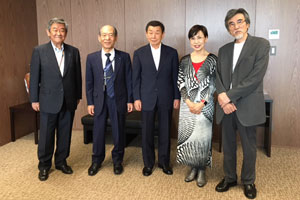
We visited the Kinki University Academic Theater in Higashi Osaka to see the "Biblio Theater," a well-reputed, newly conceived library. We met Trustee Yoshihiro Shimizu, President Hitoshi Shiozaki, Vice President Daizo Masuda, Library Director Satohito Hakkaku, and others, and were guided by Seigo Matsuoka, Director of the Editorial Engineering Research Institute, who organized the project, and the Institute staff. Pictured from left to right are Vice President Masuda, President Shiozaki, Trustee Shimizu, Yuko TANAKA Yuko, and Director Seigo Matsuoka.
It is truly an amazing and interesting library. In ordinary libraries, books are classified by format (single volume, paperback, new book), the Nippon Decimal Classification System, the National Diet Library Classification Table (NDLC), and so on. However, this does not create a fusion of literary and scientific thinking, as natural science, social science, literature, and philosophy are separated.
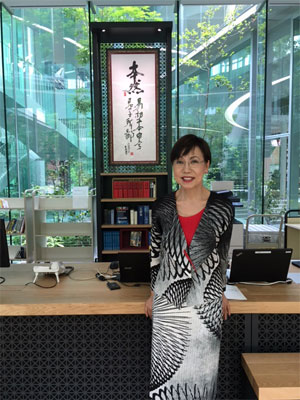
In the bibliotheater, the knowledge and ideas obtained from books are introduced in front of you, showing how they are connected to books in other fields. For example, major headlines such as "The Relationship between the Brain, Mind, and Body," "Selling, Buying, and Waking Up," and "How to Protect the Nation and People" are written on sign lantern-shaped electric lights and displayed above the bookshelves. Once there, the first recommended book is put up, and once you finish reading that, you can explore related books from there on the same bookshelf. The related books do not follow a conventional classification system, but are collected according to their contents, ideas, and methods. The structure is by Seigo Matsuoka. If you want to go further into the field, you can go to the main library. There are plans to link the library's search system with that of the main library. This is an exciting experience for students who are not familiar with books. When a discovery is made, there is a wall of graffiti on the side of the library, where students can write down passages that made a strong impression on them. Each bookshelf is not huge, and it is tempting to read through an entire bookshelf on a single theme. This is the organization of the first floor, which is named "NOAH33. The second floor is called "DONDEN," where about 20,000 manga and 20,000 new book collections are arranged according to a theme. By placing manga and books in the same place, visitors read books before they know it.
What is revolutionary about this system is that the inducement to read is not preachy. The bibliotheater and the academic theater that houses it are spaces where people can stroll around like a town, and the bookshelves are like stores with signs, leading to reading by the action of walking around and taking a peek. Furthermore, it is clear that this organization is arbitrary, not controlled or authoritative like a classification system, and one's own thinking begins to create a different organization, such as "I would put this book next to this book," or "That book is related to this book. You could call it an active learning library. However, the book by Seigo Matsuoka, which is displayed at the entrance of the library, shows the destination of this thinking. The book is a collection of three books by Seigo Matsuoka, which are "Honzen" ("Chūyō"), "Yōritsu yoryoku wo yiru kawaru wa kimuji no hiyasan desu" (Kusuhara), and "Honto nen" ("Chūyō").
Returning to Dojima, Osaka, at dusk, I went to the Suntory Cultural Foundation for the selection of the Regional Culture Award.
On the same day, I happened to hear that NHK E-television's "New Benzemi: Hanamichi of Tests" was featuring Hosei University and Kinki University. I could not watch it.
June 25 (Sun)
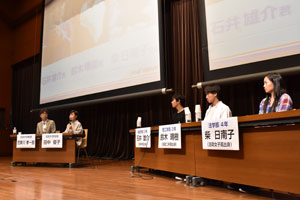
A joint information session for affiliated schools was held. This year, after my lecture, Professor Koichiro Komikawa of the Faculty of Lifelong Learning and Career Studies moderated the event and invited three students who graduated from each of the three affiliated schools and are now studying at Hosei University to talk about the characteristics of their studies and their relationships with their professors.
Saturday, June 24
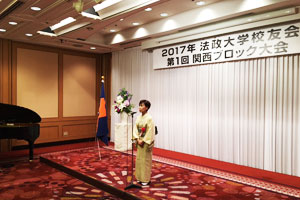
The Kansai block of the Alumni Association was established. At the first conference of the Alumni Association, a public lecture was held to introduce Hosei University to the people of the Kansai region. The Alumni Association invited not only the general public but also teachers from cram schools, prep schools, and high schools, making the lecture very meaningful.
June 21 (Wed)
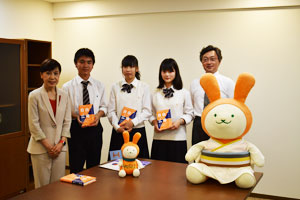
There is an event called "Welcome Festa" to introduce Hosei University to first-year high school students from the three affiliated schools. A video was filmed to be shown on the day of the event. Students from the broadcasting club of Hosei University Second Middle and High School came all the way to the Kudan building with their filming equipment. They were Shuhei Nakamura, a second-year high school student, Miki Matsuuchi, a first-year high school student, Saaya Noguchi, also a first-year high school student, and their advisor, Mr. Yuji Inoue. I raised three good points about Hosei University. I mentioned three good points of Hosei University: its globalization along with diversity, the proactive involvement of students in the various operations of the university, and the highest value it places on "freedom. Thanks to the members of the broadcasting club, I enjoyed the talk. Thank you!
On the same day, female deans, former deans, and staff managers came to the President's office to give their opinions on the keynote speech, "Diversity in Universities," to be delivered at the July 1 I-Dalian President's Conference. The discussion was very fruitful, with a variety of suggestions and experiences being exchanged. We hope to link this movement to the advancement of diversity at our university.
June 18 (Sunday)
Due to many events and business trips on Saturdays and Sundays, the frequency of appearances on TBS "Sunday Morning" is now about once every two months. On this particular day, the main topics of discussion were the enactment of the "Preparatory Crimes Against Terrorism" and the Kakei Gakuen issue. How will the newly enacted crime of preparation for terrorism be implemented in the future? The more diligent police officers, including those in the public security sector, are likely to work hard to investigate in accordance with this law. What kind of investigations will be conducted to stop crimes before they happen? As citizens, we need to imagine. That is the "problem" with the Preparation for Terrorism Act. International cooperation in criminal investigations is certainly possible with this bill. But it also means that citizens all over the world are facing the same problem.
Regarding Kakei Gakuen, we have raised three issues. One is that there are too many stakeholders in this school corporation within the government. If it was a "fluke," then the government must prove and explain that "there are people involved, but decisions are made fairly," but this has not been done. Second, although university research and education must be independent of power, it appears that the school corporation is being used for political purposes. This is also related to the descent from heaven issue. The third question is: Can regional development be achieved simply by attracting universities? The third question is: Can regional development be achieved simply by attracting universities? Imabari City has already begun to provide significant assistance, including the free transfer of city-owned land. The city will continue to be involved in the future of the university, as it has been in recent years with the conversion of universities with unfilled capacities into public ones. And students will leave the city if there are no jobs here. What should regional development look like?
Whistleblowing was the theme of the "Wind in the Willows." Freedom of critical speech is essential in organizations where power may be fixed, such as government offices, cabinets, political parties, corporations, and schools. Although there is a law called the "Whistleblower Protection Act," it is probably weak as a protection law because of the unfair treatment of whistleblowers by corporations. It is essential to have a third-party committee to monitor and guide whether the protection is strictly enforced and whether the issues complained of have been corrected. The U.S. seems to have such a committee. The foundation of democracy is not a system in which the government knows its citizens, but a system in which the citizens know what the government is doing and saying.
June 16 (Friday)
A fundraising video was taken. A DVD was filmed to encourage parents and alumni to donate to the university. Universities exist for the social mission of education, not for profit-making or capital accumulation. Environmental improvements, including buildings, and scholarships should be funded by grants and donations. This way, student fees can be focused on education. We would like to see a maturation of the donation culture in Japan.
June 15 (Thursday)
The Faculty Self-Assessment Roundtable Meeting was held. Under the theme of "Efforts to Realize Diploma Policies ---- from the Perspective of Curriculum Construction," the 15 faculties and the Center for Liberal Arts presented their respective diploma policies and the corresponding curricular principles or actual construction, along with the deans' ideas. Diploma Policies Diploma policy refers to the policy for graduation recognition and degree conferral, and is expressed as "students who can do," "have mastered," and "possess the ability" will be recognized for graduation and awarded a degree. The idea is to recognize graduation not from the perspective of the instructor, but based on what skills the student has acquired. In the future, the results of academic training will be made more visible, and the level of achievement will also be evaluated. Each department can check the level of achievement for specialized departments, but broad knowledge, flexible thinking, creativity, independence, humanity, ethics, and a sense of responsibility are also important policies. How do we measure these attainments? It is a difficult task. We will also have to consider "practical wisdom education," which is unique to Hosei and different from other universities. How do we measure the attainment of Practical wisdom, such as writing, presentation, discussion, and problem-solving skills acquired through practical training, discussions, and thesis writing? We must seriously think about this. It is a fruitful day for me every time.
June 9 (Friday)
The Cabinet will decide on the details in the summer and fall. In the past, the construction of the Tama Campus was carried out under the "Factory Restriction Law," which restricted the construction of new and additional universities in the city center. Despite the restrictions imposed by the law, Hosei University has made various efforts to improve the educational environment and to create new faculties that are needed by the times. Even with these new restrictions, we would like to think of ways to ensure high quality education that responds to the needs of the times.
June 8 (Thursday)
The Tokyo Shimbun has a project called "A Walk on Campus with the President. Today, I took that "walk" at the Koganei Campus. Many women are studying at Hosei University's undergraduate and graduate schools of science and engineering. We wanted to introduce women in the sciences at Hosei University.
Kaeko Takano, Graduate School of Computer and Information Sciences, Major in Computer and Information Sciences, is researching a head-mounted display that can deploy a 360° image similar to human vision. Yorisa Matsumoto, a student in the same major, is researching real-time 3D scanning using multiple depth cameras. Haruna Yamamoto and Riko Manabe, both students in the Department of Mechanical Engineering in the Faculty of Science and Engineering, aspire to become professional pilots. There are 100 students in this program, 12 of whom are women.
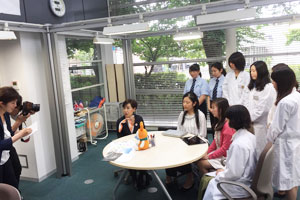
Ms. Yuri Hagiwara, Major in Frontier Bioscience, Graduate School of Science and Engineering, is researching phytoplasmas, a type of bacteria that parasitize plants and cause diseases, at the genetic level. Chie Tonegawa, also in the same department, is re-examining the disease caused by a fungus on horseradish leaves. Ms. Yukari Miyake, also in the same department, is using genome editing technology and other techniques to clarify the entire genome expression signaling network of bacteria that survive in diverse environments. Kei Fukumoto, Graduate School of Science and Engineering Major in Applied Chemistry, is developing a coating material with a water-repellent effect similar to lotus leaves. By combining fluorine and silicone, he aims to provide not only a water-repellent effect but also the ability to easily remove water droplets that adhere to the surface. Momoko Aoyama of the Department of Chemical Science and Technology in the Faculty of Bioscience and Applied Chemistry is conducting basic research on thin-film fabrication and charge control to develop lightweight, flexible, and highly efficient solar cells using carbon nanotubes. Many other women are also studying at Koganei. After completing their graduation, they joined companies or continued their research.
I first spoke with the GBC (Glass Box Office Hour Center). In this high-ceilinged, glass-fronted room, students consult with upperclassmen and faculty members of the same specialty as they are studying. This center is run by the students themselves. Hosei University's school song was also written by students who raised the money themselves and went to Haruo Sato and Hidemaro Konoe to ask them to write the lyrics. Even today, students on each campus have created peer nets and run many organizations. The voluntary activities of students are a tradition and a major feature of Hosei University.
We were shown how to operate an aviation flight simulator. The simulator is so good that major airline companies use it for their entrance examinations. Aeronautical pilotage is closely related to the history of Hosei University, which established an aviation department in 1929. In 1931, shortly after the school song was composed, students of the aviation club flew to Rome in a plane named "Seinen Nippon-go" (Youth Japan), after the words of the school song. He was the first university student to successfully fly a propeller-driven plane to Europe. Hosei University was truly a frontrunner. In 1944, the Hosei University Aviation Institute was established. This was the forerunner of the Faculty of Engineering.
After this, I visited the greenhouse of the Faculty of Bioscience and Applied Chemistry. They grow a wide variety of plants to study plant diseases. With the expected increase in world population and food shortages, avoiding plant diseases is the key to increased food production. Hosei University is at the forefront of "building a sustainable global society," which is the vision and charter of Hosei University. I was also shown an electron spin resonance apparatus at the Micro-Nano Technology Center. This research is also about building a sustainable society.
Each is advancing in line with the university's philosophy. With women making up half of the faculty, there is bound to be scientific innovation by women.
June 6 (Tue)
An agreement between Yubari City Mayor Naomichi Suzuki and the Faculty of Law was signed at a signing ceremony. The university has been conducting fieldwork in various regions, and Yubari City has been one of the cities with which we have been deeply involved. I consider Yubari City and its mayor to be the front runners in the city's revitalization efforts, and I see them as the ones who are taking the initiative in facing the challenges that Japan will face in the future. I would like to continue to promote cooperation with local governments that are taking on new challenges.
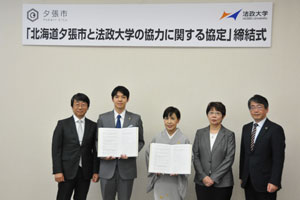
At a reception held in the evening for the National Mayors' Association of Hosei University, I heard Mayor Suzuki talk about his energy policy and other topics. I will continue to pay attention to him. I always look forward to the Mayors' Summit. Each mayor speaks vividly about the splendor of his/her community in a few short words. I want to learn from them.
June 3 (Saturday)
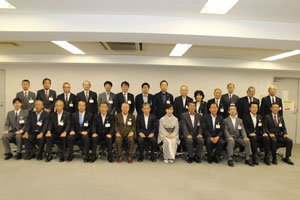
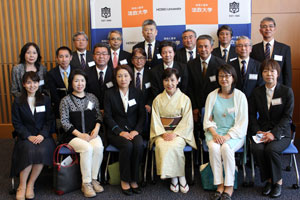
A reception was held for the old and new officers of the supporters' association. This is the time of the year when the officers of the supporters' association are replaced. Thank you very much for your hard work, even though you have been rotating for a year. Thank you very much for your hard work.
June 2 (Friday)
The Financial Times, a British economic newspaper, interviewed me. The interview was about the Defense Equipment Agency's military spending, but when I met him, he was very interested in the university and asked me all kinds of questions. He was very interested in our university and asked us all kinds of questions. What kind of article would it be?