

Wednesday, November 30
The evening was a meeting where the President and Trustee answered questions from the board members of the Supporters' Association, an association of parents. It is very important to inform the parents of the university's policies and current situation, and no amount of time is enough. I would like to respond to everyone's enthusiasm to the fullest.
Sunday, November 27
I gave a lecture on "Odano Naotake for Japanese Culture" at the Suntory Museum of Art in Tokyo Midtown, Roppongi, as part of the "Odano Naotake and Akita Dutch Painting" exhibition on view through January 9. Odano Naotake not only illustrated "Kaitai Shinsho" (The New Text on Human Anatomy), but also went beyond landscape painting by depicting sky and water, incorporating Dutch landscape paintings. Edo culture is a culture that met European and Asian cultures and technologies and reworked them with a high degree of editorial skill. Naotake Odano is a painter who represents this characteristic of Edo culture.
Saturday, November 26
The Kyodo News Agency sponsored a dialogue for a major New Year's dialogue, "Toward Our Tomorrow," which will be distributed to all local newspapers on January 1 of the New Year. The dialogue was with Norihiro Kato, literary critic and professor emeritus at Waseda University. One of the issues shared in the dialogue was how to break away from the dependency on the U.S. after the election of Trump. In this ultimate situation, which we have not seriously considered although we have stood at the turning point many times, there are now two options. One is to revise the Constitution and achieve self-reliance through militarization as before the war. The other is to achieve self-reliance by maintaining pacifism toward the world based on the spirit of Article 9. For more details, please read the newspaper. And I hope you will think about it with me.
In the afternoon, the inaugural meeting of the "Association of Legal Professionals" was held. This association was created by a coalition of the Lawyers' Association, a group of lawyers and other graduates working in the legal profession, the Hoyukai of Certified Public Accountants, the Hosei Accountants' Association, a group of tax accountants, the Real Estate Appraisers' Orange Law Association, and the Gyosei Scrivener Orange Association. It was a very gratifying inauguration, with plans to show students the path to certification by way of explanations to new students and endowed lectures.
In the evening, the weightlifting club hosted a grand party to celebrate Hiromi Miyake's bronze medal, Yoshiyuki Miyake's inauguration as president of the Weightlifting Association, and Yoshinobu Miyake's honorary recognition as a citizen of Tokyo. Hiromi Miyake, who is well known as a voracious reader, had a strong desire to study while aiming for the Tokyo Olympics, and was very interested in the Graduate School of Sports and Health Studies at TMDU. Hiromi Miyake, who spends her time not only as an athlete but also as a fulfilled human being, is an important role model for current students.
November 25 (Friday)
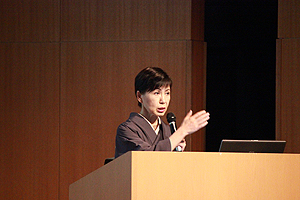
I gave a lecture at the neighboring Miwada Gakuen High School. It is a traditional girls' high school that will soon celebrate its 130th anniversary. Under the title of "Practical Wisdom for Freedom," I spoke not only about our university's philosophy and approach to education, but also about globalization and how to deal with the Edo period. The audience, which consisted mainly of high school seniors but also included first- and second-year students and their parents, listened to the lecture with great interest.
What surprised me was the question-and-answer period. The students were surprised at the question-and-answer session. I worry that it will lead to feelings of exclusion. What should we do?" I can't help but feel concerned about people in developing countries. What should I do to help them live in a better society? What kind of work can help them? Some people cannot go to college because of poverty. This creates a cycle of poverty. Why is this happening and what can we do about it? You mentioned the need for basic self-affirmation apart from deviation score rankings, but I am still concerned about rankings as I approach the entrance examinations. What should we think about that?" --I answered each of their questions carefully, and although we went well beyond the scheduled time, I was filled with a sense of fulfillment having come into contact with their high level of awareness of the issues, their frankness, and their richness of expression. I had the impression that Miwada Gakuen High School is a school that succeeds in educating students to "think".
November 24 (Thursday)
The LDP lawmakers who graduated from Hosei University have formed an organization called the LDP Hoyukai, which holds a social gathering once or twice a year. On the day of the meeting, I brought with me a letter of request from the Japan Association of Private Universities, for which I serve as Executive Trustee, requesting that subsidies for ordinary expenses for private universities and other institutions be reduced to the same proportion as set forth in the Law for the Promotion and Subsidization of Private Schools.
November 22 (Tuesday)
A female badminton player visited us. They came to show us their medals after winning the All-Japan championship. Women's sports are also getting stronger" at Hosei University.
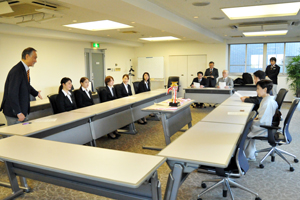
There was an interview with the English newspaper JapanTimes. The theme was still global and diversity. The interviewer, a group of students, was very interesting. They asked us very essential questions, and it was a very productive time for us.
Monday, November 21
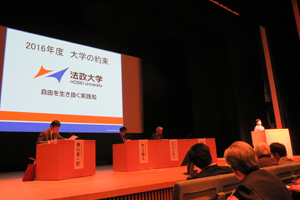
The "University Promise: Top Message Forum 2016" was held at Nikkei Hall, sponsored by Nikkei Inc. It was a big meeting with three sessions throughout the day. I attended the first session. I appeared in the first session, "Developing Human Resources for a Global and Diverse Society," together with President Masato Murakami of Shibaura Institute of Technology, which provides generous support for female scientists, and President Michael Carmano of Nanzan University, which has made early progress in globalization. There is a tendency to think that globalization means Americanization with an English-first approach, but this should not be the case. This is where the realization of "diversity" is necessary. We need to think of globalization and diversity as a single entity. The discussion we had in this direction will be published in the Nikkei Newspaper around mid-December.
November 19 (Saturday)
The regular lecture meeting of the "Seven People's Group for World Peace Appeal" was held at the university. This group was founded by Raiteo Hiratsuka, Hideki Yukawa, and Yazaburo Shimonaka, founder of Heibonsha, to call for peace in the world after the 1954 U.S. hydrogen bomb test at Bikini Atoll that exposed the Japanese Daigo Fukuryu Maru. Later, Kawabata Yasunari, Asanaga Shinichiro, and Inoue Hisashi also became successive members. It is unique in that scientists are always members. The latest appeal is the 122nd, concerning the rush to South Sudan.
The theme of the day was Okinawa, and it was co-sponsored by the University's Institute for Okinawan Studies. Unfortunately, I had to leave in the middle of photographer Yoshino Oishi's lecture because I was scheduled to speak at the next meeting.
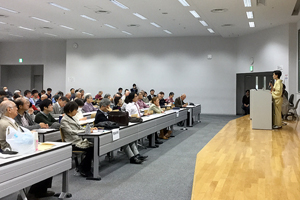
The annual alumni teachers' roundtable meeting was held. Teachers from junior high and high schools gathered from all over the country. After a talk on "Practical Wisdom for Freedom," Professor Hiroshi Sanuki of the Faculty of Lifelong Learning and Career Studies gave a deeply insightful lecture on active learning. Then, moderated by Professor HIRATSUKA Maki of the Faculty of Social Sciences and Director of the President's Office, who specializes in pedagogy, there was a discussion between graduate faculty members and current students who aspire to become teachers. The graduating faculty member spoke about how what he learned and experienced while at Hosei University has deeply penetrated into his life and become the basis of who he is. I was greatly encouraged to hear them say that "Practical Wisdom for Freedom" became clear to them. I would like to continue this meeting in the future.
The Tokyo Rokugan cheering squad alumni/alumnae Rokubankekai was being held, and I came to greet the participants. It is a grand meeting of the Tokyo Six Universities' cheering squad alumni and alumnae. It is held on a rotating basis, and this time our university was the venue. Professor Emeritus Keiko Yamane, who had been the head of the cheering squad for a long time, attended the meeting and we renewed old friendships after a long absence. I was glad to see him concentrating on his work as a specialist.
November 18 (Friday)
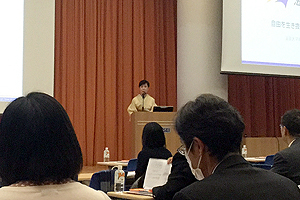
This year, my three-year term will end. On this day, the election for the next President was held, and he was reelected. The University maintains a system in which the President is elected by the entire faculty and staff. Elections are a rare opportunity to learn about one's own country, municipality, and organization, as one must exercise one's individual right to choose in any case. That, I believe, is an important aspect of democracy. Learning and thinking and making decisions are essential to democracy, but they also take time and effort. I would like to thank the faculty and staff who support this value.
There was a gathering of the Zaikaijin Club, an organization led by alumni business leaders. Alumni have become presidents, chairmen, and directors of a wide variety of companies. Some have started their own businesses. I hope that the graduates will help each other beyond their occupations and nurture them into good companies, thereby orienting society.
November 16 (Wed)
Mr. Shinichi Tamura, President of Hokusei Gakuen University in Sapporo, paid a visit to the President's office. In 2014, there was an incident in which an adjunct lecturer was threatened to quit his position. The incident, which included threats to blow up the university, shocked many universities by threatening freedom of speech and university autonomy through violence. At that time, Mr. Tamura stated that the founding spirit of the university is to nurture "open-minded individuals who value heterogeneity and see all people, inside and outside, as neighbors, based on a broad academic perspective free from oppression and prejudice," that "academic freedom and freedom of thought and belief are the most important protections for an educational institution," and that "any attack on our university He also stated that "academic freedom and freedom of thought and belief are the most important protections for educational institutions," and that "any attack on our university is a despicable act that violates the autonomy of the university, and we will deal with it firmly. At that time, I sent a letter to Mr. Tamura, whom I had never met. Mr. Tamura was later reelected as president of the university, and I now have the opportunity to meet him.
The university faces a variety of challenges, but it is precisely at such times that we can return to the basics and maintain our stance, relying on the Hosei University Charter. This was an event that demonstrated this point to me. I would like to continue to interact, learn, and collaborate with many presidents and alumni university faculty members in the future.
Saturday, November 12
It was the day of the annual "National Gathering of Graduates" in Kyoto. About seven hours. It was a long day. Sengenshitsu, who is now 93 years old, began his lecture with his own experience of mobilization of students. He said that even on the battlefield, students carried books with them and read whenever they had time. Because their lives were limited, they must have wanted to acquire even a fraction of the superior intellect that abounded in the world. Some of them were students at Hosei University. I could feel their thoughts and feelings and was upset.
I had talked with Sen Genshitsu in a magazine when he was Sen Soshitsu, and was invited to the Urasenke Hawaii Convention. He has done a great job of spreading chanoyu throughout the world as a place for reflection and dialogue, rather than as a ceremonial event. I myself am a Urasenke practitioner and holder of a license. He also spoke about ningi (benevolence), rei (propriety), chi (wisdom), shin (faith), and filial pi (loyalty), which were once the basis of education. Hosei University's educational philosophy differs from this in content, but it is in the field of education that the values that form the basis of human life are presented and discussed. I began my own lecture by repeatedly asking myself, "Is this possible at Hosei University?
Mr. Eikin Kongo, the 26th head of the Kongo school, and others performed the second half of the Noh play "Shakyo" (Stone Bridge) with two powerful lions. The two lions are the "Karazishibotan," a familiar sight in Noh, Japanese dance, hanafuda (Japanese playing cards), and carving. In my book "Edo Hyakumu" (One Hundred Dreams of Edo), I wrote about "Ishibashi (Stone Bridge)" by Soga Shohaku. The bridge is narrow and slippery, and is crowded with a hundred lions. The narrow and slippery stone bridge rises far into the sky, and the lions are falling one after another as they attempt to cross it. The lions are incarnations of (and vehicles for) Monju Bosatsu, and the scene unfolds like purgatory as sentient beings try to cross the stone bridge toward the world of Monju. I usually have nightmares even in the glamorous setting of the stone bridge. Ishibashi" is a profound story that changes with the times.
Next, about 20 geiko and maiko from Gion Koubu in Kyoto performed teuchiuchi and mai. This was a great opportunity to see teuchi, which has become a form of entertainment. Teuchi" was an event held in theaters in Edo and Kyoto during the Edo period on the first day of a kyogen performance that began on November 1 of the lunar calendar. In this festival, people called "patronizers" or "teuchi-jyuns" (those who favor the performers) would wear the hand towels of the performers, hold up bowed lanterns, and clap their hands in a "arya-arya-arya" or "yoi-yoi-yoi-yoi" sound. The sound was described as "like the sound of the waves of Lake Biwa that appeared overnight. November 1 of the lunar calendar is the day of the "Ichiyo-rikaichi," or the celebration of the winter solstice, which is the origin of Kabuki. It is said that this is because Amaterasu hid in the heavenly iwaya-do, and Amenouzume (symbolizing Kabuki) lured her out with a dance, causing Amaterasu to appear again (symbolizing the coming and going of Amaterasu). In this sense, the Teuchi is a performance of the highest blessing. I am deeply grateful to the geiko and maiko of Gion Koubu who blessed us by including the name of Hosei University in their performance.
Next up was a performance by Takuya Fujita, Jaehee Kwon, and Byung-Gil Yoon, the "Three Great Tenors. The "three great tenors" refers to the concerts that Luciano Pavarotti, Placido Domingo, and Jose Carreras developed in the 1990s, and surely that is the format of this project. As an opera lover, I prefer the opera itself, but the songs alone bring the story to life and are very enjoyable.
Afterwards, we went into the reception. I would like to express my sincere gratitude to Chief Cabinet Secretary Yoshihide Suga, an alumnus, for taking time out of his busy schedule to stop by and tell me about his political journey from Akita to Hosei, and from there to Yokohama's Nishi Ward. When I meet Mr. Kan, I am reminded of the Kubo-cho Kaikan in Nishi Ward, where he gave a speech, and my house next to it. We all started from poverty and a modest life.
This grand event was made possible by the generous support of Mr. Chang-Woo Han, Chairman of MARUHAN, and the members of the Kyoto Alumni Association. I would also like to thank the members of the Kyoto Alumni Association and President Kuwano and Vice President Okada for their support in bringing the Alumni Association to this point. Thank you all for your hard work.
November 11 (Friday)
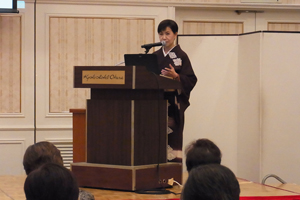
I gave a lecture at a seminar on textile dyeing and weaving culture in Kyoto. I talked about cloth for the first time in a while. It is also a story about the relationship between nature and human beings. However, the fact that Kyoto's craftsmanship is in danger was clearly felt during the Q&A session.
November 10 (Thursday)
The second Japanese speech contest will be held in Vietnam, and I shot a DVD to greet everyone. The winner will be invited to Hosei University. Although I have visited Vietnam many times, I regret that I can seldom go abroad now due to my many official duties as President.
Wednesday, November 9
He held his second standing speech for the President's election. I began by saying, "Thank you for coming together for this unexciting vote of confidence on a day when astonishing election results are being circulated around the world. This election for President was a vote of confidence, as there were no opposing candidates. As per the rules, he gave a 25-minute vote of confidence. I would like to thank the Election Committee for their hard work. On the same day, a newsletter was also issued in which questions from the teachers' union (Zen Hosei) were sincerely answered.
The "surprising election result" was, of course, the confirmation of Trump's victory this afternoon.