Saturday, October 31
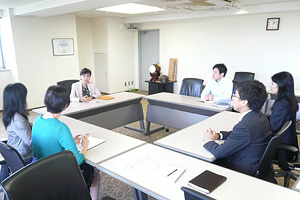
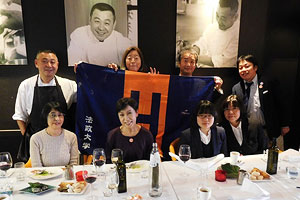
Finally, it is the day of the Brussels Law & Politics Meeting. And it is the last day of my business trip. We had a dinner party at INADA, a French restaurant run by a Japanese chef, which was introduced to us by one of our alumni, Yoko Jinno. Ms. Yoko Jinno has been living in Belgium for more than 30 years and is now the editor-in-chief of "Petit Pois", an information magazine for Japanese living in Belgium. Although information gathering and alumni activities for overseas alumni associations have just begun, there is always someone who can be a key person in each region.
The European trip had many goals: to prepare for the organization of alumni associations abroad; to conclude agreements with four universities and prepare for the conclusion of such agreements; to inform students and teachers at Japanese schools about Hosei University today; to observe and confirm new developments in university education; and to promote Hosei University's research presence in Europe through lectures at the Japan Society for the Promotion of Science (JSPS). The trip exceeded our expectations.
October 30 (Friday)
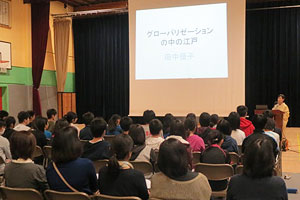
I gave a lecture at the Japanese School of Brussels. Established in 1973, it is the third largest Japanese school after the Japanese School in Dusseldorf and the Japanese School in London. The school has about 300 students in elementary and junior high school, and also has a supplementary school with nearly 250 students, where students in grades 1 through 3 and their parents listened attentively to my lecture. After graduation, students have the option of attending a local international school or returning to Japan to enter a high school with a returnee quota or dormitory.
This lecture was also introduced on the Brussels Japanese School website.
October 29 (Thursday)
We visited Roskilde University in Roskilde, Denmark. Roskilde was the capital of the Kingdom of Denmark from the 11th to 15th century, where a palace was located and a cathedral was built. The cathedral is a World Heritage Site. However, there was no time for sightseeing. The whole day was spent at a university located on the outskirts of Roskilde. The low-rise campus continues in a vast space. Vice President Peter Kjaer's greeting conveyed the fact that Danish universities are also facing financial problems.
Professor Emeritus Inger Jansen, former Vice President, a woman who was involved in the founding of the university, then gave a detailed explanation of the history of Roskilde University's founding and its educational approach, known as the Roskilde Model. Professor Henning Salling Olesen, former president of Roskilde University, joined us to answer our questions.
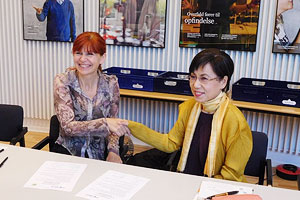
Near noon, the current Rector, Prof. Hanne Leth Andersen, appeared, spoke about the international student situation, and signed the agreement with me on the spot, and a general academic agreement was signed. The dean was a younger woman than I, dressed in a tight-fitting shirt and mini-skirt. The whole university's divergent and free atmosphere seemed to me to be the goal of Hosei University. It was not only the atmosphere. Roskilde University was born out of the student movement of the 1960s. I wrote an essay about its founding and educational methods, which you can read here.
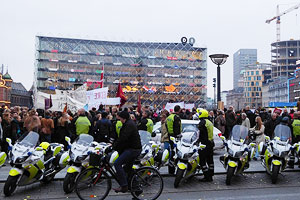
When we left the university and stopped by the hotel to pick up our suitcases for our flight to Brussels, Belgium, we were surprised to see that the City Hall Square in front of us was packed with students in a rally. Flags of different universities and schools were fluttering and students were speaking in turn. This is due to the government's announcement that it will cut the budgets of high schools and universities by 2% each of the next four years. This is not a demonstration against the increase in tuition fees, as there are no tuition fees for educational institutions in Denmark. It is a protest against the change in the educational environment. Students from Roskilde University were also prepared to go to the demonstration, so they must be here. According to Copenhagen police, 10,000 to 15,000 people participated.
October 28 (Wed)
While the Director of the Center for Global Education and the President visited the International Exchange Section of Aarhus University to explore the possibility of an agreement, I learned about Roskilde University, which I would visit the next day. It is a very interesting university.
October 27 (Tuesday)
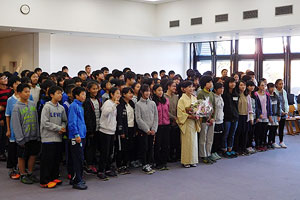
Today is the day of the lecture at the Japanese School of Dusseldorf. A Japanese school is a school that provides compulsory education for the children of Japanese expatriates in the area, and includes both an elementary school and a junior high school. The Japanese School of Dusseldorf opened in 1971 as the first Japanese school in Europe. With over 500 students, it is the largest Japanese school in Europe.
In 2011, I gave a talk on the theme of "Edo in Globalization," a book published by Iwanami Junior Shinsho. The junior high school students and their parents listened to me. After the lecture, there were very sharp questions, which made me realize that this is an environment where people can think and speak freely.
The lecture was also introduced on the website of the Japanese School of Dusseldorf.
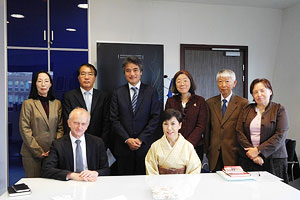
In the afternoon, I went to the University of Düsseldorf to discuss an inter-university agreement with Professor Christian Tagsold. We had been considering an agreement but it had not materialized, but on this day we found out why and decided to explore an agreement between the Department of Contemporary Japanese Studies at the University of Düsseldorf, which has about 500 students, and Hosei University.
In the evening, at the invitation of Dr. Mariko Fuchs, a doctor of education who teaches German children, we had a meeting with a group of Japanese who are engaged in a citizens' movement. The Japanese in Germany seem to have a growing sense of crisis toward Japan, as they compare the Japanese government's stance with that of the German government, which has withdrawn from nuclear power generation and is accepting large numbers of refugees. Germany is addressing the issue of refugees as a human rights issue. However, it is said that the German government, anticipating that the influx of refugees will not stop, has chosen to actively welcome the initial influx of highly educated and under-aged refugees!
October 26 (Monday)
I arrived in Strasbourg after a five-hour train ride the day before. Today is the day I give a lecture in English at the University of Strasbourg. It is sponsored by the JSPS Strasbourg Office. The President's Office is the one who supports me every day. The Administrative Director of the Center for Global Education will join me from Japan, making it a three-woman trip.
First, I had a meeting with Michel Deneken, First Vice President of the University of Strasbourg, at 9:00 a.m., including the continuation of the agreement. I learned a lot from the way he introduced the university in an easy-to-understand manner at the Vice President's office, and I will definitely try to introduce that method. The other party marveled at the fact that the President, the Office Manager, and the General Manager are all women.
The lecture was given using a lot of slides. The lecture was based on his book "Nuno no Chikara" (The Power of Cloth), which has already been published in English translation. He showed examples of trade with Asia during the Edo period (1603-1868), kimonos made of life-giving trees, and kimonos made of landscapes, and discussed what was necessary for a sustainable society. The lecture also included an explanation of what was needed for a sustainable society.
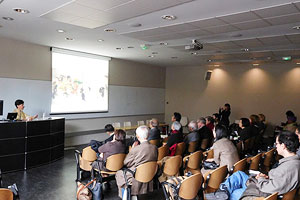
The Ambassador of Japan to the Consulate General of Japan and other consulate officials, Ms. Marie-Claire Lett, President of the French-Japanese University, Vice President Francis Kern, and professors who teach Japanese culture at the University of Strasbourg were also present for the lecture.
The University of Strasbourg has a long history of accepting students from Japan since the 1880s, and in the 1990s, the university adopted a policy to further deepen exchange relations with Japan. In the 1990s, the University of Strasbourg had a policy to further deepen its exchange with Japan. It seems that the University has been actively promoting exchange with Japan by establishing a "Japan Committee" in all faculties, including the Department of Japanese Studies, as well as institutions to mediate and promote research exchange between the two countries, such as the French-Japanese University Hall and the JSPS Strasbourg Office. Even now, Japanese is the second most popular foreign language of choice on campus, after English.
The University of Strasbourg and TUFS have a student exchange agreement, and students have studied at ESOP* and have gone on to work for Japanese companies. Hosei University students are also currently studying at the University of Strasbourg. Incidentally, the university is very strong in the sciences and has several Nobel Prize winners.
After the lecture, I had lunch with the university staff and returned to Düsseldorf, where I took three trains to meet the other travel support person, a section chief of the Alumni Relations Office, who had stayed for the next project.
October 24 (Saturday)
The Hosei meeting for alumni was held at Kikaku, a Japanese restaurant in Düsseldorf, Germany. The staff members, including the head of the Alumni Relations Office, were well prepared for the meeting, which turned out to be a very enjoyable event. The president of the Alumni Association also attended the meeting, which gave me the feeling that we may someday be able to hold a continental European Alumni Association meeting in Düsseldorf. The UK has already established an Alumni Association.
On the day of the event, we met a variety of people, including people from Frankfurt and other locations in Germany, people from Poland, and the grandson of an alumnus whose grandfather was killed in action, and who came because he "wanted to see the prewar Hosei emblem that was left with him. Some brought their three adult sons, some their elementary school sons, some their newborn children, and some with their companions. Some of the children are half-Japanese, some are Japanese, and some of the companions are German, British, or Japanese. I realized how many of our graduates are working all over the world. Dusseldorf is a place where Japanese companies are concentrated, but not all of them are from companies. There is a diverse range of work.
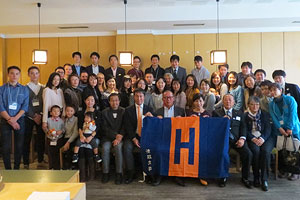
The steady work of our staff members in getting the word out about the meeting to the local Japanese media, gathering information, and so on, is bearing fruit. The information gathering will continue. If you are reading this from overseas, please go to the "For Alumni" page on our website and register your address. We will notify you when we hold a meeting.
In this age when alumni are spreading out across the world, the university would like to do its best to support alumni living in the same town or region, so that they can support each other in this difficult environment.
October 18 (Sun)
There was a victory celebration for the Kendo Club. The Kendo Club won the individual championships for both men and women at the World Championships, and also won the world championship in the women's team competition. The Kendo Club also won the world championships in both the men's and women's team competitions, the All-Japan championships for current and former students, and the Kanto championships for individuals and teams. 7 different championships have all been won over the past year, and on the 17th the track and field team qualified for the Hakone Ekiden, which was a relief for everyone. Let's continue to support the Kendo Club.
October 15 (Thursday)
It is the day of the graduate school self-assessment meeting, and since there are 15 graduate schools, everyone's presentation will last only 8 minutes. Even so, I could feel the individuality and enthusiasm of each graduate student. As I have experienced myself, it is quite difficult to manage seminars and classes with a mix of aspiring researchers, international students, and working students, and it is essential to have supplementary classes after seminars, guidance by teaching assistants (TAs), and a general paper presentation meeting. Even so, many faculty members face this challenge and continue to make reforms.
Hosei University Senior High School for Girls, a Super Global High School (SGH), announced that it plans to develop its school reform and to make it a co-ed school under the name of "Hosei University Kokusai High School (tentative name). I am from a Catholic school for girls, so I know the soft and spontaneous nature of an all-girls school. I know that some of the current students, even after they graduate, may not be comfortable with the idea of a co-ed school. There was a role in the past that single-sex education played. But now, Hosei University is a university that aims for diversity. We live in a society that is increasingly accepting the fact that human sexuality is not exclusively divided into "male" and "female. We have students who come from various countries around the world, and students who have grown up in other countries and returned to their own countries. We want our students to learn about the diversity of the real world from an early age.
I had a chance to talk with Kenji Yamamoto, Executive Trustee of the Japan Association of National Universities, who, as President of Wakayama University until March, issued a "Lifelong Support Declaration" to students, graduates, and the local community. His book, "The Promise and Challenge of a President of a Regional National University," is an interesting book with a very basic educational philosophy: education as a process of "humans becoming humans," and the importance of experiencing "crowds" and "troubles" from childhood. It was refreshing to see Japan as seen from a national university, which is different from what we can see from a private university.
October 13 (Tuesday)
We visited the administrative offices of the Koganei Campus, where students from the three Faculty of Science and Engineering (Faculty of Computer and Information Sciences, Faculty of Computer and Information Sciences, and Faculty of Bioscience and Applied Chemistry) study, to hear what everyone had to say. I have been there for entrance examinations and events, but this was the first time I visited the laboratories. Each department gave us a very detailed tour, including the dean, and we learned a lot about the details of their guidance and challenges they face. Thank you very much.
October 11 (Sun)
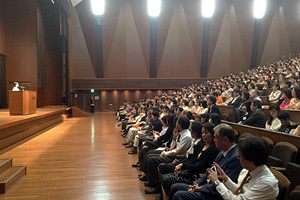
A meeting for parents in the Tokyo metropolitan area was held under the auspices of the Supporters' Association. The lecture was titled "The Power to Survive Anywhere in the World. Parents filled the Sattva Hall to capacity. Thank you very much.
October 10 (Saturday)
I went to Yokohama to greet the PTA members of the three affiliated schools. This year, Hosei Girls' High School is the organizer. I saw a slide show of the free and creative activities of the students at the girls' high school and thought again, "What a good school!
October 9 (Friday)
As Trustee, I addressed the General Assembly and the Symposium on University Evaluation held by the Japan University Accreditation Association (JUAA). The JUAA is not an organization that regulates universities; quite the opposite, it is an organization that helps individual universities to set goals based on their own uniqueness before being regulated, and to carry out continuous reforms to enhance quality while self-evaluating to achieve those goals. It is also a member of the International Quality Assurance Network, which provides and exchanges information so that individual universities can make their own efforts. The symposium was held by the committee members who edited the "Internal Quality Assurance Handbook," and it was a very interesting symposium, full of enthusiasm and a lot to learn.
October 7 (Wed)
Hosei University's Vietnam office was to be opened, and a video greeting was recorded for the opening ceremony. I have been to Vietnam three times for NHK work, government work, and research, and I love the country. Unfortunately, I could not visit Vietnam this time due to a business trip to Europe during the same period. So this is a video recording, but I hope to have a chance to visit there someday.
October 6 (Tuesday)
Today, we conducted another "workplace visit" to each department at the Ichigaya Campus. I was bowled over by the sense of urgency, perspectives, and new ideas of the employees who are working to improve the university as much as possible. Today, too, I gained many suggestions.
October 3 (Saturday)
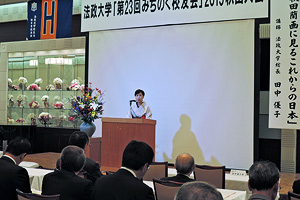
Alumni Association Michinoku Block Convention was held in Akita City. The Alumni Association organized a lecture open to the public. The subject of the lecture was "Future of Japan as seen in Akita Rangga. I spoke about the value of Naotake Odano's paintings and how they are one model of Japan's uniqueness. Can we create a unique Japan, one that is not dependent on a superpower, one that is not a "normal country?" is the conclusion.
Akita Prefecture was the field of my seminar. It is also a place with which I have close ties in my research on the Edo period, and last year I visited Kakunodate for a lecture and a symposium. I have been indebted to the local people. One of them, Mr. Hiroshi Kawaguchi, an alumnus and a former mayor and member of the House of Representatives of Kosaka Town, known for its mineral circulation system, also visited us. Mr. and Mrs. Kitagawa of "Noshiro Japanese Language Study Group," in which seminar students participated, also visited us. Her husband is an alumnus. They started with Japanese language education for orphans left behind in China, and now they are teaching Japanese to their wives from seven different countries to survive in the community. This year, she received the Commissioner for Cultural Affairs Award. These are people who have important methods for the future of Japan.
Akita has had local and global connections everywhere since the Edo period.
October 2 (Friday)
I visited each department of the university and asked about their progress and challenges. The visits to administrative departments, which I started last year, are always fruitful for me. I will continue to make the rounds, although my visits are short because it is difficult to find the time to do so. Thank you for your cooperation.