

April 30 (Thursday)
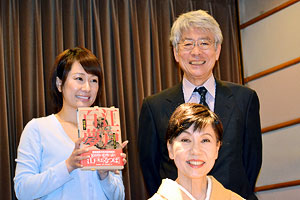
Nobuhiko Shima appeared on the TBS radio program "Nobuhiko Shima: 100 Views of My Life, People of Ambition," in which journalist Nobuhiko Shima serves as an interviewer. The program will be broadcast on TBS Radio from 21:30 to 22:30 on May 17 (Sunday) and 24 (Sunday). Since Mr. Jima came to teach at Hosei University as a lecturer, we had a lively discussion about the university.
April 24 (Friday)
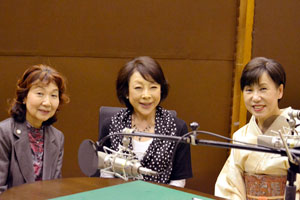
I recorded "NHK Radio Late Night News: 100 Rakugo" and "Meijin Gei wo Savor", a new series of regular appearances that will start at 1:00 a.m. on April 30 (May 1). It will air every other Thursday at midnight. Today's theme was "Kaen Taiko" and "Rehearsal House" by Shinsei Kokontei. He talked with Ms. Shino Ikenami, the granddaughter of the 10th Kanewaratei Basho. Shino-san was not only an interesting talker, but also a wonderful person in both her words and her attitude toward life.
Her talk partner, Kanehara-tei Hakuraku, was the first disciple of Shino's father, Kanehara-tei Umawake, who was at Hosei Second High School on November 16, 2011.
April 17 (Friday)
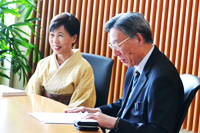
Today's HOSEI ONLINE interview is with Professor Koji Sakamoto of the Graduate School of Policy Innovation. He is the author of "Nihon no ichiban ichiban ichiban desiderai kaisha" (The Companies You Want to Cherish Most in Japan) 1-4, which we have previously featured here, and the winner of the "Nihon ichiban ichiban ichiban desiderai kaisha" grand prize, and a graduate of the Faculty of Business Administration at Hosei University.
The origin of the word "economy" is "Keisei Jimin" (to save all people by running the world). The fundamental questions of what a company is to society and what management should be like are here.
April 16 (Thursday)
Hosei University has a system called the "University Evaluation Office" in which all faculties, graduate schools, and the corporation make their own goals and strive to achieve them, and also receive external evaluations to improve the quality of education and research.
Since last year, we have also included a mechanism for external evaluation in our Super Global Program. Today, we presented the long-term vision being formulated to the deans and others, and exchanged opinions in preparation for future evaluations.
April 15 (Wed)
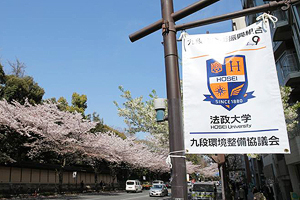
Did you know that since April 1, Hosei University's emblem in orange on white has been decorating the streets along Yasukuni Street from Ichigaya Station to Kudan-zaka-ue? In the season of falling cherry blossoms, this white color blended with the cherry blossom color and was beautiful.
In fact, this display was realized through a very difficult path. Today, we held a dinner party to express our gratitude to the Chiyoda Ward Council members, the Kudan Environmental Improvement Council, and the Kudan Shopping Street Promotion Association for their efforts to make it a reality. Thank you very much, everyone at Kudan-ue.
The emblem will be open until tomorrow, the 16th, but will be reopened during the open campus season.
April 13 (Monday)
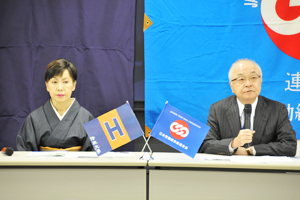
I attended the press conference for the inauguration of the Institute for Solidarity-based Society together with RENGO President Koga.
The Institute for Solidarity-based Society is a master's degree program launched in collaboration with Hosei University, the Japanese Trade Union Confederation, and the Japan Labor Culture Foundation. Solidarity Society means "a civil society based on the solidarity of people. How to create a sustainable society including economy and environment, a solidarity society based on people's solidarity, with the goal of a fair civil society based on respect for individual freedom and democracy - this is an important and consistent with the mission and vision of Hosei University. This is an important project that is consistent with the mission and vision of Hosei University.
April 11 (Saturday)
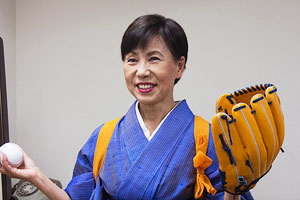
The Tokyo Six University Baseball Tournament has started. Although the game was postponed back two hours due to rain, I was able to safely throw out the first pitch in this commemorative year of the 100th anniversary of the baseball team and the 90th anniversary of the Six University Baseball Club. I was able to pitch anyway, even though I am completely new to baseball, thanks to the semi-hardball coach Takahiro Honma and his students, the hardball coach Hisanori Aoki and his students, and the staff members of the President's office. In particular, the driver of the President's car is an all-around sportsman, and he gave me special training while I was waiting. This gave me a lot of training and good exercise. Thank you very much.
And on this first day, we won against Keio University. Congratulations! The defensive strength of the team was outstanding.
April 10 (Friday)
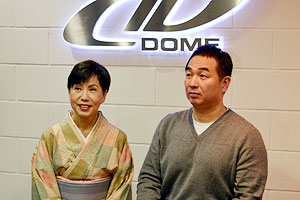
TBS came to our school for an interview. Afterwards, we had an interview for HOSEI ONLINE at DOME corporation in Tennozu, where the president of DOME, Mr. Shuichi Yasuda, is a graduate of the Department of Japanese Literature, Faculty of Letters, Hosei University, just like me. He was also a member of the Tomahawks American football team and later captain of the All-Japan University American Football Team.
We had an enthusiastic conversation about the direction in which university sports should head.
April 9 (Thursday)
American artist Cannon Hersey visited Hosei University Press and the President's Office.
Cannon Hersey is the grandson of John Hersey (1914-1993), the author of "Hiroshima," the first book published by Hosei University Press.
John Hersey was a Pulitzer Prize-winning journalist.
His book "Hiroshima" (translated by Kinichi Ishikawa and Kiyoshi Tanimoto) was published in 1949 and started the history of Hosei University Press, which is known for its translated books.
The original book was published in August 1946 in The New Yorker, which sold 300,000 copies in one day.
It is a graphic reportage based on interviews with six atomic bomb survivors. One of the translators, Kiyoshi Tanimoto, was one of the hibakusha who appeared in the book.
John Hershey later returned to Hiroshima in 1985 and wrote "Hiroshima and After". The current edition has been expanded and updated to include that manuscript, and has been translated by Toru Akedagawa. It is an important book for the history of Hosei University.
The purpose of Canon Hershey's visit to Japan and his activities in Hiroshima and Nagasaki are summarized in the following essay.
April 6 (Monday)
It was the entrance ceremony for Hosei Girls' High School. The girls' high school was recently adopted as a Super Global High School. Together with the university, it will now grow as an international school.
After the entrance ceremony, five students and Principal Kazuhito participated in an open discussion. It was very encouraging to hear the students articulate what globalization means to them.
April 5 (Sun)
Chief Cabinet Secretary Yoshihide Suga and Okinawa Governor Takeshi Onaga. The scene of these two sharply confronting each other across the table was repeatedly shown on TV, in newspapers, and on the Internet. The scene was also aired with Onaga saying, "We both graduated from Hosei University, but I came here with a passport to study until I was 22 years old.
In 1972, the year of Okinawa's "reversion" (I use the word "reversion" in parentheses), the Institute for Okinawan Studies was established at Hosei University, which had been a center for Okinawan studies on the mainland.
I, Yoshihide Suga (1973 graduate of the Department of Political Science, Faculty of Law), and Takeshi Onaga (1975 graduate of the Department of Law, Faculty of Law) were all enrolled at Hosei University that year.
When I entered the university in 1970, I was attending a lecture by Professor Moriyoshi Tonoma*, a leading scholar of Okinawan literature. Mr. Onaga must have heard it too. Forty-three years have passed since the "reversion" to Japan.
What in the world have these years been like?
Okinawa was an independent country called Ryukyu during the Edo period. It was not a part of Japan (Yamato) in the first place. In 1872, it was incorporated into Japan, and in 1945, it became the scene of a horrific battle later known as "Operation Suteishi". Today, 74% of the U.S. military bases in Japan are still concentrated in just 0.6% of Japan's land area.
So how should we solve this problem? We need to think of this as our own problem, not just Okinawa's. The question of what Okinawa is is not a question of what Japan is.
The question of what Okinawa means to us is to ask what Japan's postwar period was like. Seventy years after the war, Japan, which should have moved toward non-war and democracy, is now being tested.
- Professor Morizen Sotoma...Professor Emeritus of Hosei University, born in Naha City. He is a leading authority on Okinawan studies and Director of the Institute for Okinawan Studies at Hosei University. He is known for his research on "Omorosaushi," a collection of old Okinawan songs, and has written many books, including "Minamijima Bungaku-ron" and "Okinawa no Kotoba to Rekishi" (The Language and History of Okinawa), as well as "My Okinawa War Diary: Maeda Kochi, Sixty Years of Testimony," which chronicles his own experiences during the Battle of Okinawa.
April 4 (Saturday)
This was the inauguration ceremony and training for new teachers. Thirty-five years ago, when I was assigned to this position, there was no such thing, and we were suddenly given lectures in classrooms, so everything was a groping process. We are now in an era where we can grasp the whole picture and engage in education while consulting with each other. I encourage teachers to try their hand at various endeavors.
April 3 (Friday)
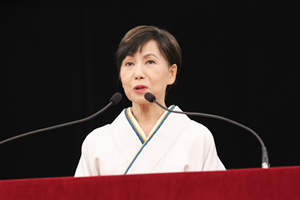
It was the entrance ceremony for the 2015 academic year. From this time onward, we will be bringing you the deans' words in their own voices. New students, you have heard the voice of the deans of your own faculty. Please be familiar with your deans and make the most of your time as a student.
This year, three of our deans are women. The percentage of female deans is now 20%. This is the first time in the history of the university. The creation of a female dean further opens the possibility of a female Trustee and a female President.
This year, I wore the same school colors of orange and navy blue overlaid with a date collar on my kimono for the entrance ceremony as I did last year. The date collar is a reproduction of the way of wearing kimonos in the days when kimonos were layered like a juni-hitoe (twelve-layered kimono), using only the collar as a garment. Usually, only one type of date collar is used on top of the white half collar, but any number of types can be layered. Ideally, the layers should follow the "kasane-no-irome," a list of colors that has been handed down since the Heian period (794-1185). The colors are an assortment of colors from nature, such as cherry blossom, plum, and wisteria. However, the school colors of orange and navy blue are not on that list. Therefore, we have decided to use this as the name of "Hosei-Suso".
April 2 (Thursday)
I gave a lecture at a training session for newly hired staff, and the inauguration ceremony was held on the 1st, so the staff who just graduated from the university are still very nervous.
April 1 (Wednesday)
Finally, the new semester, the start of the 2015 academic year, is upon us.
I would like to write about the policies of the President's Journal for the new semester. At the beginning of the President's Journal, it says, "This page is to introduce President TANAKA Yuko's daily work, such as lectures, interviews, and events on and off campus, other than internal meetings, by President Tanaka himself. I have heard some people say that this "outside of internal meetings" part is not always understood, and that it does not convey what the President is all about. However, it is not possible to write down in detail the contents of the enormous volume of meetings.
Therefore, we decided to inform you at the beginning of the academic year of what the President does, including the so-called routine work, or regular tasks, and what the President's Journal is about.