

(real name: Hikoho Kubota), the children's literature author who wrote "Daizo Grandpa and the Gan", which appears in elementary school Japanese language textbooks, is a graduate of the Faculty of Letters.
Muku was born in 1905 to a rancher in Takagi Village, Shimoina County, Nagano Prefecture. He was an impressionable boy who accompanied his father into the mountains, listened to his grandmother's stories about the old days at the edge of the irori, and was moved by "Heidi, Girl of the Alps," a children's book by Johanna Supilli. Muku is said to have called "Heidi" "the book of destiny. The natural environment of the Inadani valley between the Southern and Central Alps may have helped him to become a writer.
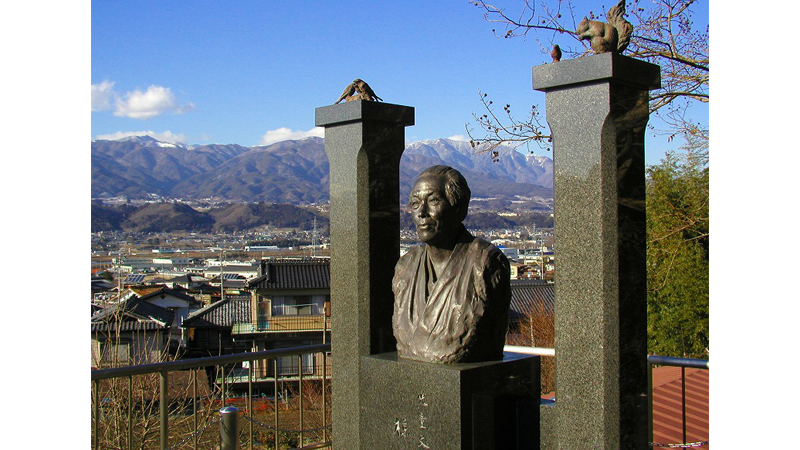
Bust of Hatoju Muku overlooking the Ina Valley (courtesy of the Takagi Village Hatoju Muku Memorial Museum)
Muku entered Hosei University in 1924. It was the third year after the university moved to its current location in Ichigaya, a time when the university was making the leap from a former law school to a general university, and the atmosphere was full of "enterprising weather. Muku was especially taken care of by the French literature scholar Yoshio Toyoshima and the English literature scholar Souhei Morita, and even though he was a student of the Japanese literature department, "all he did was listen to lectures from the French literature and English literature departments.
During his fulfilling university life, Muku was fascinated by the world of poetry and studied under the poet Sato Sonosuke. Under the name "Hikoho Kubota," which was a one-character change from his real name, he self-published his first collection of poems, "Sunma," while still a student. Muku began to perceive nature in a sensuous and intuitive way and gradually began to think about "what is pure beauty." He also published a coterie magazine called "Lian" as a place to showcase his works.
After graduating from university, he moved to Kagoshima, where his sister lived, and while working as a teacher, he published children's literature featuring animals. Daizo Grandpa and the Gun" was published in the November 1941 issue of Shonen Club (Boys' Club). In order to resist the wartime trend toward heroic stories, Muku expressed the preciousness of life through a contest of wits between a hunter named "Daizo Grandpa" and a smart bird named "Gan" (a wild goose).
After the war, he served as director of the Kagoshima Prefectural Library, where he advocated the "20-minute reading for mothers and children" campaign, which spread throughout the country. Some of his works have been translated into foreign languages, while others, such as "The Life of Maya," have been made into animation.
Since 2012, the Faculty of Intercultural Communication has been conducting the "Study Japan Domestic Training Program" mainly for international students, visiting Inadani, Muku's birthplace. Looking back on the steps taken by his seniors will provide an opportunity to broaden their perspectives and expand their thinking.
-
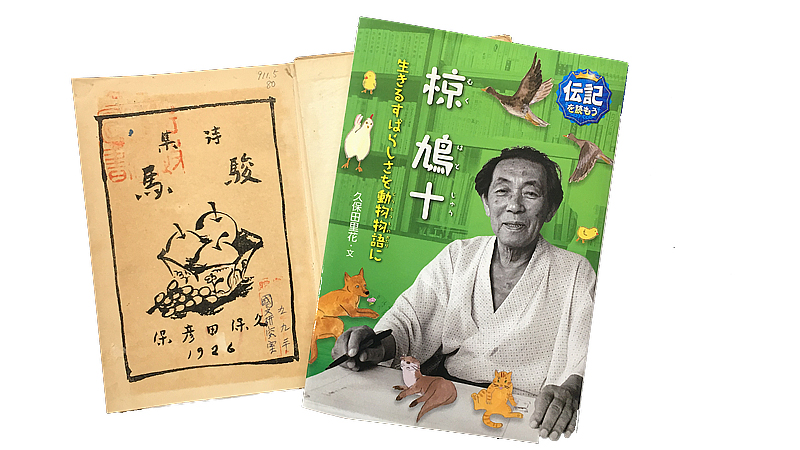
Hatoju Muku's poetry collection "Sumba" (self-published, 1926) and his biography "Hatoju Muku: Ikiru Hajimashisa wo Zoo Monogatari ni" (Akane Shobo, 2019) written by his grandson, Rika Kubota.
-
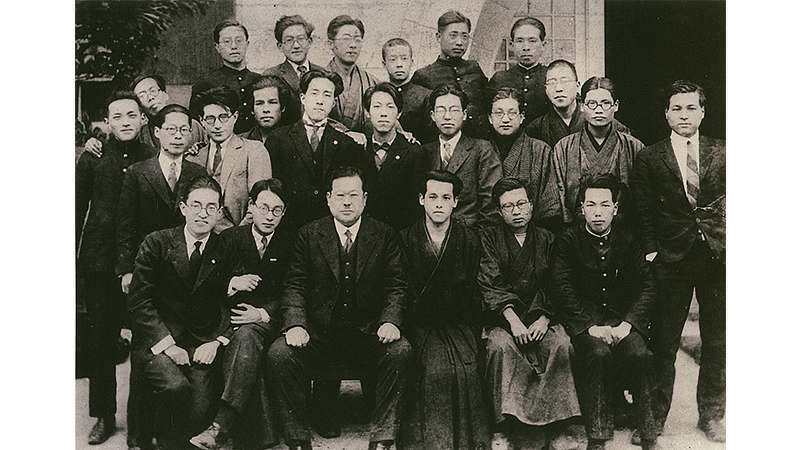
Group photo at the graduation ceremony; the fifth person from the right in the second row wearing a bow tie is Hatoju Muku (1930)
HOSEI Museum Themed Exhibitions
Noh "Tradition" and "Modernity
Period: on view through April 26 (Wed.)
Location: Ichigaya Campus, Kudan-Kita Building, 1st floor
Details: HOSEI Museum website
Interviewed by: Ms. Rika Kubota, Muku Hatoju Memorial Museum, Faculty of Intercultural Communication, Professor Toshio TAKAYANAGI Toshio, HOSEI Museum Office
(First published in the March 2023 issue of Hosei, a public relations magazine)