

FY2022
Rituals of Miyako Island Revived - Kannigai of Ikema and Sarahama - Hosei University Institute for Okinawan Studies 50th Anniversary Commemorative Exhibit
FY2022Okinawa Prefecture is a vast sea area measuring approximately 1,000 km east to west and 400 km north to south, dotted with approximately 160 islands divided into the Okinawa Islands, the Sakishima Islands (Miyako and Yaeyama), and the Daito Islands. The natural environment and history of each of the approximately 40 inhabited islands has nurtured a distinctive culture.
Since its founding in 1972, the Institute for Okinawan Studies at Hosei University has been engaged in research on the remote islands of Okinawa. Representative research projects include comprehensive linguistic, cultural, and social studies of Kume Island, Kuko Island, and Tonaki Island. Photographs of island landscapes and buildings taken during the research provide a valuable record of the islands as they were in those days.
In addition, the institute digitizes and preserves photographs taken by domestic researcher Hisako Kato during her ethnographic surveys. Kato's research and studies focus on Okinawan fishing villages, and her representative work, "Hunter of the Sea: Okinawa Fishermen - History and Lifestyle of the Itoman Uminchu," won the Okinawa Times Publishing Culture Award. In contrast to the Itoman fishermen, who are the representative "umintyu" (sea hunters) of the main island of Okinawa, he has also conducted research on Ikema Island in Miyako and Sarahama, Irabu Island.
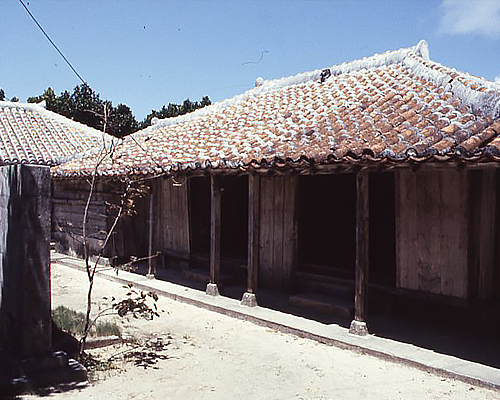
A traditional private house on Watanaki Island. It features a red-tile roof hardened with stucco and a "hinpun" screen placed at the front of the house (1987).
On Ikema Island, nearly 50 rituals were once held annually and were deeply connected with people's lives. These rituals were carried out by female deities called "Tsukasamma" (Tsukasamma mothers). While tukasamma were given authority as sacred beings, they were also subject to significant restrictions on their personal lives.
The Sarahama area of Irabu Island was established in the 18th century by immigrants from Ikema. Therefore, many rituals are influenced by Ikema, but some are performed in a different way, showing the influence of the history of the two regions. Unfortunately, no deity is currently elected and no rituals are performed by tukasamma.
The exhibition commemorating the 50th anniversary of the Institute for Okinawan Studies will feature photographs of rituals in Ikema and Sarahama taken by Mr. Kato in the 80s and 90s. The exhibit will revive the long-defunct "Kamiwasai" rituals, such as "Yukui (fertility prayer)" in Ikema and "Muzubui (harvest prayer)" and "Kani Gai (well wishes)" in Sarahama.
*An article on the commemorative exhibition was also published in the April issue.
-
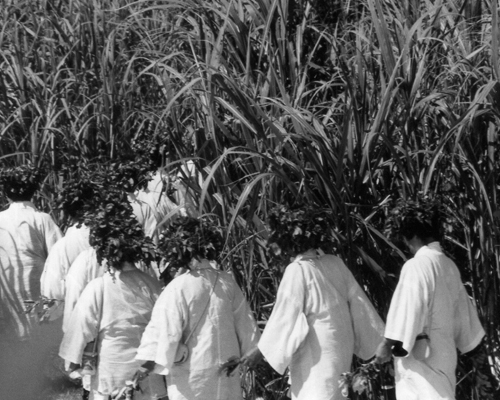
Tsukasamma and others touring the place of worship at the ritual "Yukui" on Ikema Island (1985).
-
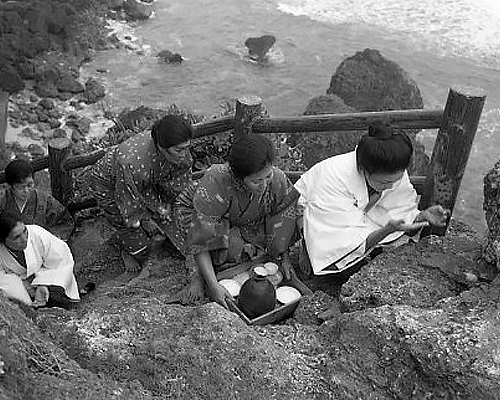
The "ka-ni-gai (well wishes)" of Sarahama, Irabu Island. Tsukasamma praying on the way down the steep stairs to the well (1993).
Hosei University Institute for Okinawan Studies 50th Anniversary Exhibit
Knowing, Thinking, and Connecting with Okinawa
Period: May 13 - August 26
- Kudan-Kita Bldg. 1F (Museum Core) 50 Years of Hosei University's Institute for Okinawan Studies
- Boissonade Tower 26th floor (Museum Satellite) Roof of Shuri Castle 2022 Exhibition
- Sotobori Bldg. 6F (Museum Satellite)
Photo Exhibition "Rituals of Miyako Island Revived: Deities' Wishes of Ikema and Sarahama
Details: HOSEI Museum website
The schedule and contents may be subject to change due to the effects of the new coronavirus infection and other factors.
Please check the above website for details.
(Interview supported by: HOSEI Museum Office, Hosei University Institute for the Study of Okinawan Culture)
(First published in the May 2022 issue of Hosei, a public relations magazine)