

FY2020
Vol.015 One Hundred Years after the University's Elevation and the Opening of the Ichigaya Campus: Chikashi Matsumuro, the First President of Hosei University
FY2020Hosei University celebrates the 100th anniversary of its elevation to the status of a university in 1920. University promotion means that the university was authorized as a "university" under the University Ordinance. Prior to that, the name of the school was "Hosei University," but it was still a school under the Technical School Ordinance.
Born in 1852 to a family of a feudal lord in Kokura, Fukuoka Prefecture, Matsumuro graduated from the Law School of the Ministry of Justice and, while serving as a judge, taught criminal law and civil law at the Tokyo Law School, the predecessor to Hosei University, as a lecturer. While serving in Nagasaki in his official capacity, he continued to have a close relationship with the University, including serving as the head of the Kyushu branch of the newly established Alumni Association.
In 1913, Matsumuro resigned as Minister of Justice and assumed the position of President. Kenjiro Ume, who was a classmate of Matsumuro at the Law School of the Ministry of Justice, had been promoting various projects, including the establishment of the Law and Politics Department for foreign students from Qing China as the University's Prime Minister (equivalent to today's President), but he died suddenly in mid-stride. However, he passed away suddenly in mid-stride, leaving a vacancy in the position of head of school administration, and Matsumuro succeeded him.
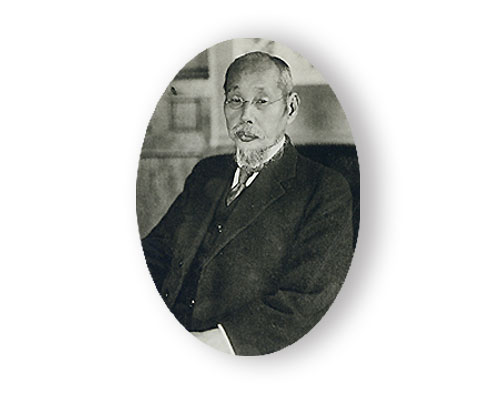
Portrait photo of MATSUMURO Chisato (in the president's office in the new building, circa 1930)
In 1921, the year following its promotion to university status, the university moved from the cramped Kudan-jo campus building, known as the "pigsty," to the Fujimi campus site (now the Ichigaya campus). With the help of Kobe Kouichi, an alumnus of the university and a major figure in the Koshu Zaibatsu, construction of the first school building, a three-story wooden structure, was completed.
In the Edo period, this area was densely populated with Hatamoto residences, and in the Meiji period, the Saiseikai hospital and military medical school were built one after another, and the adjacent land is said to have been a plaza surrounded by a red brick wall.
The first school building stands majestically in front of the outer moat, and the sign "Hosei University" written by President Matsumuro was hung above the arch of the main entrance. The University suffered little damage from the Great Kanto Earthquake, and a series of modern school buildings were constructed to improve the campus.
Many children of wealthy families in the surrounding area enrolled in the university, and it was during this period that "Hosei boys," Hosei's version of "mobo (modern boy)," formed a glamorous student culture based in the Kagurazaka and Iidabashi areas.
In 1880, the university was established as Tokyo Hogakusha (Tokyo Law School), and while moving from place to place in the Kanda area, it provided legal education to promising young men and women who moved to Tokyo. The university's elevation to a university status marked its transformation from a law school to a general university, and the Ichigaya area has since become the center of the university's development.
-
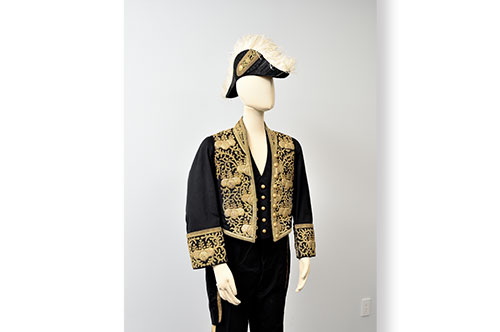
Matsumuro Chisato's uniform (jacket, vest, pants, and cap) donated by his bereaved family.
-
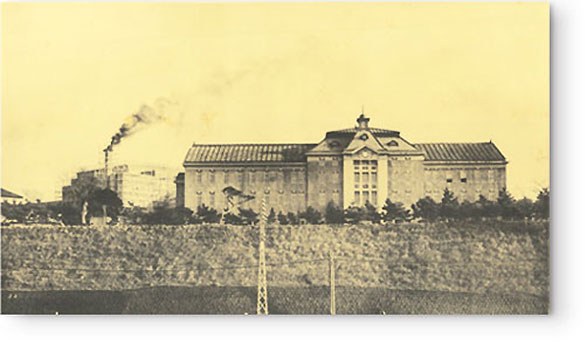
The first school building seen from the outer moat (from the graduation album of the Faculty of Economics in 1927). The third school building on the far left, which was just about to be completed, survived the air raid and was renamed the "First School Building" after the war, and was demolished in 2007.
Interview supported by HOSEI Museum Office
(First published in the January/February 2021 issue of Hosei, a public relations magazine)
Articles published in the past are available on our website