

FY2020
Vol.012 The Weightlifting Team and Olympic Glory - Yoshinobu Miyake, who supported the development of the sport
FY2020Yoshinobu Miyake, who graduated from Hosei University in 1962, set many new world records in weightlifting and competed in the Olympics four times. His career can be traced back to the development of the sport in Japan.
Miyake was born in 1939 in Murata-cho, Shibata-gun, Miyagi Prefecture, and was introduced to barbells while in high school.
The University's weightlifting club, founded in 1951 and launched the following year, featured Shigeo Kogure, who had won a national championship in high school.
Wanting to continue competing after high school, Miyake decided that in order to compete on the international stage in sports, it was important to polish his Japanese language skills and improve his character, so he enrolled in the Department of Japanese Literature in the Faculty of Letters in 1958, devoting himself to both academics and sports.
While still in school, he competed in the 1960 Rome Olympics in the bantamweight division along with Kogure. High hopes were pinned on Miyake, who had set a world record the previous year, but he was out of shape and ended up winning the silver medal. To make up for his disappointment, he spent the next four years setting clear goals and a detailed schedule.
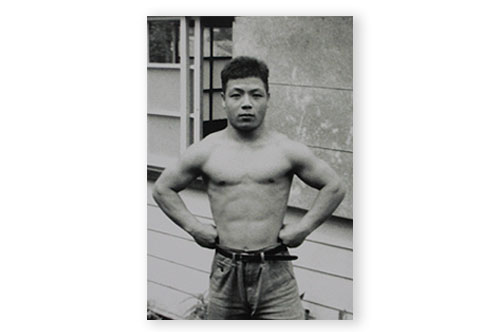
Yoshinobu Miyake, who competed in a body contest during his first year of college (courtesy of Miyake).
At the 1964 Tokyo Olympics, where he competed in the featherweight division, he won the gold medal he had longed for with a new world record of 397.5 kg. Shiro Ichinoseki (bantamweight) and Hitoshi Ouchi (middleweight), both members of the University's weightlifting team, also won bronze medals.
He competed in his third Olympics in Mexico in 1968, together with his younger brother Yoshiyuki, who was six years younger than him and had just graduated from the Faculty of Economics of the University. Yoshinobu was unable to train as much as he would have liked, but he won a gold medal in the featherweight division, and the sight of him and his brother standing on the podium together with Yoshiyuki, who won the bronze medal, drew much attention. Ouchi won a silver medal, and Ichinoseki also placed 5th.
The tradition of the University's weightlifting team continued, and Hiromi Miyake (Yoshiyuki's daughter), a student at the Faculty of Lifelong Learning and Career Studies, competed in three Olympic Games after graduation, winning a silver medal at the 2012 London Olympics and a bronze medal at the 2016 Rio de Janeiro Olympics (both in the 48 kg division).
Yoshinobu Miyake has continued to contribute to the Japanese weightlifting community as an instructor since his retirement. He has also worked hard to improve the training environment, and a training facility in Koriyama, Fukushima Prefecture, hosts training camps for the Japanese national team and the university's weightlifting team.
-
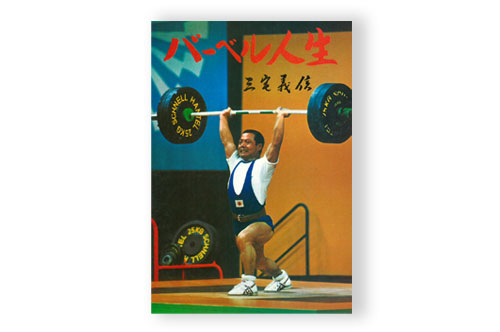
Yoshinobu Miyake summarized his life after competing in four Olympic Games in "Barbell Life" (Zemponsha, 1973).
-
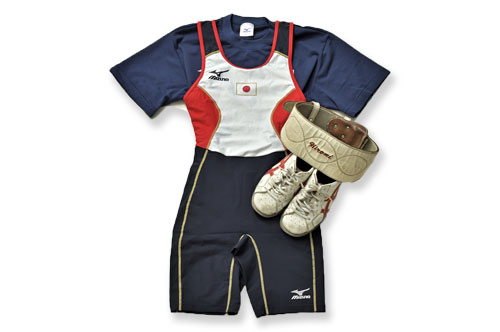
A set of costumes worn by Hiromi Miyake at the 2012 London Games (donated by Miyake), including the "Hiromi" embroidery on his belt, which can be seen up close at the HOSEI Museum's thematic exhibit.
Interview supported by HOSEI Museum Office
(First published in the August/September 2020 issue of Hosei, a public relations magazine)
Articles published in the past are available on our website