

Academic Year 2019
Vol.010 The Essence of Hosei Baseball - Nobuo Fujita and Tadashi Wakabayashi
Academic Year 2019It was 90 years ago in the fall of 1930 that Hosei University's baseball team, which boasts a 100-year tradition, won its first Tokyo Six University Baseball Championship. The key players behind this victory were manager Nobuo Fujita, who created the golden age of the team in its early years, and the ace player of the time, Tadashi Wakabayashi.
Fujita, who entered the school in 1923, experienced a rock bottom loss to Waseda University, 0-34, and began to emphasize systematic player organization and technique. After graduation, in 1929, he was appointed manager and immediately organized a tour of Hawaii. It is said that he took the players on board as first-class passengers not only to improve their baseball skills, but also to develop their international outlook.
Wakabayashi, a second-generation Japanese immigrant living in Hawaii, came to Japan as a member of an American business team while still in high school. While still in high school, Wakabayashi came to Japan as a member of a U.S. business team. He showed his versatility in pitching against university students, using a vertical curve and a knuckle ball, which no one had yet thrown in Japan. Seeing this, the Hosei baseball team worked hard to enroll Wakabayashi at the university. However, Fujita's tactical guidance paid off, and the team achieved its long-sought first championship.
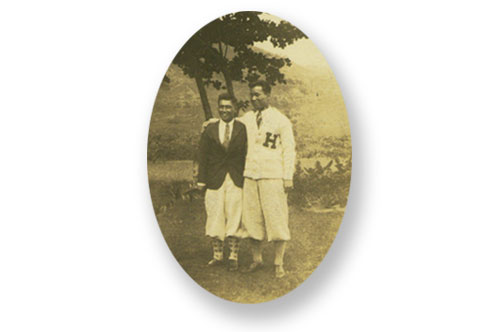
Manager Nobuo Fujita (left) and pitcher Tadashi Wakabayashi (right)
At that time, the Tokyo Rokugaku University baseball team had the privilege of traveling to the United States the year after winning the championship. Fujita, who had been searching for a baseball style suited to the Japanese by ordering technical books from the U.S., was impressed by the contents of an instructional book given to him by the manager of the University of Illinois baseball team, which he translated and published under the title "Yakyu Yomihon" (Baseball Reader). The book was the fruit of Fujita's theory, which advocated defensive baseball in a time when the goal was to play hard-hitting baseball, and it became the bible that formed the basis of Hosei baseball. Fujita won a total of four championships as a manager, and after the war, he served as a professor at the then Second College of Liberal Arts.
After graduation, Wakabayashi joined the soon-to-be-established Osaka Tigers (now the Hanshin Tigers), and his skillful pitching was known as the "seven-color magic ball. He also believed that children were important for the postwar reconstruction, and made efforts to contribute to society by visiting children's homes. In honor of these achievements, the Hanshin Tigers established the Tadashi Wakabayashi Award in 2011 to recognize players who contribute to society.
Wakabayashi's dream of becoming the manager of the Japan-U.S. World Series, as he had said before his death, has been passed on to his younger colleagues. Atsunori Inaba, a graduate of the university, will become the manager of the Japanese national baseball team for the Tokyo Olympics to be held this year, and is expected to play an active role on the international stage.
-
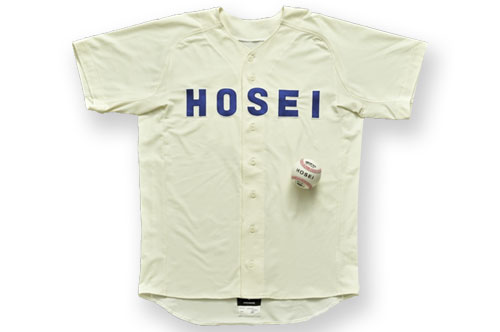
A cream-colored uniform (donated by Hisanori Aoki, manager of the baseball team) and a practice ball with the university's name on it (donated by the baseball team) have been handed down since 1974.
-
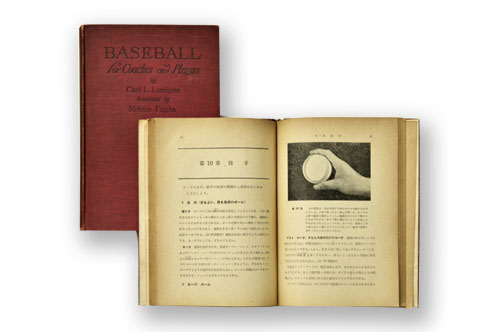
Fujita's translation of "The Baseball Reader" (1932, Iwanami Shoten).
(Courtesy of the Center for the History of Hosei University)
(First published in the March 2020 issue of Hosei, a public relations magazine)
Articles published in the past are available on our website