

Academic Year 2019
Vol.008 Maintaining the Autonomy and Freedom of the Faculty of Academia -Tetsu Nakamura, President for 15 years
February 25, 2020
Academic Year 2019 Akira Nakamura, who became President of Hosei University at the height of the university conflict, maintained a basic stance of dialogue with students and led the university to "normalize" the situation through a variety of reforms.
Nakamura was born in Tokyo in 1912 and studied law at the Imperial University of Tokyo (now the University of Tokyo). After the war ended, he became a professor in the Faculty of Law at the University, saying that he felt "closer to Hosei University, which had been devastated by the war as a place of free learning and the arts.
When the educational system and facilities could no longer keep pace with the expansion of the student population, some students, distrustful of postwar democracy, began to advocate the "dismantling of the university" and resorted to radical tactics such as occupying and blockading the university, using violence against faculty members, and obstructing examinations. In response to the "internal strife," an incident in which the university's autonomy was violated through the use of violence, the university was forced to call for the dispatch of riot police and to adopt a lockout* posture.
In the midst of this turmoil, Nakamura, who became President in May 1968 at the age of 56, emphasized dialogue with students in order to protect the freedom and autonomy of the university. This is symbolized by the President's press conferences and briefings (so-called "mass group discussions"), which were held at least eight times in Room 511 of the 55th Building and other locations. Nakamura is said to have purified himself with water before each meeting, and while accepting what he considered to be reasonable requests, he maintained the university's position as a school of learning and took a firm stance against the "dismantling theory" of the students.
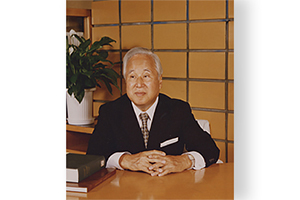
Tetsu Nakamura as President (photo taken in the summer of 1982)
During his 15-year tenure as President, Nakamura constructed the 69th Building, Kizuki General Hall, Student Hall, Ichigaya Gymnasium, and Koganei Gymnasium, and established the Okinawa Culture Research Institute in 1972, the year Okinawa returned to Japan, In 1972, when Okinawa returned to Japan, the Okinawa Institute of Culture was established.
These reforms led to a transition from "conflict" to "normalization" in the 1980s.
Even after he resigned as President after the "Machida (Tama) relocation" proposed by himself and the creation of a new faculty he had been considering fell through, he continued to demonstrate his talent and vitality, serving one term as a member of the House of Councilors and engaging in a variety of activities in the fields of art and literature.
- Lockout: Sealing off campus entrances and exits to ensure the safety of the general student population
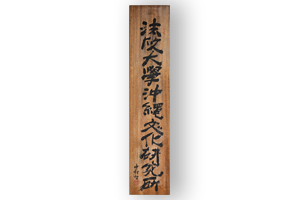
Signboard for "Hosei University Institute for Okinawan Studies" written by Nakamura (1972, in the collection of the Hosei University Institute for Okinawan Studies)
-
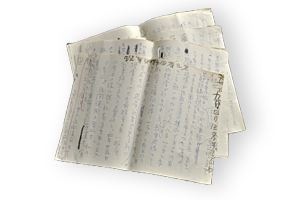
Manuscript of the President's press conference and briefing, pencil corrections by Professor Shozo Fujita, Faculty of Law, 1970 (in the collection of the Center for the History of Hosei University)
-
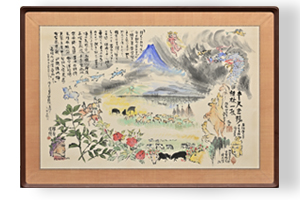
He was descended from Urakami Gyokudo, a literati painter of the Edo period, and was also an accomplished painter (1972 work, owned by the Institute for Okinawan Studies, Hosei University)
(Courtesy of: Hosei University History Center, Hosei University Institute for Okinawan Studies, Hosei University)
(First published in the November/December 2019 issue of Hosei, a public relations magazine)
The following links will take you to previous "HOSEI MUSEUM" articles.