

Academic Year 2017
Vol.97 The dormitory where students from all over Japan lived
June 13, 2017
Academic Year 2017The University once housed a "dormitory". Its history dates back to the days of the Tokyo Law School, the predecessor of Hosei University.
The Kanda Nishiki-cho School Building of the Tokyo Law School, established in 1881, was a reused samurai residence, and the dormitory was located in a corner of this wooden house. A boarding house was also attached to the school.
Students who did not enter the dormitories either stayed at boarding houses in the Kanda area or became live-in students at the homes of government officials and scholars, and worked hard at their studies.
In 1920, the university was officially recognized as a university under the University Ordinance, and a preparatory course was offered to prepare students for undergraduate studies, and many students from rural areas were enrolled. In 1934, the "Hosei Dormitory" was established in Kichijoji (Musashino City) as a dormitory for preparatory courses.
According to the "Hosei Daigaku Shinbun" (Hosei University Newspaper) of the time, the dormitory fee was "19 yen per room for two persons (with breakfast and dinner per day and three meals on Sundays and holidays) in principle.
The dormitory fee was 19 yen per room for two persons (with breakfast and dinner per day and three meals on Sundays and holidays). There was also a dojo and tennis court on the premises.
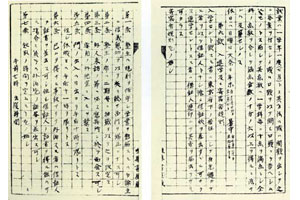
Tokyo Law School dormitory rules. Students were required to "devote themselves to their studies and maintain good conduct," and were forbidden to "talk in a high-pitched voice," "talk in an obscene manner," and "borrow money, silver, or clothing.
In 1936, when the Pre-College moved to the Kizuki Campus (Nakahara-ku, Kawasaki City), the Hosei Dormitory also moved to the same location. While the school building was a three-story reinforced concrete structure, all three dormitory buildings were two-story wooden structures with a total of 80 six-mat Japanese-style rooms.
In the pre-college program, most of the classes are taught by the same students. The students in the Hosei dormitories, who studied and lived together, developed a strong bond with each other, aided by their love for the school, and a so-called "dormitory culture" was nurtured.
According to an alumnus' recollection, "The dormitory was filled with a spirit of autonomy and freedom," and a "dormitory magazine" was published to publish literary works and critiques. At the "Dorm Festival," held every other year, students set up an outdoor stage and performed rakugo (comic monologues) and plays, and it seems that many residents of the neighborhood came to watch.
Most of the buildings on the Kizuki campus were destroyed by fire in air raids during World War II, and the history of the Hosei dormitory came to an end at this point. After the war, the Fuchu Student Dormitory, a four-story reinforced concrete building, was built in Fuchu City in 1965, where many students lived until 2010.
Although the lodging options have diversified due to changing lifestyles, the "room search" of new students who come from all over the country has continued to be a part of the new semester scene at the university since the Meiji era.
-
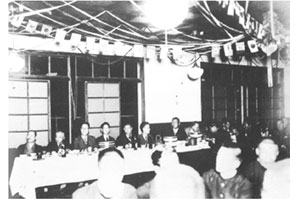
A party held in the dining hall after the dormitory festival (1939)
-
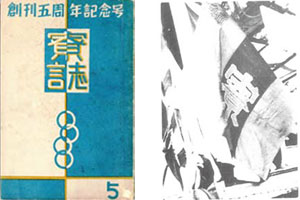
Left: "Dormitory Magazine" published by Hosei Dormitory Right: Hosei Dormitory flag with the school color orange on both sides
(Courtesy of the Center for the History of Hosei University)
(First published in the April 2017 issue of Hosei, a public relations magazine)
The following links will take you to previous "HOSEI MUSEUM" articles.