

Academic Year 2016
Vol.88 Student culture flourished in the early Showa period
April 21, 2016
Academic Year 2016With the enactment of the University Ordinance, Hosei University was elevated from a technical college and became an official private university in 1920. With this change, classes were moved from evening to daytime, and both the characteristics of the students and campus life changed dramatically.
The university's education, which had developed around law and political science, expanded into literature, philosophy, and other fields with the birth of the pre-college course (equivalent to a liberal arts program). Toyoichiro Nogami, then Dean of the Preliminary Course (later to become President), took the initiative. The Dean of the Preparatory Course, Toyoichiro Nogami (then President), took the initiative in inviting top scholars such as Hyakken Uchida and Souhei Morita, as well as German language scholar Tsuruo Sekiguchi and philosophers Kiyoshi Miki and Jun Tosaka, as faculty members, and students aspiring to study literature and philosophy also began to gather at the university.
Students who had more time and mental capacity began to feel a sense of solidarity by belonging to the same organization for five years through their preparatory and undergraduate studies, and began to actively engage in activities outside of academics. One example is the performance of the German play "Faust" by a volunteer group of students who had taken Uchida's German classes.
In June 1921, "Faust" was performed to commemorate the inauguration of the first school building.
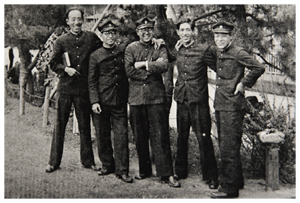
Students in school uniforms and square caps from the Taisho and early Showa periods.
After the Great Kanto Earthquake of 1923, the number of applicants for admission to the university increased rapidly, partly because the newly completed school buildings suffered almost no damage. As Tokyo entered the Showa period (1926-1989) and the "modern" atmosphere overflowed, an increasing number of students began to engage in artistic activities such as music and theater with like-minded friends. The rivalry with other universities also provided a tailwind, leading to the establishment of a number of athletic organizations and the formation of alumni associations run by student representatives on their own initiative.
The crystallization of such enthusiasm can be seen in the new school song, which was born in 1930. In the same year, the baseball team won its first championship in the fall league of the Tokyo Six University Baseball Tournament, and the new school song became a symbol of the "Hosei spirit" of creating a student culture with students' own hands. The following year, the Aeronautics Club (now the Aviation Club) attracted nationwide attention when it became the first student club in Japan to fly from Tokyo to Rome in a biplane, the "Seinen Nippon-go," a biplane propeller-driven plane.
The student culture that flourished in the early Showa period is still carried on in many club activities and organizations today, including the Newspaper Society (founded in 1924), the Music Club (now the Symphony Orchestra, founded in 1921), and the chorus group "Arion Chorus" (founded in 1928).
-
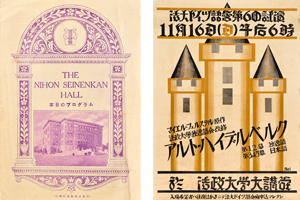
Poster for a German-language play performance. (Right) A pamphlet of the Music Club's performances, which have continued for many years since the first performance of "Faust" in 1921. (Right) A pamphlet of a performance by the Music Department, which gave performances at off-campus halls and in regional areas (left).
-
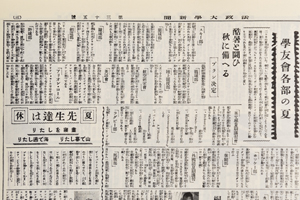
The Hosei University Newspaper carried articles introducing the various clubs belonging to the Gakuyukai and reporting on their activities.
(Courtesy of the Center for the History of Hosei University)
(First published in the March 2015 issue of the public relations magazine "Hosei")
The following links will take you to previous "HOSEI MUSEUM" articles.