

Academic Year 2015
Vol. 87 Special Issue Commemorating the 100th Anniversary of the Club's Founding 100 Years of the Hosei University Baseball Club, which has produced great players in the "Hosei Spiel".
March 17, 2016
Academic Year 2015The Hosei University Baseball Club celebrated its 100th anniversary in 2015. We look back at the history of this traditional baseball club, which has won 44 championships in the Tokyo 6 University Baseball League and has produced some of the greatest players of all time.
The long road from the founding of the club to participation in the University League and its first championship
In the Taisho era (1912-1926), as baseball fever increased due to the popularity of the Waseda-Keio game, students of the university began to gather in the schoolyard or at the nearby Yasukuni Shrine to enjoy baseball in the form of voluntary clubs. The University's baseball club was officially established in 1915, when 12 or 13 members approached the University and obtained a special field and baseball equipment in Kashiwagi (in today's Kita-Shinjuku area of Shinjuku Ward).
At the time, this was the era of the Three University League, which included Waseda University, Keio University, and the emerging powerhouse Meiji University. The baseball team competed well against the three universities from the year of its foundation to the following year, and was officially admitted to the league in the spring of 1917.
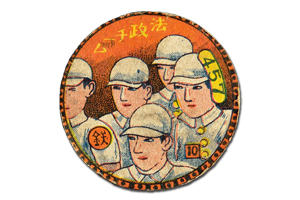
Marumenko with the Hosei Baseball Club
Later, Rikkyo University joined in 1921 and Tokyo Imperial University (now the University of Tokyo) in 1925, giving birth to the current "Tokyo Six University League. In 1926, the Meiji Jingu Baseball Stadium was completed as the exclusive stadium for the Rokugakusei League, and the popularity of university baseball heated up. Incidentally, the first game played at the stadium was between Hosei University and Meiji University, which the University won 4-1.
After joining the league, the team was unable to break through the thick wall of Waseda, Kei, and Ming, and was languishing in the "B" class for a while. However, in 1929, Nobuo Fujita, in his second year of graduation, was appointed manager, and the following year, Tadashi Wakabayashi, who grew up in Hawaii, joined the team. Wakabayashi was the first pitcher in Japan to throw a sinker and knuckleball, and became famous for his "seven-color breaking ball.
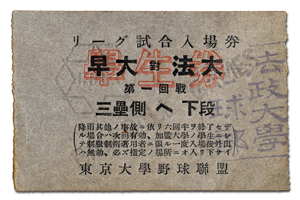
Admission ticket for the Waseda University-Hosei University game in the Six College League (1930s)
The team continued to make rapid progress, winning five league championships under the leadership of manager Nobuo Fujita and his younger brother Shozo Fujita, and entering a period known as the prewar golden era. Nobuo Fujita, who later became known as the "father of the Hosei baseball team," was also a pioneer in introducing cutting-edge theories and tactics from the United States, an advanced baseball nation at the time, to Japanese baseball.
In his search for an authentic baseball instruction book, Fujita had a fateful encounter with Carl L. Lundgren, manager of the University of Illinois baseball team, during a tour of the United States after the team's first league championship. The textbook, written by Lundgren himself, contained detailed explanations of game tactics as well as explanations of practical skills with photographs.
Impressed by the excellence of the book, Fujita published it as "Baseball Reader" with the cooperation of the club members. He also distributed the book to all the players and used it in actual coaching. The American baseball theory that Fujita adopted has remained the foundation of the Hosei Baseball Club to this day.
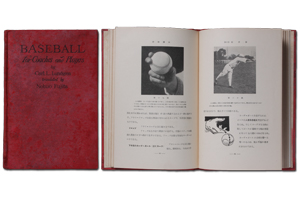
Baseball Reader" by Carl L. Lundgren, translated by Nobuo Fujita (Iwanami Shoten). Contains detailed technical explanations with illustrations and photographs.
Interruption of the Six College League and post-war history
In the days when there were no professional leagues, the Rokugakusei University League games were highly popular among the public, and students cheered each other on in spectacular games at the stadiums. The enthusiasm of the students who cheered for the Hosei Baseball Club is well expressed in the word "Hosei-spiru" (meaning "spirit"), which appears in a cheer song written by the students themselves in 1929.
Due to the intensification of the Pacific War, the Six University League was forced to suspend the league after the 1942 Fall League. During the war, a total of 26 precious lives were lost, including both active baseball players and alumni who went off to war.
However, the long war ended in the spring of 1946, and league games resumed as early as the spring of 1946. Since Jingu Stadium was confiscated by the General Headquarters of the Allied Forces (GHQ), the league initially used both Kamiigusa and Korakuen stadiums, with only one round-robin game, but many spectators flocked to the grounds where the sound of the ball had returned after a long absence.
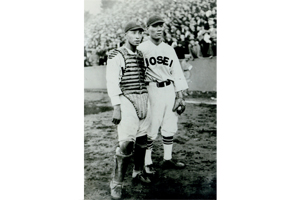
The battery of pitcher Tadashi Wakabayashi and catcher Nobuo Kura, who built the prewar golden era of baseball.
Hosei Baseball Club Alumni Adorn Japanese Baseball History
The Hosei Baseball Hall of Fame has inducted nine Hosei alumni, including Nobuo Fujita and Tadashi Wakabayashi, Hidenosuke Shima, Hisanori Karita, Kazuto Tsuruoka, Junzo Sekine, Rikuo Nemoto, Reiichi Matsunaga, and Koji Yamamoto, the highest honor for a baseball player.
The team also produced professional baseball stars and representatives of the baseball world, such as Koichi Tabuchi, Koji Yamamoto, and Masaru Tomita, who were known as the "Three Crows of Hosei," Masatake Yamanaka, who still holds the record for the most wins in a single season with 48, and Taku Egawa, who was called "the monster. The Rokunin University League is the stage for the Rokugaku Daigaku (Six College) League.
The Hosei Baseball Club has won 44 championships in its 100-year history, second only to Waseda University (including three titles in four straight years), and eight All-Japan University Baseball Championships. The "Hosei spirit," which has been passed down through the generations for a century, is still firmly engraved in the hearts of 21st century baseball players.
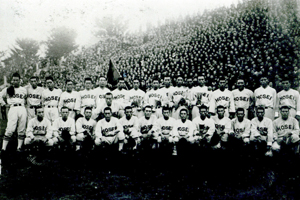
1930 Autumn League Championship, the first in the long-awaited Six University League
The Hosei Baseball Hall of Fame has inducted nine Hosei alumni, including Nobuo Fujita and Tadashi Wakabayashi, Hidenosuke Shima, Hisanori Karita, Kazuto Tsuruoka, Junzo Sekine, Rikuo Nemoto, Reiichi Matsunaga, and Koji Yamamoto, the highest honor for a baseball player.
The team also produced professional baseball stars and representatives of the baseball world, such as Koichi Tabuchi, Koji Yamamoto, and Masaru Tomita, who were known as the "Three Crows of Hosei," Masatake Yamanaka, who still holds the record for the most wins in a single season with 48, and Taku Egawa, who was called "the monster. The Rokunin University League is the stage for the Rokugaku Daigaku (Six College) League.
The Hosei Baseball Club has won 44 championships in its 100-year history, second only to Waseda University (including three titles in four straight years), and eight All-Japan University Baseball Championships. The "Hosei spirit," which has been passed down through the generations for a century, is still firmly engraved in the hearts of 21st century baseball players.
1930 Autumn League Championship, the first in the long-awaited Six University League
-
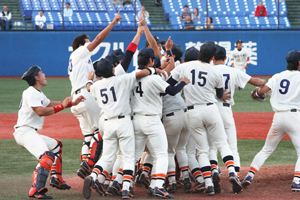
Players rushing to the victory in the autumn league in 2012.
-
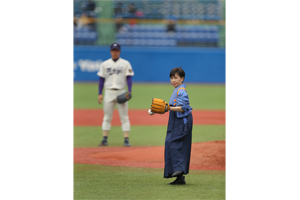
On April 11, 2015, President TANAKA Yuko threw out the first pitch at the opening game of the Spring League. This is the first time in the history of Tokyo Rokugaku University Baseball that a female President has thrown out the first pitch
From January 19, 2016 (Tuesday) to May 31, 2016 (Tuesday), "Exhibition Commemorating the 100th Anniversary of the Hosei University Baseball Club" will be held at the 6th floor exhibition space in the Sotobori Building, Ichigaya Campus.
(First published in the January/February 2015 issue of the public relations magazine "Hosei")
The following links will take you to previous "HOSEI MUSEUM" articles.