

Academic Year 2015
Vol.84 The 67-year history of Hosei University Press, which has published more than 3,000 books
September 17, 2015
Academic Year 2015In December 2013, the total number of books published by Hosei University Press "Sousho, Univercitas" surpassed 1,000.
Hosei University Press was established in 1948 as part of the university's 70th anniversary celebration. The first Trustee was Toyoichiro Nogami, then President of Hosei University and a scholar of English literature and Noh drama. Modeled after the University Press in Europe and the U.S., it was conceived as an institution that would play a role in the expansion of the university, together with correspondence courses that were established to respond to the democratization of education and intellectual thirst immediately after the war, and was started as a project of the Hoyukai Foundation, which was established earlier.
The first publication was "Hiroshima" (translated by Kinichi Ishikawa and Kiyoshi Tanimoto), a well-known record of the A-bomb damage. It is the first reportage work on the A-bomb damage in history by Pulitzer Prize-winning author John Hershey, which realistically depicts the experiences and insights of six A-bomb survivors and made the world aware of the devastation caused by the atomic bombing. The book was a great success, and the publishing house took a step forward as one of the standard-bearers of postwar enlightenment.
In January 1962, the name was changed from Hoyukai to Hosei University Press, and 14 years after its maiden publication, the Hosei University Press Foundation was established. As an independent entity, it began publishing two major series of books.
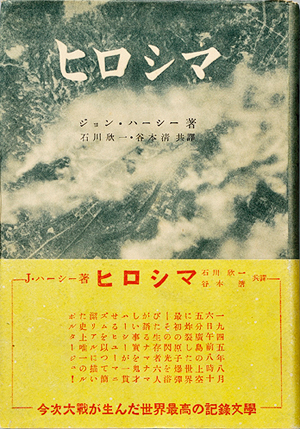
The first edition of Hiroshima. The current expanded edition adds "Hiroshima Afterward," written by the author after revisiting Hiroshima in 1985.
One of these is the "Sosho Univercitas," a series of translations focusing on books of philosophy and thought. The word "Universitas," which is also the origin of the word "university," means universality or the whole world in Latin, and it began with E. Fischer's "Why Art is Necessary" (translated by Toru Kono) in 1967, followed by Bashlar, Wittgenstein, Eliade, Benjamin, Elias, Levinas, Derrida, Deleuze, Habermas, Luhmann, etc. For 47 years, we have continued to introduce the cutting edge of knowledge in the world.
The other is the "Cultural History of Things and People" series, which focuses on various "things" that have formed the basis of Japanese folklore, culture, and history, and looks at specific aspects of people's lives up to the present day.
Hosei University Press is celebrating its 67th year since its founding. Hosei University Press will continue its tradition of comprehensive academic publishing, paying attention to harmony and collaboration in its three divisions of specialized research books, textbooks, and general education books, as well as in the translation and introduction of both original and foreign literature.
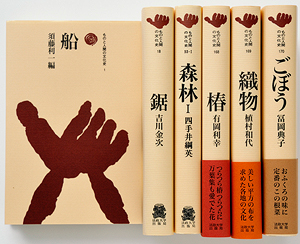
For its entire publishing activities, including "A Cultural History of Things and People," the Publishing Bureau received the 9th Azusa-kai Publishing Culture Award in 1993

Sousho, Univercitas," which counted 1030 items in total as of August 2015.
Interview supported by Hosei University Press
(First published in the August/September 2015 issue of Hosei, a public relations magazine)
The following links will take you to previous "HOSEI MUSEUM" articles.