

Academic Year 2014
Vol.78 Materials related to Tetsuzo Tanikawa, Former President of Hosei University
February 12, 2015
Academic Year 2014Hosei University's Qualification Program held the "Tetsuzo Tanikawa Exhibition" from November 11, 2014 (Tuesday) to January 31, 2003 (Saturday) in the Museum Exhibition Room on the 14th floor of the Boissonade Tower, Ichigaya Campus, displaying his achievements in four main sections: "Hosei University," "Translation, Philosophy and Criticism," "Social Activities," and "Family and Friendships. The following are some of the exhibits that were on display.
Introduced here are some of the related materials that were on display.
Tetsuzo Tanigawa (1895-1989) was born in Tokoname-cho, Chita-gun (now Tokoname-shi), Aichi Prefecture, and attended the Department of Philosophy of Kyoto Imperial University (now Kyoto University) from Daiichi High School, where he studied under Kitaro Nishida.
After graduation, he became a professor in the Department of Philosophy at Kyoto University in 1928, and remained at the university for 38 years until his retirement in 1966. During this time, he also served as Faculty of Letters and Director of the Nohgaku Research Institute, and served as President from 1963 to 1965.
Former President Tetsu Nakamura said, "Tanigawa was the symbol of Hosei University before and after World War II" (see "The Person and Thought of Professor Tanigawa" in the December 1989 issue of this magazine).
![Tanigawa's head sculpture (by sculptor Hiroatsu Takada [1900-87]) Tanigawa continued his friendship with Takada through the introduction of the poet Toshihiko Katayama. Portrait sculptures of Ouchi Hyōe and Miyazawa Kenji were recommended by Tanigawa (in the collection of the Center for the History of Hōsei University).](https://www.hosei.ac.jp/application/files/1315/7984/0713/150212_01.jpg)
Tanigawa's head sculpture (by sculptor Hiroatsu Takada [1900-87]) Tanigawa continued his friendship with Takada through the introduction of the poet Toshihiko Katayama. Portrait sculptures of Ouchi Hyōe and Miyazawa Kenji were recommended by Tanigawa (in the collection of the Center for the History of Hōsei University).
Known as a philosopher and critic, Tanigawa's critical activities covered a wide range of fields, including literature, art, society, and religion, as well as his research on Kenji Miyazawa.
His activities were also multifaceted, as he served as editor of Shiso (Philosophy), chief editor of Fujin Koron (Women's Public Opinion), and deputy director of the Imperial Household Museum (now the Tokyo National Museum).
He was a close friend of Kitaro Nishida, Shigeo Iwanami, Yoshinari Abe, Tetsuro Watsuji, Toyoichiro Nogami and his wife Yayoko, Kiyoshi Miki and Tatsuo Hayashi, all of whom he studied with at Kyoto University, as well as Naoya Shiga, Takeo Arishima, Hiroyuki Agawa, Muneyoshi Yanagi, and others, and he also enjoyed tea ceremonies with Sankei Hara and Mimian Matsunaga, and also worked with Abe, Watsuji, Kotaro Tanaka and others during his tenure as Deputy Director of the Imperial Household Museum. He was also a tea ceremony host to Hara Sankei and Matsunaga Minaori, as well as to the Emperor during his tenure as deputy director of the Imperial Household Museum.
His eldest son Shuntaro Tanikawa (1931- ) is known as a poet, translator, and picture book author.
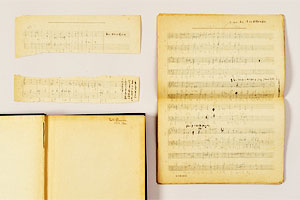
His wife, Takiko, studied at Doshisha Women's School (now Doshisha Women's University), and after graduation continued piano lessons at a music school. Tanigawa met Takiko at a music concert while at Kyoto Imperial University. The photo shows "A manual of harmony," a Western book with "TakiOsada (maiden name)" on the back cover, and the sheet music that was inserted in the book. The book has writing that appears to be in Takiko's own hand (Hosei University Library).
In his later years, when he was selected as a person of cultural merit, Tanigawa said, "I have only lived my life as a calligrapher in accordance with Dogen's legacy of 'Shusho-Innyo,'" and remained vigorous until the day before he passed away, getting his hair done at a barber store, serving as chairman of the steering committee at a traditional Japanese craft exhibition, reading and enjoying television until late at night. After reading and watching TV until late into the night, he went into eternal sleep.
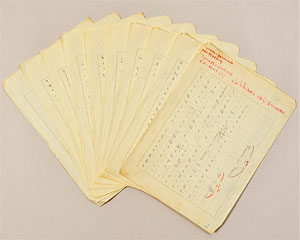
Tanigawa was also known as a pacifist and was an enthusiastic advocate of the World Federation Movement. The photo shows his autograph manuscript (in the collection of the Hosei University History Center) in which he wrote his impressions about the holding of the "Pacem in Terris" conference and its coverage.

The TSU library houses the Tetsuzo Tanigawa Collection, a collection of 1,042 foreign books mainly on German philosophy. The book shows detailed writings. Both from the Tetsuzo Tanigawa Collection.
(Interviewed by Naoto Fujita, Lecturer in Hosei University's Qualification Program and Concurrent Lecturer in the Faculty of Lifelong Learning and Career Studies)
(First published in the December 2014 issue of Hosei, a public relations magazine)
The following links will take you to previous "HOSEI MUSEUM" articles.