

Academic Year 2013
Vol.62 Mysterious Additions to "Ezo-shima Kikan" - A Manuscript Conveying Ainu Culture from 200 Years Ago
July 11, 2013
Academic Year 2013
The map of exotic figures on the front end of Book A is not related to the original, and may have been supplemented from "Nihon bussyo banzai kura"? The map of Ezo on the left is of the Kato Kyogo type and differs significantly from Murakami's "Map of the Ezo Islands. It is noteworthy that "Karafuto Shima Ichina Kitaizochi" is written on the map.
Ezo-shima kikan" is known as a document that faithfully depicts the customs of the Ainu people of the time by Murakami Shimanojo (Hata Bokumaru, 1760-1808), an official of the Edo shogunate. Murakami was a member of the Shogunate's Ezochi exploration team that visited Hokkaido, Kunashiri, and Etorofu several times starting in 1798.
The Kansei period was a time of heightened security in the north against the threat of Russia, and although various information regarding the Ainu came in, most of it was treated only as curiosity. Murakami and his colleagues carefully observed Ainu life and wrote "Kikan Ezo" and "Ezo kanbunki" based on the belief that the Ainu retained the ancient form of the Japanese people and that their study was very important for understanding Japan itself. Rinzo Mamiya, known for his work on the map of Ezo including Sakhalin, was one of Murakami's students, and it is said that he became interested in geography and surveying when he worked for Murakami as a boy.
The International Research Institute of Japanese Studies (IRIJS) at TUFS is unique in its research on northern history, and together with the Okinawa Institute of Culture at TUFS, has made great achievements in the study of the bordering areas from the perspective of different cultures within Japan. The International Research Institute of Japanese Studies has two manuscripts of "Kikan Ezo-shima" in its collection, known as Hon A and Hon B. Hon A omits some parts of the original, while Hon B is a copy of the original.
Book A is an abridged version that omits some parts of the original, while Book B is a complete copy that is faithful to the original. The problem is that Book A, which is an abridged version, is not only an abridged version of the original, but also contains additions that seem to indicate that the author has done considerable research on the Ainu and intentionally rewritten the original, such as filling in missing parts or expressing a different view than the original (see photo description).
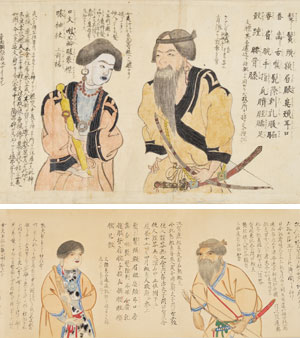
Book A (above) and Book B depict Ainu chiefs. Book B has no particular explanation, but Book A clearly states that it is a portrait of the famous Kunashirian Ainu chief Ikorikayani, "Barbarian Name Ikorikayani Portrait Nari, Chief (Wotona) Tokii, Third Son." How the author of Book A learned this is unknown.
However, it is currently unknown who the author of Book A was and how he acquired this knowledge. This is because neither Book A nor Book B contain the author's name or date, and no other manuscripts similar to Book A have been found.
The study of "Ezo Shima Kikan" has not been very active, partly because there are few researchers. However, as the most faithful pictorial material on the Ainu people, it deserves greater recognition, and future research on the enigmatic Book A, with its additions and corrections, is expected.
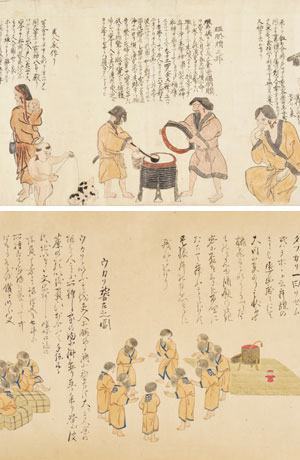
Book A (above) depicts a scene of sake brewing. In Book B (bottom), the corresponding scene is of a dance called tafkari (rimse).
Interviewed by: OGUCHI Masashi, Professor, Department of History, Faculty of Letters, and Concurrent Research Fellow, International Research Institute of Japanese Studies
Reference: "A Study of Ainu Pictorial History," Toshikazu Sasaki (Professor, Center for Ainu and Indigenous Studies, Hokkaido University; M.A. in Japanese History, Graduate School of Humanities, Hosei University). (Professor, Center for Ainu and Indigenous Studies, Hokkaido University; M.A. in Japanese History, Graduate School of Humanities, Hosei University)
The following links will take you to previous "HOSEI MUSEUM" articles.