

Academic Year 2013
Vol.61 Genji Pictures in the Shiki Collection (Early Summer) - Rural Genji and the Tale of Ise
June 06, 2013
Academic Year 2013
This is a series of six large-format nishiki-e prints by Utagawa Kuniyoshi, consisting of "Karanazorae Funasobi" (a series of three prints on the right) and "Bijinniwa-asobi" (a series of three prints on the left) [both published by Sumiyoshiya Masagoro, 1847 - 1852]. The "Bijinniwa-asobi" (Beautiful Garden Play) is decorated with kakitsubata and yatsuhashi (bridge), as in the above painting. Huihan Funafunasobi" is based on a scene in one of the 34 stories of "Minamurashi-naka Genji," in which the koshimoto of the autumn mansion, invited by Mitsuji, arrive in a small boat in the Tang (Chinese) style. Kuniyoshi also added the scene in the upper left corner of the painting, in which Mitsuji is looking at the boat from the spring house. The Chinese costumes of the boat and the rowers reflect the Chinese taste of the time.
This is a series of six large-format nishiki-e prints by Utagawa Kuniyoshi, consisting of "Karanazorae Funasobi" (right) and "Bijinniwa-asobi" (left) [both published by Sumiyoshiya Masagoro, 1847 - 1852]. The "Bijinniwa-asobi" (Beautiful Garden Play) is decorated with kakitsubata and yatsuhashi (bridge), as in the above painting. Huihan Funasobi is based on a scene in the 34th episode of "Tebashi-naka Genji," in which the koshimoto of the autumn mansion invited by Mitsuji arrive in a small boat in the Tang (Chinese) style. Kuniyoshi also added the scene in the upper left corner of the painting, in which Mitsuji is looking at the boat from the spring house. The Chinese costumes of the boat and the rowers reflect the Chinese taste of the time.
The late-Edo period playwright Tanehiko Yanagitei's combined volume of "Minamurasaki ni Okanai Genji" (The Country Genji), combined with the illustrations by Toyokuni Utagawa III (Kunisada I), became very popular among the general public. The illustrations were further transformed into gorgeous multicolor nishiki-e (ukiyoe) prints for sale, which were popularly called "Genji-e" (Genji pictures). In addition to Toyokuni himself, many other artists, including Kuniyoshi, Kunishu, and Hotei, created Genjie pictures, and the depicted kimonos, tools, and even the shape of the topknots became popular among the common people.
In the Shiki Bunko collection in the TUFS library, there are books containing Genji-e paintings by Toyokuni, Kuniyoshi, and others, which show exquisite and vivid nishiki-e with a sense of the season. Nishiki-e, which use vegetable pigments, tend to fade when exposed to air and light, but fortunately, this bound book has been preserved in very good condition. When we look through the early summer paintings, we find a distinctive background depicting kakitsubata (potherb mustard) blooming on alternating bridges.
The bridges are called "Yatsuhashi" (eight bridges), and if you add kakitsubata to the bridges, people of that time would immediately recognize it as "The Tale of Ise". The story is based solely on the motif of the tale in which the hero, who is likened to Urahara no Narihira, composes a poem while gazing at kakitsubata flowers at a place called "Yatsuhashi," a place with eight bridges across a river in Mikawa Province (eastern Aichi Prefecture) on his way down to the eastern part of Japan. At that time, the classics were Ise and Genji. The combination of the two, which are close in image, as the main characters are a beautiful aristocrat and a nobleman, to create a more fantastical world, shows the generosity of the Edo common people's culture.
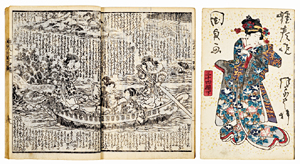
Cover and illustrations (painted by Toyokuni) of the 34th volume of Tanehiko Yanagitei's "Minamurashi-naka Genji". The illustrations were sold as the vivid nishikie shown below

Toyokuni Utagawa III (Kunisada I) produced a series of three large-format nishiki-e prints entitled "Four Seasons in Spring: A Tour of the Garden" (Enshuya Hikobei, 1847-1852). The left panel depicts Ashikaga Mitsuhito, the hero of the story, in a garden modeled after the ninth section of Ise Monogatari (The Tale of Ise), with a group of koshimoto (female courtiers) holding tobacco trays and swords (left). Kahoyohana" is said to be the old name for kakitsubata, and this scene is similar to the one above. The two koshigoto (female courtesans) on either side of the hero, Mitsuji, who is wearing a distinctive ebichasen topknot, are dramatically depicted as if in a theatrical painting.
Interviewed by KOBAYASHI Fumiko, Associate Professor, Faculty of Letters
The following links will take you to previous "HOSEI MUSEUM" articles.