

~Re-evaluating Dr. Boissonade's Achievements: The History of Hosei University
Dr. Boissonade supported the pioneering period of the university. The busts of Dr. Boissonade are now located on the 1st and 26th floors of the Boissonade Tower.
The original bust was created 77 years ago in France.
Why was the original bust made at this time and place?
By looking back at the secret story of the creation of the bust and the history of the Boissonade, we will discover how Dr. Boissonade's achievements have been received by future generations.
1. introduction
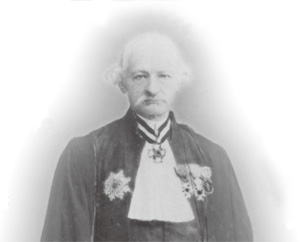
Emile Boissonade de Fontarraby was born in Vincennes, France in 1825. After teaching at the Universities of Grenoble and Paris, he was invited by the Meiji government as a legal advisor and came to Japan in 1873. He is known as the "father of modern Japanese law" for his achievements in laying the foundations of modern Japanese law, including the Civil Code and Penal Code, and he also devoted himself to legal education in Japan, teaching at the Law School of the Ministry of Justice and supporting the Tokyo Law School, the forerunner of our university, in its early years as its first vice president. After spending 22 years in Japan, he returned to Japan in 1895. In 1910, he passed away in Antibes, southern France.
Dr. Boissonade was a true "benefactor of the pioneering period" for the University. His bust is now placed in the Sky Hall on the 26th floor of the Boissonade Tower. However, it may be less well known that busts made from the same prototype still stand at the Supreme Court of Justice and the University of Paris.
The original bust was created in 1934, 25 years after Boissonade's death, on the eve of World War II. Since then, the world has experienced a turbulent history, including the outbreak of World War II, the start of the Cold War after its conclusion, and Japan's wartime turmoil and defeat in the war, followed by rapid economic growth and the intensification of student movements.
This bust of Boissonade has also been deeply involved with such "history. From its birth to the present, what meaning have people found in the bust of Dr. Boissonade and what wishes have been entrusted to it in the social conditions of each era? We will examine the 77 years that the bust has traced and the "thoughts" of the people involved.
The Lost "First" Bust
In fact, the bust modeled after Boissonade is not the first one owned by the University. First, let us introduce the first bust of Boissonade that existed "before" the bust at the University.
Following the news of Boissonade's death on June 27, 1910, the "Dr. Boissonade Memorial Construction Association" was established at Meiji University in November of the same year by Kuninori Kada, Shiro Isobe, Toyozo Takagi, Shogo Kurizuka, Tatsuo Kishimoto, and others who were students of Boissonade and close friends. With the funds raised, the association commissioned Kozaburo Takeishi, an up-and-coming sculptor who had returned from Belgium, to create a bust of Dr. Boissonade. Takeishi created a bust of Boissonade based on a photograph. The completed bust was installed at the Tokyo District Court on May 27, 1913, but unfortunately was destroyed by fire in the Great Kanto Earthquake of September 1923. Although the bust cannot be seen today, a rare photograph of the bust survives in a newspaper article from that time.
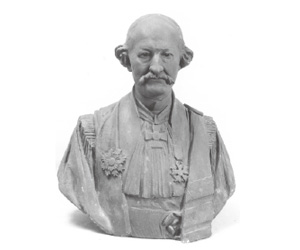
The original bust made by Beneteau, owned by the University. It is assumed to be based on the photo on the lower right, which was found among Boissonade's belongings.

(Left) A scene from the bust unveiling ceremony held at the University of Paris on June 27, 1934. (Right) A photo from the Tokyo Asahi Shimbun dated June 16, 1913, which reported the installation of the bust of Boissonade at the Tokyo District Court.
3. the "Professor Boissonade Memorial Project" by Japanese in France
We will now look back on the circumstances that led to the creation of the bust of the University.
In April 1934, just before the 25th anniversary of Boissonade's death, Naojiro Sugiyama (a professor at Tokyo Imperial University), Wataru Narahashi (a lawyer who later served as Secretary General of the Cabinet and Minister of Transportation), Matakazu Kido (a special correspondent of the Osaka Mainichi and Tokyo Nichinichi Shimbun (now Mainichi Newspapers)), and others were in Paris. The "Professor Boissonade Memorial Project" was launched in Paris in April 1934, just before the 25th anniversary of Boissonade's death, under the initiative of Japanese living in France, including Naojiro Sugiyama (professor at Tokyo Imperial University), Wataru Narahashi (lawyer who later served as chief cabinet secretary and minister of transportation), and Matakazu Kido (correspondent for the Osaka Mainichi and Tokyo Nichinichi Shimbun (now the Mainichi Newspapers)), with the support of French Ambassador Naotake Sato and Edgar Alix, president of the Paris Law School. In Japan, a committee of promoters was immediately established, led by Foreign Minister Hiroki Hirota and Justice Minister Matsukichi Koyama (later President of the University), with the participation of ministries and agencies, universities related to Boissonade such as Hosei, Tokyo University, and Meiji University, the Japan-France Society, the Maison Franco-Japonaise, the Osaka Mainichi and Tokyo Nichinichi Shimbun, and others.
In response to these activities in Japan, a "Committee for the Unveiling Ceremony of the Bust of Professor Boissonade" was established in Paris, led by Ambassador Sato, President Alix Alix, and Professor Henri Capitain, and the committee commissioned Felix Benneteau, a sculptor active in France at the time, to create the bust. Felix Benneteau, who was active in France at the time. Benneteau created a prototype and a bust to be installed at the University of Paris, and the unveiling ceremony was held on June 27, 1934, in the grand hallway of the University of Paris, attended by about 300 people from Japan and France. At the unveiling ceremony, Ambassador Sato donated the bust in the name of the Japanese sponsoring committee. In addition, a speech was made by French and Japanese professors in honor of Boissonade's achievements. The bust still stands today in the corridor of the University of Paris, as it was when it was first installed.
The remaining donation was used for the preservation and repair of Boissonade's cemetery in Antibes.
4. the thoughts of the Japanese in France behind the busts 5. the spirit of the university
Kido, one of the founders of the project and a correspondent for the Osaka Mainichi and Tokyo Nichinichi Shimbun (and later director of the University of Tokyo Newspaper Research Institute), who was in charge of publicity for the commemorative project, said at a roundtable discussion with Professor Yoshikawa and others that "Boissonade, who had been somewhat forgotten at one time, has been reexplored and this commemorative project has been realized. The reason why this commemorative project was realized is due to the great efforts of the initiators, Professor Sugiyama of the University of Tokyo and Professor Capitain of the University of Paris.
Sugiyama was a member of Masaaki Tomii (who, like Kenjiro Ume, was one of the three doctors who drafted the Civil Code. He was a favorite disciple of Masaaki Tomii (who, along with Kenjiro Ume, was one of the three doctors who drafted the Civil Code and supported the University during its Japanese-French law school period and served as vice president of Hosei University), who is known as an authority on comparative law and French law. Sugiyama had a close relationship with TUFS for more than 10 years since he was a graduate student, lecturing on civil law at TUFS, and he regarded Boissonade as "a jurist of Western genius and Japanese spirit" and "a great benefactor of modern Japanese culture. Sugiyama was in Paris at the time as an exchange professor with the University of Paris, and in Paris, from November 1933, he "gave a series of lectures on the history of Meiji civil government and received a very warm reception from the French academic community" (Tokyo Asahi Shimbun, November 25, 1934). It is assumed that he introduced Boissonade's contribution to modern Japan in his speech.
Kido himself said that he heard about Boissonade from Sugiyama and decided to participate in the commemorative project. He also says that Sugiyama's mentor from his days in France, Professor Capitain (University of Paris), was the one who supported Sugiyama on the French side.
Although Kido's testimony above is considered correct as a direct reason for the initiation of the commemorative project, the question remains as to why Narahashi Wataru, the other initiator following Sugiyama and Kido, joined the project, and why the project was initiated not in Japan but by a Japanese resident in France. The question remains as to why the project was initiated by a Japanese resident in France and not in Japan.
Narahashi is famous as a major politician who even served as Minister of Transportation after the war, but at that time he was a young lawyer who came to France because of his admiration for French liberal thinkers such as Voltaire and Rousseau. After studying at the University of Lyon, he went on to a doctoral program at the University of Paris, where he was also an advisor to the City of Tokyo, which was involved in litigation with France, because of his knowledge and insight into French law.
In Narahashi's autobiography and biography, there is no reference to the commemorative project, but there is a description that he started an activity called "National Disaster Defeat League" in September 1933, the year before the commemorative project ("Narahashi Wataru Den", 1982). At the time, there was a growing concern among Japanese living in France, many of whom were liberal cultural figures and intellectuals, that Japan's international isolation would be deepened by its withdrawal from the League of Nations in March 1933. Kuninosuke Matsuo (a correspondent for the Yomiuri Shimbun) and other comrades gathered together and developed a peace movement.
In his autobiography, "Tales of Paris," Matsuo, a member of the association, wrote in late 1934 that he and Narahashi, Sakamoto, and others "agreed to strive for the realization of goodwill between Japan and France and, if possible, to form a cultural union between Japan and France, and, on the other hand, to spur diplomacy to approach Britain economically in order to prevent Japan, Germany, and Italy from approaching (*1). As a first step, they formed the "Japan-France Comrades Association. Although the name "Alliance to Overthrow the National Disaster" does not appear in the book, its philosophy and participating members are identical, which leads us to assume that the "Franco-Japanese comradeship association" described by Matsuo is the same activity as the "Alliance to Overthrow the National Disaster," or its successor.
To understand Narahashi's participation in the Boissonade Memorial Project, we should take into account that he was not only a legal expert, but also that there were a series of activities by Japanese living in France who were concerned about their mother country's isolation in the international community and its slide toward imperialism, and who wanted to turn things around by deepening the goodwill between Japan and France. The Japanese living in France, who were concerned about the crisis in their mother country, which was running on imperialist principles, tried to turn things around by deepening the goodwill between Japan and France. Dr. Boissonade, "a great benefactor of modern Japanese culture," was the most appropriate person to symbolize the Japanese living in France who were aiming for a strong "goodwill between Japan and France.
The original bust was then delivered to the Tokyo Committee for the Promotion of the French Revolution, and Matsukichi Koyama, one of the key members of the Japanese Committee for the Promotion of the French Revolution, donated it to TUAT, where he was serving as President. This is the prototype of the bust that is still preserved at the University today. Later, a bust based on this prototype was installed in the entrance hall of the Grand Chamber of Justice (present-day Supreme Court) (date unknown), but it was destroyed by fire in an air raid on Tokyo in March 1945.

Hyoue Ouchi, his granddaughter Mariko (on the right), and French Ambassador Levy (on the left) attend the unveiling ceremony of the bust at the University on December 21, 1953.

(Left) Boissonade's tombstone in Antibes, southern France, to which a new circular relief was added in 1979 at the initiative of then President Tetsu Nakamura as part of the 100th anniversary of the founding of the University (Right) Enlarged relief. (Right) Enlarged view of the relief, created by sculptor Tsuneo Nishi, Professor of Tama Art University, with the inscription in French: "Donor of this relief in honor of Dr. Boissonade, benefactor of Hosei University (founded in 1880 in Tokyo), Hosei University, 1979.
5. the spirit of the founding of the university: the construction of the bust at the university for the reconstruction of the university
The "Dr. Boissonade Commemorative Association" was founded by Dr. Hyoue Ouchi, President of the University, Mr. Kotaro Tanaka, Chief Justice of the Supreme Court, and Mr. Soumei Uzawa, President of Meiji University. It was eight years after the end of World War II and about a year and a half after the conclusion of the San Francisco Peace Treaty, when Japan, having overcome defeat at an astonishing speed, was already about to enter a period of rapid economic growth. The reconstruction of the new campus was underway, and the 53rd Building (the former graduate school building) was completed as a first step. Based on the prototype that had been in the University's custody, the commemorative association created two busts, one to reconstruct the bust of the Supreme Court that had been destroyed by fire, and the other to install in the courtyard of the new 53rd building of the University. In addition to the busts, the University also created a marble pedestal with an inscription to accompany the busts.
On the morning of December 21, 1953, the bust unveiling ceremony was held at the Supreme Court in the presence of President Ouchi, Chief Justice Tanaka, President Uzawa, French Ambassador Daniel Levy, President de la Morandiere of the Paris Law School, and Prime Minister Shigeru Yoshida. On the afternoon of the same day, a similar unveiling ceremony was held at Hosei University with almost the same members. At the unveiling ceremony at Hosei University, President Ouchi said, "Hosei University is in the process of rebuilding itself in many ways after having suffered so much damage in the war. Needless to say, we must first of all greatly rekindle the spirit of academic freedom and love for truth that existed in the past. In this sense, we must also restore the founding spirit of Dr. Boissonade," he said, explaining the significance of the bust. In 1937, when President Ouchi was a professor at Tokyo Imperial University, he was arrested in the "People's Front Incident" (*2) along with many other professors, including Hiromi Arisawa, who later became President of the University (acquitted in September 1944), for violating the Security Law. (*2) This was truly a case of oppression in which the "spirit of freedom and love for truth in learning" in this statement was trampled upon by state power. As the movement to remove President Ouchi from his professorship gained momentum within Todai because of this incident, one of the "Todai liberalists" who "resisted" the movement was Secretary Tanaka, who was then a professor in the Faculty of Law at Todai.
It is deeply moving to know that he was present at the unveiling ceremony and watched President Ouchi's speech, considering their close relationship. The "spirit of freedom in learning and love for truth," which President Ouchi describes as "the founding spirit of the school by Dr. Boissonade," must have been something that both of them, who shared such wartime experiences, were eager to "restore. The placement of the bust of Boissonade in the center of the courtyard of the newly completed school building, the most prominent location on campus at the time, was an act of symbolically expressing that the "reconstruction" of the University after the war would begin with the "reconstruction" of Boissonade's "founding spirit" first.
President Ouchi is credited with "restoring" the university after the war and laying the foundation for the postwar period, but it goes without saying that this "restoration" was not only in the physical aspect of campus reconstruction, but also in the ideological and spiritual aspects.
From the 1960s to the present
In the late 1960s, a storm of school conflicts raged throughout Japan. In 1969, during this time, the University's Boissonade bust was also damaged.
President Tetsu Nakamura declared that the bust would be reconstructed by the centennial of Boissonade's visit to Japan in 1973, and on November 15, 1973, at the "Boissonade Centennial Lecture," the bust was successfully restored and placed in the courtyard of the 53rd year building as it was before.
In September 1992, with the demolition of the 53rd Building, the bust was moved to the courtyard of the 80th Building, but in 2002, it was installed in the Sky Hall on the 26th floor of the Boissonade Tower, a new school building named after Dr. Boissonade, along with a newly created wooden pedestal.
The marble pedestal made in 1953 along with the original bust is currently kept at the Tama Campus, along with the original bust, and new ways of using it are being considered.
1 Six years later, in 1940, the Tripartite Pact was concluded. The following year, in 1941, the Pacific War broke out with the Japanese attack on Pearl Harbor.
2 The People's Front Incident: In 1937, the Security Law expanded the scope of suppression to include not only the Japanese Communist Party, but also the Marxists (labor-farmers) and social democrats, who had previously been legal entities. In 1937, the Japanese Communist Party (JCP), which had previously existed legally, expanded the scope of its suppression to include not only the JCP but also Marxists (labor-farmers) and social democrats, and even university professors were rounded up for "plotting to form a Popular Front in response to the call of the Comintern.
- Dr. Boissonade and the Academic Culture of "Freedom and Progress
- Vol.34 Exhibit materials for the exhibition commemorating the 100th anniversary of Boissonade and Kenjiro Ume's death: Boissonade's graduation certificate and Masatoshi Hori's written notes of his lectures
- Unveiling ceremony of the bust of Dr. Boissonade
The following links will take you to previous "HOSEI MUSEUM" articles.