

Academic Year 2012
Vol.48 Hosei University Tama Campus Library's "Baseball Reader" and the First Golden Age of the Hosei University Baseball Club
May 24, 2012
Academic Year 2012The "Baseball Reader" and the First Golden Era of the Hosei University Baseball Club
Hosei University's baseball team has won the Tokyo Rokko Daigaku Baseball Championship 43 times, the most of any university in history. The first championship was won in 1930, in the 16th year of the club's foundation.
The year after the first victory, the team made a trip to the United States. During the tour, the team played games against local university baseball teams and semi-professional teams, and after watching a Major League Baseball game, the team gained many valuable experiences, including a meeting with Babe Ruth, who was called the God of Baseball. One of the most important of these experiences was an encounter with Carl L. Lundgren, manager of the University of Illinois baseball team. Nobuo Fujita, who was looking for a good instructional book to further improve his baseball team, was given a textbook written by Lundgren. It was used by the University of Illinois baseball team for summer training, and it covered not only technical explanations but also game tactics. After returning to Japan, Fujita translated and edited the textbook with the cooperation of the club members, and published it as "Yakyu Yomihon" (Baseball Reader) from Iwanami Shoten (reprinted by Hosei University Press in 1950 and 1953), and distributed it to all club members. The book was reprinted by Hosei University Press in 1950 and 1953, and was distributed to all club members.

In 1930, Hosei won its first Tokyo Rokugakusei Baseball championship. The following year, the team won a second championship, marking the beginning of the golden age of baseball in the early Showa period.
The baseball "Yakyu Yomihon" in the University's collection bears the autographs of all the members of the team that participated in the U.S. tour. One of the autographs is that of Tadashi Wakabayashi, who was instrumental in the first golden age of the baseball team. Wakabayashi, a second-generation Japanese-American born in Hawaii, was the fourth-highest winning pitcher in the history of Tokyo Rokugaku University baseball, with 43 wins, and led the team to three championships during his tenure at the university. After turning pro, he continued to play for the Hanshin and Mainichi teams, winning a total of 237 games, and became the first baseball player from the University to be inducted into the Baseball Hall of Fame. In addition to Wakabayashi, other inductees into the Baseball Hall of Fame include Hisanori Karita, who became famous as a defensive specialist, and Hidenosuke Shima, who served as the first umpire general manager of the Central League after retiring from baseball.
In January 2012, a special exhibition titled "Hosei University Sports Exhibition 《Hosei Baseball》" was held at the Museum Exhibition Room on the 14th floor of the Boissonade Tower on the university's Ichigaya Campus, focusing on the baseball team. In addition to "Yakyuu Yomihon" (Baseball Reader), many books, photographs, and related items related to the University's baseball team were displayed, attracting the interest of many visitors.
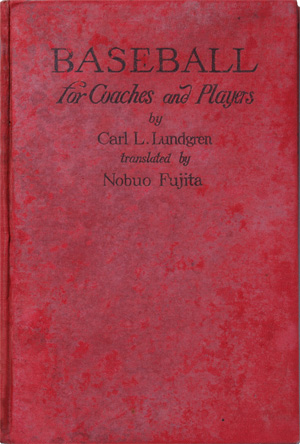
The cover of "The Baseball Reader. It is written in English, "Written by Carl Lundgren and translated by Nobuo Fujita.
-
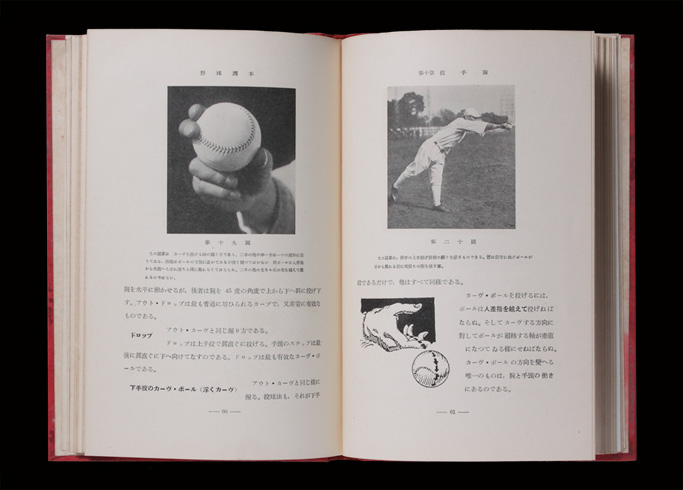
The "Yakyu Yomihon" contains many illustrations and photographs of the club members as models. Wakabayashi served as the model for the pitcher's edition.
-
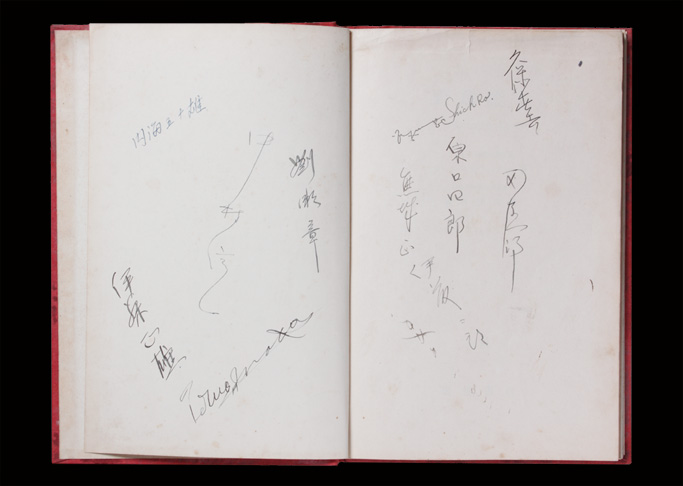
The four blank pages at the end of the book show the autographs of the 21 members who participated in the U.S. tour. Considering that three of the members were inducted into the Baseball Hall of Fame, it was truly a golden era.
The following links will take you to previous "HOSEI MUSEUM" articles.