

FY2011
Vol.38 Hosei University Ohara Institute of Social Studies Collection "Tsukishima Survey" Household Survey Original
February 23, 2012
FY2011 From 1918 to 1920, a large-scale social survey of the residents of Tsukishima, Tokyo, known as the "Tsukishima Survey," was conducted. Officially called the "Field Survey in Tsukishima, Kyobashi Ward, Tokyo," the survey was conducted as an attempt to investigate the state of sanitation in the city, which had not been done before, under the auspices of the Health and Sanitation Investigation Committee established in the Health Bureau of the Ministry of Home Affairs at the time.
The survey was planned and promoted by Iwasaburo Takano (1871-1949, professor at Tokyo Imperial University, social statistician), who became the first director of the Ohara Institute of Social Problems. Gonda Yasunosuke (sociologist and researcher of popular entertainment), Hoshino Tetsuo (medical doctor), Yamana Yoshitsuru (social activist), and others participated in the survey, which was a pioneering attempt at the time to conduct a joint survey by a group of researchers. Takano conducted the survey not as a mere health and hygiene survey, but as a "survey of social life, especially the lives of workers in a large city," which included economic and social research. For these reasons, the "Tsukishima Survey" has gone down in history as the pioneer of empirical urban social surveys in Japan.
The survey was conducted by setting up a survey office in a rented house in the area, where surveyors lived and conducted "(1) a close examination of the housing conditions of residents, especially skilled worker families, (2) a detailed household survey of selected skilled worker families, (3) health examinations of children, especially elementary school children, (4) surveys of births, deaths, and diseases, and (5) other surveys such as educational conditions and entertainment. The results of the survey were published in three reports. The results of the survey have been published in three reports.
The original "household account book" used for the survey of skilled worker families is in the collection of the Ohara Institute of Social Problems at Hosei University. The original one family book contains detailed information on daily income and expenses during the period of the survey. In this sense, it is an extremely valuable resource.
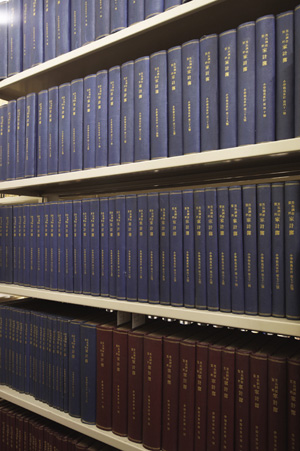
The original "household account book" of one family per book. The brown cover below shows the original household account book of the "Survey of Elementary School Teachers' Household Economy in and around Tokyo" conducted at the same time.

The household account book contains detailed entries of income and expenditures, such as "8 sen for children," "5 sen for fish and mezashi," and "3 yen for clothes," and is valuable for understanding the prices of things at the time.

On the left is a portrait of Takano Iwasaburo. He served as director of the Ohara Institute of Social Problems until his death, and in 1946 he became the fifth chairman of the Japan Broadcasting Corporation (NHK). Four of the researchers other than Takano, including Gonda Yasunosuke, Yamana Yoshitsuru, and research assistants, later became members of the Ohara Institute of Social Problems. At right is the three-volume report of the "Tsukishima Survey.

The report includes many photographs. On the left is the research office and dormitory (rented house) and the researchers. On the right is a view of the inside of the machine factory at that time.
The following links will take you to previous "HOSEI MUSEUM" articles.