

FY2011
Vol.36 Hosei University Library Materials Hige Ichiro "Kite" Collection
February 09, 2012
FY2011 In July 2010, the kite collection of the late Ichiro Hige (1922-2003), a leading researcher and collector of Japanese and international kites, was donated to Hosei University by his family. A part of the collection was open to the public from July 6 to August 5 of the same year in the museum exhibition room of the Boissonade Tower, and a ceremony to thank the donation was held on July 20, inviting Mr. Hige's wife, Etsuko, and his family.
The collection consists of 2,690 items: 1,995 kites (molded or assembled kits), 532 kite paintings (kite pictures, prints, calligraphy, drafts, etc.), and 163 related tools and equipment (beanbags, kite shop miniatures, documents, etc.). Mr. Hige began his research and study of kites in earnest in the mid-1960s, but his activities were not limited to collecting and researching kites. In 1969, he was invited to the exhibition by Mr. Shingo Motegi (1911-1978), founder of the Western restaurant Taimeiken, and Mr. Yusaku Tawara (1964), well-known doll toy and pottery enthusiast and editor of "Kites of Japan" (Bijutsu Publishing Co., Ltd., 1964). In the 1970s, he conducted field research in India, China, Korea, Europe, the U.S., and Pacific Rim countries in addition to his duties as president.
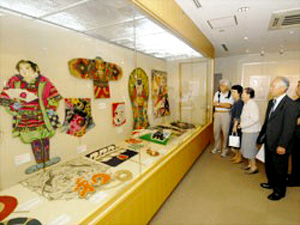
A view of the exhibition "Kites: Hosei University's Ichiro Hige Collection.
There is a theory that kites came from Micronesia as well as China. Hige explains that kites spread rapidly at the end of the Edo period (1603-1868) in conjunction with improvements in Japanese paper. As Shiko Munakata, whose kite paintings in his hometown of Aomori are said to be the origin of his prints, described "Japan, the land of kites," Japanese kites were connected to local annual events and became more diverse and colorful than in any other country. The collection includes works inherited from Yusaku Tawara, who was a close friend of Shiko Munakata. The collection also includes many historical materials that can be dated and artist-identified, making the Hige Collection one of the world's leading kite collections in terms of both quality and quantity.

Sake-buying boy" by Teizo Hashimoto, under whom Mr. Hige studied. This large kite, 143 x 86 cm, was made in the mid-Showa period. In addition to the vivid kite painting, the reverse side of the kite shows the unique handiwork of a kite maker, with thinly sliced Japanese paper wrapped in an even width around a bamboo framework.

One of the oldest kites in the collection is the "Edo Nukite (Edo Koki-ban)," which is thought to have been made before the Meiji period (1868-1912). On the handle of the sword, there is a mark "Yama ni Tadashi," which is thought to be the trade name of the publisher.

A "leaf kite" from Sonsor Island in the Republic of Palau, which is thought to be one of the origins of kites. It is a "fishing kite" used for fishing, and its leaf measures 107.9 x 51.0 cm. (left) Kakugumi kite (cloud dragon) made by Mr. Hige himself in his later years, and a string roll (thread, square rotary type, artist unknown) from his collection of related tools (right)
The following links will take you to previous "HOSEI MUSEUM" articles.