

FY2011
Vol.28 Hosei University Library Haiku Haiku by Masaoka Shiki: Draft of the second volume of "Shia-kurare-no-ki" (Haiku by Masaoka Shiki)
December 01, 2011
FY2011 Masaoka Shiki (1867-1902) was a leading haiku poet and poet of the Meiji era and one of the main characters in the NHK special drama "Saka no ue no kumo. Shiki's library collection is now housed in the University Library as "Shiki Bunko.
The Shiki Collection was donated to TUMSAT in 1949 through Samukawa Sokotsu (1874-1954), who kept Shiki's belongings at the Shiki Hermitage in Negishi, Tokyo, where Shiki spent 10 years of his short 35-year life until his death from illness. After studying under Shiki, who was from the same hometown, and taking care of Shiki on his deathbed, Sukotsu became the owner of the Shiki Hermitage and protected the collection from the fires of World War II. He later compiled the complete works of Shiki three times.
The Shiki Collection consists of more than 2,000 Japanese, Chinese, and Western books, including his most important haiku works, as well as his own notebooks from his student days and the only three Chinese books in the world.

<Reading of Haiku Writings
The numbers are in the order of writing (from right to left). ○ indicates haiku included in "Kanzan Ochiki", ・ indicates haiku erased from the same book, and △ indicates similar haiku. 2, 4, 5, and 14 are partially illegible.
1. "There is no mat on the famous moon or on the lake water.
3. a boat in the moonlight or lake water
6. my boat ha moving water, moon over
7. Crushed by the sea and the moon's shadow.
8. the moon on the water that makes my hand hiyari (mama)
9. How the moon looks
10. The moon over the pine trees, how often its appearance changes.
11. The fires have gone out in all directions and the moon is alone on the lake.
12. The moon is reflected in the waves one by one
13. The moon flows from Seta to Zessho.
15. The moon is high in the sky.
The moon is higher than Omi Fuji in the sky.
16. The sea and the mountains are one and the same
17. One mountain and seven small towns of eight sceneries
18. "I'm going to stay at my inn, the moon is rising" (Izuru Tsuki)
In 1981, when Shiki researcher Katsuji Wada, professor emeritus at Osaka Seikei Women's Junior College, conducted a survey of the Shiki Collection, he found haiku written in purple pencil on the back cover of "One Hundred Kosho" in the collection. According to Professor Wada, these haiku were written before Shiki began writing haiku, and were written when he visited Otsu on August 27, 1890 (Meiji 23) and went to Shiga and Kinsaki on the evening of August 29 to see the moon in a small boat. The haiku were written in a flurry of writing, as if to convey the excitement of creation," wrote Professor Wada in his "Shiki Bunko" investigation report.
Shiki also wrote a letter to Natsume Soseki describing his moon-viewing experience, and included phrases 7, 8, and 3.
Professor Wada notes that the written haiku were the basis of the travelogue "Shia-kurare-no-ki," the second volume of which is the original material for the haiku manuscript "Kanzan Ochiki," and that the existence of the draft as a writing on the back cover of "Kosaku Hyakugane" was completely unknown until then. There is no doubt that this is a valuable resource for the study of Masaoka Shiki.
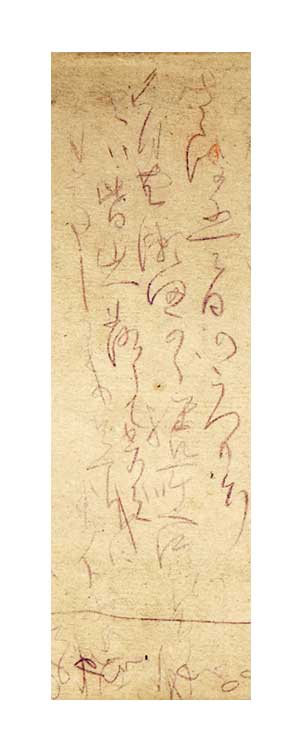
Enlarged versions of parts 12, 13, and 14 of the writing
In the first volume of "Shiyakurenoki," there is a sentence that reads, "Shiyakure means to draw silk threads by hand intermittently (tsuzukezama)," which describes Shiki's three trips to famous places such as Mt. Shyakurare no Ki" is a record of three trips he made to scenic spots such as Kuma-yama and Otsu. Shiki was 23 years old at the time. The year before, he had been diagnosed with tuberculosis and had changed his name to "Shikki" in reference to a cuckoo cuckoo, which is said to chirp until it coughs up blood.
- Reference: Katsuji Wada, "'Shiki Bunko' Chosa Kou [Survey of the Shiki Bunko]" (June 1991, Hosei University Collection Guide/Hosei University Library, ed.

The "One Hundred Kosho" is a booklet measuring 186 mm (H) x 124 mm (W) and contains novels and other works in an omnibus format. There are two issues in the "Shiki Bunko" collection, No. 1 (photo left: no publication date) and No. 2 (photo right: November 18, 1889), and a haiku is written on the back cover of No. 1. In the "Shiki Bunko" collection, there is an Otsu-e (painting) that Shihota Sakamoto brought as a souvenir to comfort Shiki on his sickbed, which inspired him to write the famous "Sick-bed, six feet high", and a painting that Shiki sketched of the Fuji girl in his own handwritten manuscript.
The following links will take you to previous "HOSEI MUSEUM" articles.