

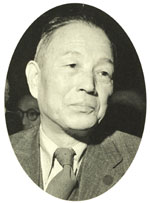
Watsuji Tetsuro (1889-1960), known for his works such as "Pilgrimage to Old Temples," "Fudo" and "Ethics," was a leading Japanese philosopher, ethicist and thinker of the Taisho and Showa periods. His system of ethics as a "study of human beings" based on his research into the history of Japanese thought is called Watsuji ethics, and along with Kitaro Nishida's Nishida philosophy, it is said to be an original system of thought by a Japanese.
In April 1922, the Department of Letters and the Department of Philosophy in the Faculty of Letters, the predecessor of the Faculty of Letters of the University, was established. Toyoichiro Nogami, who later became the President and Rector of the University, and Yoshinari Abe, then Head of the Department, welcomed Watsuji Tetsuro, Yonesho Morita (Sobei), Eizo Uchida (Hyakken), Toyotaka Komiya and other literary and philosophical scholars under Soseki Natsume. Watsuji is in charge of classical literature, history of Japanese thought, and cultural history. After three years in this position, he is invited to Kyoto University and leaves Tokyo. He then studied in Germany before becoming a professor at the University of Tokyo, where he again taught Introduction to Ethics from 1935 to 1937.

Watsuji Library. In Western books, there are many complete works of famous philosophers, major works, and research books. Among Japanese books, a large number of books on Buddhism, national history, and national literature stand out. Although there are many valuable documents, there are few rare or luxury editions.
Because of this relationship with Watsuji, in the year following his death (1960), the Watsuji Tetsuro Collection was transferred to the University at the behest of his friend Tetsuzo Tanigawa (later President of the University) and Teruji's wish that the collection not be dispersed.
The collection contains 3151 Japanese books, 1521 Western books, 103 Japanese magazines (20 types), and 53 Western magazines (15 types). The balance of Japanese and Western books is maintained, and both Japanese and Western books cover philosophy, religion, history, social sciences, art, literature, and other fields, showing the wide range of Watsuji's research and the diversity of his interests.

Thomas Hobbes, Leviathan (Everyman's library) p.66-67, detailed writing in red pencil on the original copy of Leviathan, the main work on state theory by English philosopher Thomas Hobbes.

Yasuken Kimura, "Gensho Bukkyo Shiso Ron (Essays on Primitive Buddhist Thought)" (Heigo Shuppansha, 1922), p.78-79. "Kono ko ha kyokutei fukumetsu." The following commentary can be read in the book.
Although there are not many particularly rare or gorgeous books, the greatest feature and value of the Watsuji bunko is the numerous "writings" by Watsuji in many of the books. Most of the pencil writings are in various forms, such as bylines, signs, summaries, questions, reviews, or short dedications and commemorative remarks written on the back of the front covers. Also included are pieces of paper, postcards, letters, and telegrams inserted in place of bookmarks.
These writings have not yet been fully verified, and it is said that long-term research by numerous researchers is needed, but there is no doubt that they will be valuable materials for future research on Watsuji.

In the Watsuji library, there is a copy of his own book, "A Sense of Harmony" (Chuo Koron Sha, 1958), which seems to have been presented to Watsuji by his friend Tetsuzo Tanikawa, with a piece of paper attached to the back cover that reads, "Most of these were published in women's magazines and are not intended for your eyes.

A combined total of 32 volumes of Akai Tori (Red Bird) (1918-1936), which were probably presented by Miekichi Suzuki, another student of Soseki. While a student in the Department of Philosophy at Tokyo Imperial University, Watsuji was active in literature, founding the second "New Shicho" with Tanizaki Junichiro and others. This is probably the reason why Watsuji's writings are considered masterpieces with a literary flavor.
Reference materials: Keizaburo Masuda, "The Watsuji Tetsuro Collection" (in the December 1976 issue of Hosei magazine); Yoshifumi Hamada, "About the Watsuji Tetsuro Collection" (in the June 1989 issue of Hosei magazine); "Hosei University Centennial History.
- Tsuji is the old Chinese character for "tsuji.
The following links will take you to previous "HOSEI MUSEUM" articles.