

Hosei University Village
Immediately after turning east toward "Daigaku-mura" from the Kitakaruizawa intersection on Route 146, turn left along the old road, and you will come to the former Kitakaruizawa Station Square, the center of the Kitakaruizawa shopping district. In one corner, the old Kita-Karuizawa Station building with its eye-catching reddish-brown temple-style roof remains.
In 1929, Hosei University Village built a new station building and donated it to Kusakaru Electric Railway, which renamed it Kita-Karuizawa Station.
-
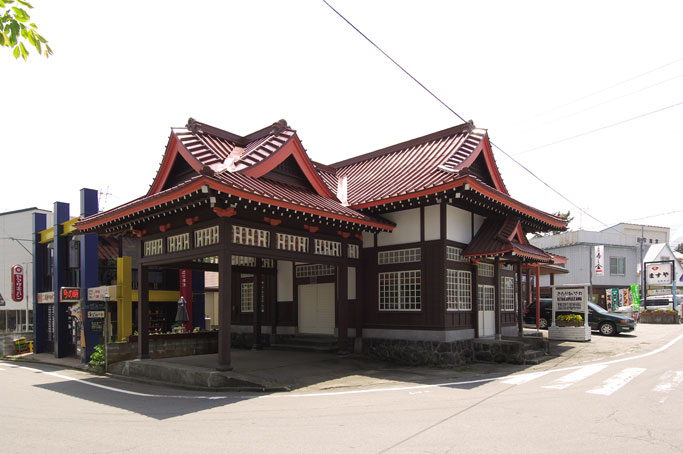
The front side of the former Kita-Karuizawa Station building. The station building was used as a location for Japan's first color film "Carmen Returns Home" (directed by Keisuke Kinoshita, 1951).
-
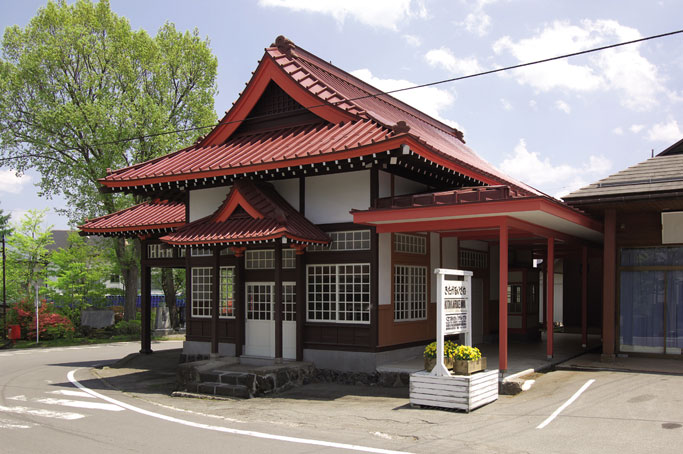
The platform side of the station building. The reddish-brown pillars in the foreground are the platforms. A platform with a roof was rare at the time.
The station building is a wooden tin-roofed building, and the main entrance is a modern design that blends Japanese and Western styles, with the initials "H" of Hosei University on the transom (ranma). The wife of Professor Toyoichiro Nogami, the first chairman of the village association of Hosei University Village (who later became its President), and writer Yayoko Nogami said, "The station building was a magnificent and bold structure for its time, not unlike the straw huts that were built in the early days. (Look at that balustrade. If you look closely, you can see that the white latticework is made up of a series of H's, the first letter of Hosei, which is another proof of the history of Daigaku-mura" (from "The Pioneering Years, During and After World War II" in "Daigaku-mura 50-year Magazine").
After the Kusakaru Electric Railway line was discontinued in 1962, the building was used as the office of Kusakaru Kotsu and as a coffee shop by alumni of the University, but in 2005, the town of Naganohara took over the site and the building for conservation and repair. This building is the only remaining Kusakaru Railway station building, and the University Village Association provided information to Hosei University when it was designated as a registered tangible cultural property (building) by the Japanese government.
By the way, Lake Shougetsu and the lakeside hotel on the north side of the "Daigaku-mura" are also associated with the "Hosei Daigaku-mura.
The year Kitakaruizawa Station was completed, Hosei University Village built the Daigaku-mura Club to provide a place for socializing and relaxation for the villagers. The building, with a floor space of 354 tsubos (3,860 m2), is said to have been built using old lumber from the Hosei University School building. It included a dining hall, a large bathtub, a lounge, an entertainment room, and a bookshelf lined with the Iwanami Collection, donated by the Iwanami family. After the war, however, it was sold to a third party and used as a tourist hotel.
The following year, in 1930, a plan to create a man-made pond by damming the mountain stream flowing into the village was put into action. The following year, the "Sawaike Pond" was completed, and it is now known as Lake Shougetsu. Fearing the destruction of the nature around the pond and its conversion into a tourist attraction, Hosei University Village's philosophy can be seen in the fact that only a small pond was created.
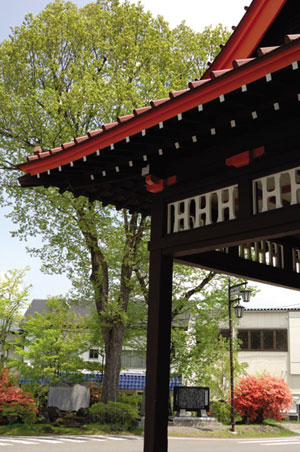
The initials "H" of Hosei University are displayed on the transom at the main entrance. The "Monument of Kita-Karuizawa Development" and other monuments can be seen in the plaza in front of the station.

Kita-Karuizawa Station under construction (reproduced from "Daigaku-mura 50-nen-history")
The following links will take you to previous "HOSEI MUSEUM" articles.