

Hosei University Village
In 1920, the then President of the University, MATSUMURO Michi, acquired 273 hectares of land in Oaza-Osuwa (now Kita-Karuizawa), Naganowara-cho, Agatsuma-gun, Gunma Prefecture, from Kusatsu Karuyuu Railway Co. This land was a ranch belonging to the Kitashirakawa family that had been sold to a private party. Kusatsu Karuyu Railroad later changed its name to Kusakaru Electric Railway and operated between Karuizawa and Kusatsu, but was discontinued in 1962.
At the end of the Taisho era (1912-1926), President Matsumuro decided to create Hosei University Village, an ideal place for education and communal living centering on Hosei University faculty, staff, and students, and planned to sell the land to faculty members.
Hearing about this plan, Professor Toyoichiro Nogami (then Dean of the Preparatory Department, later to become President and President) invited several of his faculty colleagues to visit the site during spring vacation. However, the cold plateau, where the snow had just disappeared, was completely deserted. The colleagues returned to Tokyo early, saying that they would not accept such a place even for free. In the summer of the same year, Professor Nogami returned to the area with his family and found it to be a wonderful plateau with flowers and grasses blooming as far as the eye could see and birds chirping.
Upon his return to Tokyo, Professor Nogami encouraged faculty members to subdivide the land, and in the summer of 1928, a villa was built in the first section with 40 units. This was the birth of "Hosei University Village. The price of land for sale was 1 yen per tsubo, and in principle, each person was allowed to own up to two plots of land, with each plot being 500 tsubo.
The village adopted a village council system as an autonomous organization to manage and operate the village, and President Matsumuro became the first village president.
The villagers consisted mainly of faculty members of the university's liberal arts department. However, after a visit to Professor Nogami's mountain villa, Shigeo Iwanami (founder of Iwanami Shoten) took a liking to the area and became a villager, and many scholars and artists from outside the university were also invited to join.
Among the early residents of the village were Yoshinari Abe, Tetsuzo Tanigawa, Yayoko Nogami (wife of Toyoichiro), Gen Tanabe, Yokichi Tsuda, Shinzo Koizumi, and Kunishi Kishida.
In the following year, 29, the second ward was developed and sold to 40 people. In the same year, the village built a new station building for the nearby Jizogawa Station and donated it to the Kusatsu Electric Railway. This is the "Kita-Karuizawa Station" where the station building still stands today.
In addition, the following year, the third ward was developed and the outlines of Hosei University Village were put in place. The village had no ordinances or penalties, and a natural constitution was established that called for the villagers to respect each other's lifestyles, to enjoy the highland summers at a leisurely pace, and to work in a relaxed manner.
However, in 1931, the mayor of Matsumuro Village passed away. The number of villagers continued to increase, but the composition of the village population gradually became less and less centered on university-related people, and the relationship with Hosei University began to fade. In 1937, at the beginning of the Sino-Japanese War, on the occasion of the village's 10th anniversary, the village association system was changed to a union system, and Hosei University Village was renamed "Daigaku-mura" (University Village) and began a new chapter in its history.
Reference] "Daigaku-mura 50-nen-history" 1980, Kitakaruizawa Daigaku-mura Kumiai, "Daigaku-mura 70-nen-history" 1999, Kitakaruizawa Daigaku-mura Kumiai.
-
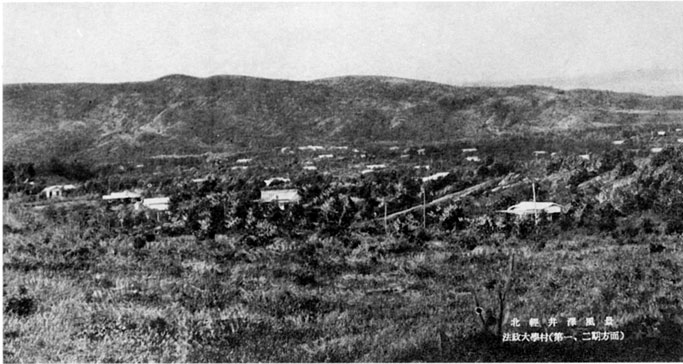
Hosei Daigaku-mura's first and second subdivisions (reprinted from "Daigaku-mura 70-nen-history"). All the villas were designed by Shigeo Kambara, a Justice Ministry engineer who also worked on the Hosei University buildings, and each villa, which ranged in size from about 10 tsubo to 15 tsubo, had a different appearance and layout, with a rustic, exotic atmosphere incorporating the Secession style with its many geometric patterns. When the village was first established, there was no electricity or running water, but the villagers who came from the city enjoyed this primitive lifestyle as a rare treat.
-
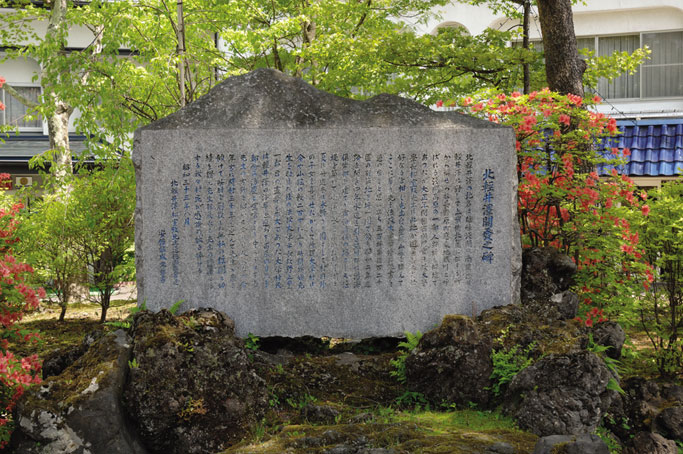
In 1959, the town of Naganohara erected the "Kita-Karuizawa Development Monument" in front of the old Kita-Karuizawa Station in honor of Mr. Matsumuro's achievements. The inscription was written by Yoshinari Abe, the president of Gakushuin, a village resident. The present Kita-Karuizawa area was named Osuwa and Jizogawa in the Taisho era (1912-1926), but when Hosei University Village was established, it was commonly referred to as Kita-Karuizawa because it was a villa area north of Karuizawa. Later, as this name became established, the name was changed to Kita-Karuizawa in 1986.
-
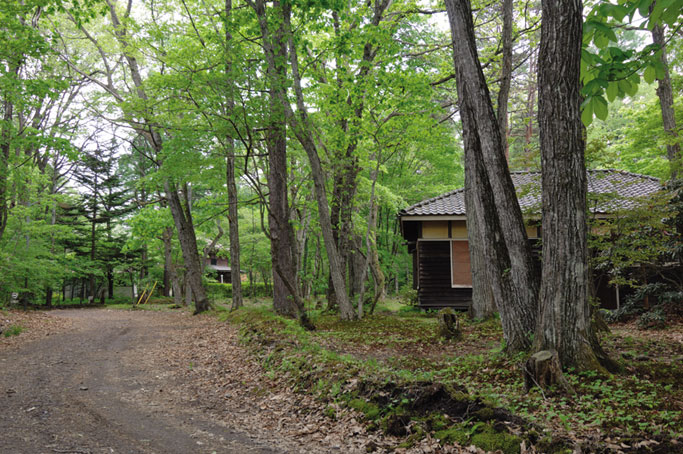
The current University Village. Except for a 4-meter road that runs diagonally across the site, the village has not been paved and remains as it was when it was first established. The unwritten rules from the time the village was founded, such as greeting each other on the street, not visiting other people's houses in the morning, and refraining from playing music in the morning and after 10:00 p.m., are still in effect today.
The following links will take you to previous "HOSEI MUSEUM" articles.