

Hosei University University History Materials
Uchida Hyakken (1889-1971, real name Uchida Eizo, alias Hyakkien) has many core fans for his fantastic novels and humorous essays that are said to be "addictive once you read them. While known as a stubborn, eccentric and selfish person, he also had a sense of mischievousness and humor. It is a famous story that he named the tea room in the garden of his house "Sanjami-goten" "Kin-kakuji" and pasted a sign at the entrance saying "I am glad that people come to the world, but not you.

A photo of Hyakken in his later years and his handwriting on the back of the photo. You can see his signature with his real name "Eizo" and another name "Hyakki-en". Hyakken Uchida was a professor at the University's Preparatory School from 1920 to 1934.
The following year, student volunteers from Hyakken's first German class performed the German play "Faust" to commemorate the inauguration of the first school building. Below is a photo of the occasion. The students, who were at the level of having read less than 20 pages of the elementary text in the first semester, spent six months preparing for the performance under Hyakken's policy that they would simply memorize the play without any understanding, whether they understood it or not. On the day of the performance, the German Ambassador to Japan, Dr. Solf, was invited to the performance.
-
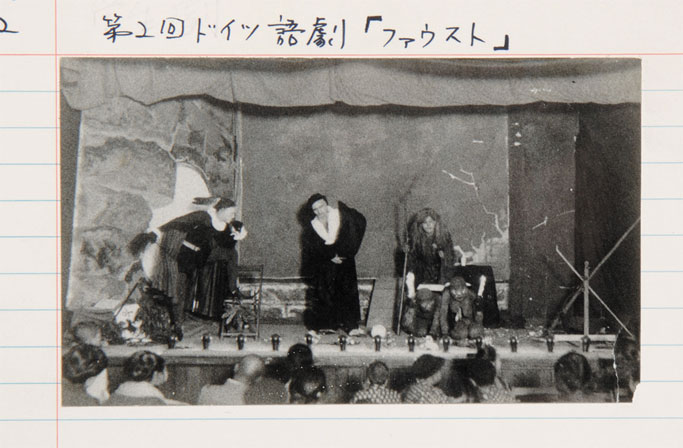
A scene from the German play "Faust. Hyakken translated and read the play, Karl Gsell, a German conversation teacher, taught pronunciation, and Tsugio Sekiguchi, who was participating in the Shingeki movement at the time, taught acting and lines.
-
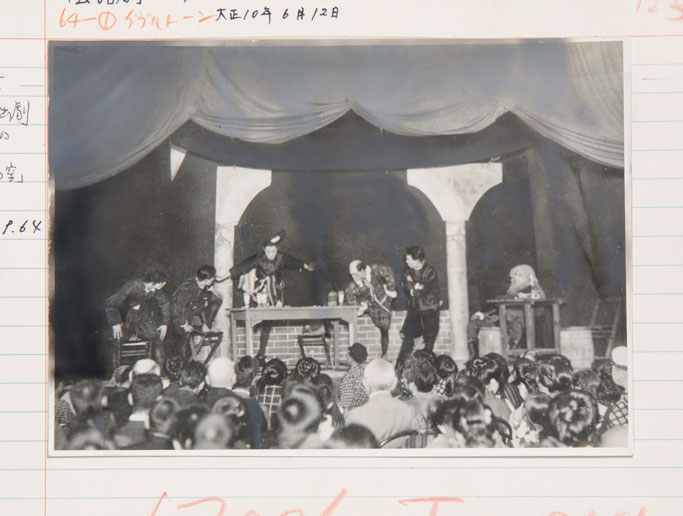
I was bureaucratic, overbearing, and selfish. At the beginning of class, everyone had to stand up and bow in unison. (from "The Pre-College Years" in "Convex and Concave Road"), it seems that Hyakken's personality was also fully demonstrated in his teaching at Hosei. It is well known that the students at that time held a birthday party called "Maada-kai" starting the year after Hyakken turned 60. Akira Kurosawa's posthumous film "Maada da da da" is based on Hyakken's essay "Maada kai" describing this period of his life.
During his time at Hosei, Hyakken also served as the first president of the aviation research society, the first of its kind at a Japanese university, but he resigned in 1934 due to the so-called Hosei Disturbance.
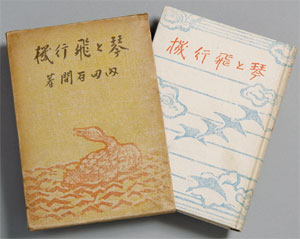
A collection of essays entitled "Koto to Aeroplane" (1942), bound by printmaker Yasunori Taninaka. Hyakken loved liquor, cigarettes, trains, cats, small birds, and the zither. Especially the zither, he studied under Michio Miyagi, known as the composer of "Spring Sea" and other pieces, since 1920, and their teacher-student relationship became a close friendship in later years. He left many essays describing his interactions with Michio Miyagi.
The following links will take you to previous "HOSEI MUSEUM" articles.