

Founders of Tokyo Hogakusha - Tetsu Kanamaru, Osamu Ito, and Masakuni Sattva
The history of Hosei University begins with the establishment of the Tokyo Hogakusha in April 1880. In that year, the National Diet League, which occupies an important position in Japan's constitutional history, was formed, and an application to establish the Diet was submitted to the Grand Council of State. In the history of the legal system, the development of the modern legal system was also beginning to take off, with the revision of regulations on deputy attorneys (equivalent to today's lawyers) and the promulgation of the Penal Code and the Crimes Control Law.
Against this backdrop, Tokyo Hogakusha was established in Kanda-Kitakoka-cho, Surugadai, Tokyo, by lawyers such as Tetsu Kanemaru, Osamu Ito, and Masakuni Satto, who were influenced by French jurisprudence, to respond to the suddenly growing need for legal education and representation services.

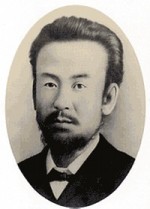
Kanamaru Magane (1852-1909)
Born in 1852 in the family of a samurai of the Kitsuki domain in Bungo Province, he moved to Tokyo at the age of 19 and single-handedly started a publishing company, Jishu-sha, and launched one of the first law journals in Japan, "Houhou Zasshi" (Law Journal).
At the same time, he became acquainted with a young law student, Masakuni Satto, who had established a law school in Asakusa. In 1878, with Motoda's help, he founded Tokyo Hogaku-sha with Osamu Ito, a deputy under Motoda, and soon after Sattva joined them.
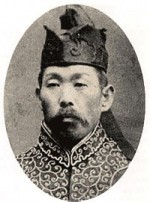
Osamu Ito (Osamu Ito) 1855-1920
He was a samurai from the Kitsuki domain in Bungo Province, like Kanemaru, and became a deputy in 1877 (Meiji 10), and was engaged in litigation work in the office of Motoda Nao.
In 1880 (Meiji 13), he participated in the founding of Tokyo Hogakusha together with Kanemaru and Satto. No other records remain, and it is assumed that he severed his relationship with the law firm shortly after its founding.
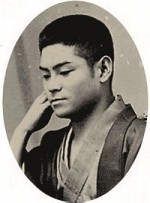
Masakuni Sattva, 1856-1897
Born in 1856 in Kyoto to a family of Ishimon Shinchaku, he entered the Kyoto French School in 1871 at the age of 15. He studied French under a French teacher, Léon Durie. In 1875, Dury became a teacher at Tokyo Kaisei Gakko (the predecessor of the University of Tokyo), so he followed his teacher to Tokyo and studied law on his own. He was recognized by Sakurai Nokan, a French jurist, and was hired by the Ministry of Home Affairs in 1878.
The following year, he came in contact with Dr. Boissonade, a teacher at the Law School of the Ministry of Justice who had been invited by the Japanese government to compile a code of laws. In 1878, he founded Tokyo Hogakusha with Tetsu Kanamaru, Osamu Ito, and others. In 1881, he founded the Tokyo Law School with Tetsu Kanemaru, Osamu Ito, and others, and in 1881, he became the head of the Tokyo Law School after it became independent, devoting his energies to its management.

Establishment of the Monument in Honor of
On April 10, 1993, the 113th anniversary of the founding of the school, a ceremony was held to unveil a monument in Shiroyama Park in Kitsuki City, Oita Prefecture.
Tetsu Kanamaru and Osamu Ito, who founded Tokyo Hogakusha, the predecessor of the University, in 1880, were both from the Kitsuki clan (now Kitsuki City, Oita Prefecture).
The monument was designed by Eiichi Yamamoto, a graduate of the University, and is a 2.7 meter triangular column made of black granite, standing in Shiroyama Park with a view of the sea. On the pedestal is a directional panel monument, pointing in the direction of north, where the couple headed in their dreams. The white stones represent the history of Hosei University from its foundation to the present, while the black stones represent the university's expectations for the future.
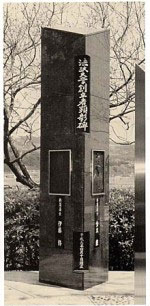
Monument in honor of the founders of Hosei University (Kanamaru and Ito) (Shiroyama Park, Kitsuki City, Oita Prefecture)