

Professors of the old Hosei University like stars
In 1918, with the promulgation of the University Ordinance, the university system, which had been limited to imperial universities, was expanded to include public and private institutions.
The former Hosei University established the Department of Law and Department of Political Science in the Faculty of Law, the Department of Economics and Department of Commerce in the Faculty of Economics, the Preparatory Course of the University, and the Graduate Schools in each Faculty. The pre-college courses included Toyoichiro Nogami, Yonesho Morita (Souhei), Yoshinari Abe, Eizo Uchida (Hyakken), and other outstanding students of Soseki Natsume.
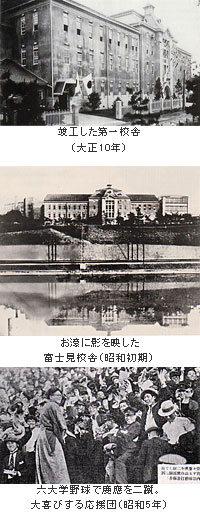
In 1921, construction of a new three-story wooden school building was completed on the current Ichigaya campus, and the university was upgraded. In 1922, the Faculty of Law was reorganized into the Faculty of Law and Letters, and the Faculty of Letters and Department of Philosophy were newly added.
In May 1928, the 50th anniversary celebration was held, and Hosei University entered its prewar golden age as educational and research activities were further enhanced. Hosei University entered its prewar golden age as its educational and research activities were further enhanced. In January 1931, Hosei University adopted a school song with lyrics by Haruo Sato, and in the fall of the previous year, Hosei University adopted a new school song, "Tokyo Roppongi" by Haruo Sato. In the fall of the previous year, the school won the Tokyo Rokugaku University Baseball Tournament for the first time.
In addition, the great news of a successful student flight to Europe sent excitement not only on the Hosei University campus, but also throughout Japan.
The "Young Japan" Flight to Europe, a Symbol of Hosei's Golden Age
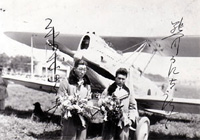
On May 29, 1931, a small biplane propeller-driven plane took off from Haneda International Airport, which had just opened. This biplane was the "Seinen Nippon-go" of the Hosei University Aviation Club, as reported on the front page of the evening edition of the Tokyo Asahi Shimbun newspaper under the title "Our 'Seinen Nippon-go' on its way to Europe. Moritaka Kurimura, a second-year student in the Faculty of Economics, was the pilot, and Ryotaro Kumagawa, the first class flight instructor, was his escort.
After crossing the Ural Mountains from Siberia, and fulfilling goodwill and friendship in Germany, England, and France, the aircraft rested its wings at Littorio Aerodrome in Rome on August 31.
The flight was hailed as the accomplishment of the century, and was a true demonstration of the "representative of Japan's youth," as the school's song says.
Demonstration of the "Representative of Japan's Youth