

News
Ichigaya】Ichigaya】Report from "Kirin Community Power Support Project" by Kirin Welfare Foundation FY2021: "Team Orange" Seminar with Iwate University "Sanriku Committee Kokoroyori" was held (11/13).
- January 11, 2022
This project was proposed as a replacement for the "Tono Volunteer Tour," which was originally scheduled to take place in August 2021, but had to be postponed to November due to the new coronavirus. However, due to a decrease in the number of infected people, the "Tono Volunteer Tour" was changed to the "Tohoku Disaster Area Volunteer Tour" and was successfully implemented. The "Tohoku Disaster Area Volunteer Tour" was therefore held after the preliminary briefing session, as a preliminary learning experience about the disaster-stricken areas. The name "Tsunagaru Seminar" was taken from the online project "3.11 Tsunagaru Seminar: Let's learn about the disaster-stricken areas 10 years later online," which was held by Team Orange on May 29 this year.
This project was conducted in a high-flex format with the cooperation of Iwate University's "Sanriku Committee Kokoyori". Although some of the previous projects organized by Team Orange had involved the cooperation of local storytellers, there had never been a project in which we talked with local university students of the same generation as ourselves, so this was a new project for us.
(1) Overview of the project
(2) Introduction of Team Orange
(3) Introduction of "Sanriku Committee Kokoyori
(4) Team Orange gave a PowerPoint presentation to "Sanriku Koyori" on the damage in the Kanto area caused by the Great East Japan Earthquake.
⑸Questions from "Sanriku Committee Koko Yori" to Team Orange regarding the disaster, and answers from us, Team Orange
(⑹Questions from Team Orange to "Sanriku Kai Koyori" regarding the disaster, followed by responses from the other side
⑺Group discussion among "Sanriku Committee Kokoyori", Team Orange, and general participants of the "Tohoku Disaster Area Volunteer Tour".
Most of the Team Orange members who participated in this project had just joined the organization in their first year, and their knowledge of the disaster-affected areas was still in its infancy. On the other hand, we are not sure if it was a good project for the other side or not. When thinking about the answers to the questions posed by our counterparts and during the discussion at the end, the difference in awareness between the members of the other organization and ourselves regarding the Great East Japan Earthquake seemed to have been highlighted. However, if this is the case, we regret that we proceeded with this project without learning much about the disaster area and the disaster itself. Moreover, the fact that we were largely dependent on the cooperation of people who had visited the disaster-stricken areas before (senior members of the team, etc.) was also due to our inexperience. However, thinking about it in reverse, I feel that this project has served as an opportunity for the current members of Team Orange to deepen their understanding of the earthquake and the disaster-stricken areas and raise their awareness. I believe that this was true not only for Team Orange members, but also for the general participants. I would like to continue to think of projects like this that can push people to take a step forward in their understanding of the disaster-stricken areas.
Finally, I would like to close by expressing my gratitude to the "Sanriku Committee from Here" for their cooperation in making this project possible. I hope that we can connect this relationship with new projects and exchanges. (Rina Ishida, 2nd year student, Faculty of Law, Department of Law, Volunteer Center Student Staff Team Orange)
Yuki Terouchi, representative of Iwate University's "Sanriku Committee Kokoyori
If we had not had this opportunity to exchange opinions, we would not have known what people in the Kanto region were thinking about Sanriku. It was a very valuable experience for us to hear the opinions of people from outside of Tohoku who are working in the same age group as us. I think there was a lot more to talk about than we had time to discuss in this meeting alone, so it would be ideal if we could have another opportunity like this, or if we could eventually work together in the field.
Impressions from participating students
I was able to hear directly from people of the same age about the situation and feelings at the time of the Great East Japan Earthquake, which was a different discovery from volunteering in the Tohoku disaster area. During the discussion time, regarding the discussion theme "Future of Disaster Relief Volunteers," Ms. Kokoyori expressed her opinion that "disaster relief requires a certain level of skill to help the traumatized, so training should be provided," and I felt that this kind of opinion from people who had suffered from the disaster in the field was very valuable. I felt that these opinions from people who had been affected by the disaster were very valuable. We would like to make the most of the exchange we gained at the Tsunagaru Seminar in our own volunteer activities. (Volunteer Center Student Staff Team Orange, 2nd year student, Faculty of Law, Department of Political Science, Takahashi Karen)
I am glad that I was able to talk with local people before going on the volunteer tour. Even though we are working in the same disaster-affected areas, there are different perspectives and feelings from the viewpoint of those who are not affected by the disaster, and I learned a lot. When Mr. Kokoyori asked me, "What does reconstruction mean? I could not give a clear answer on the spot, so I was able to participate in the volunteer tour while thinking about reconstruction in my own way. (Volunteer Center Student Staff Team Orange, 2nd year student at the Faculty of Law, Department of Law, Sekine Yuki)
-
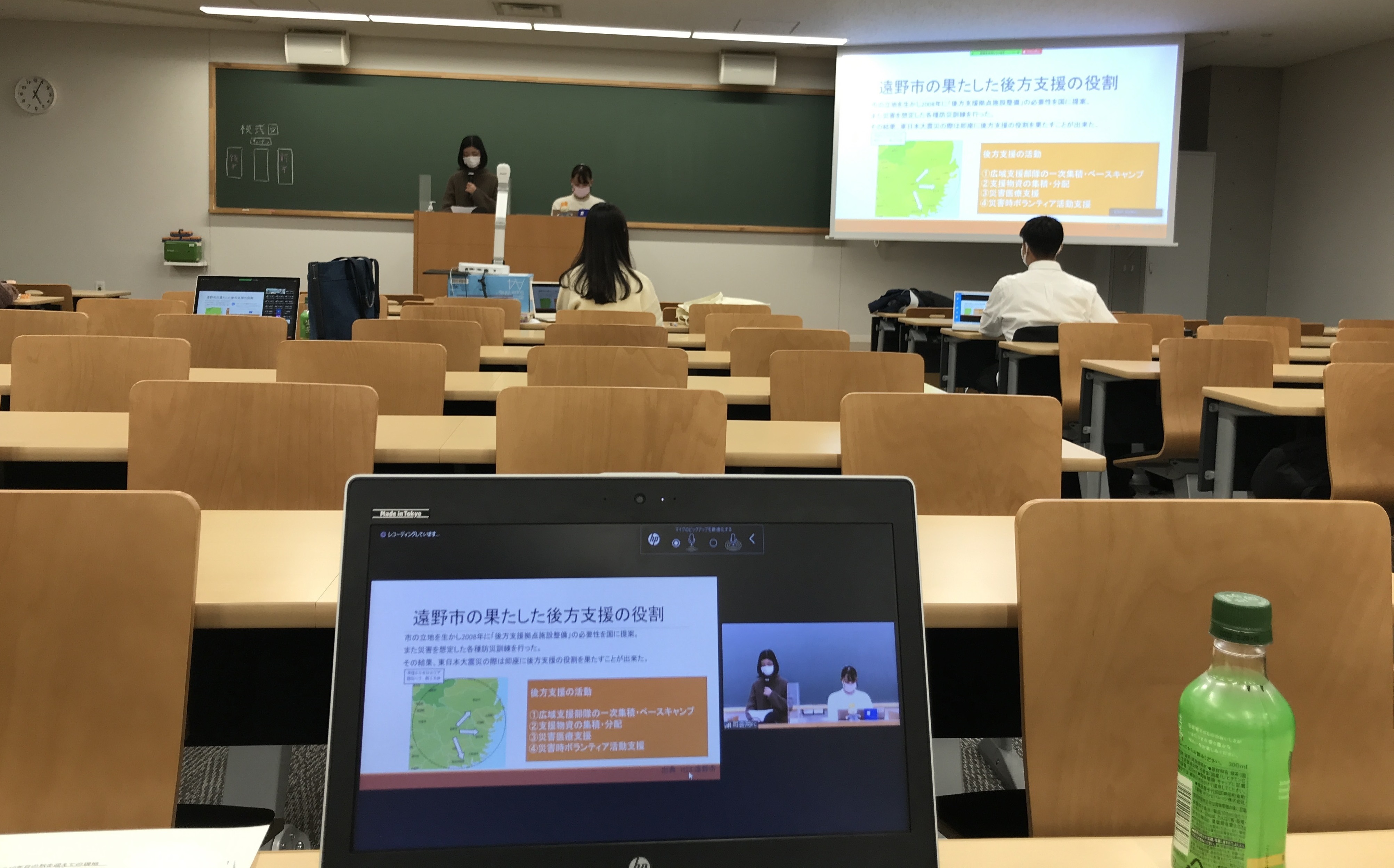
The tour was held by connecting Iwate University and Zoom.
-
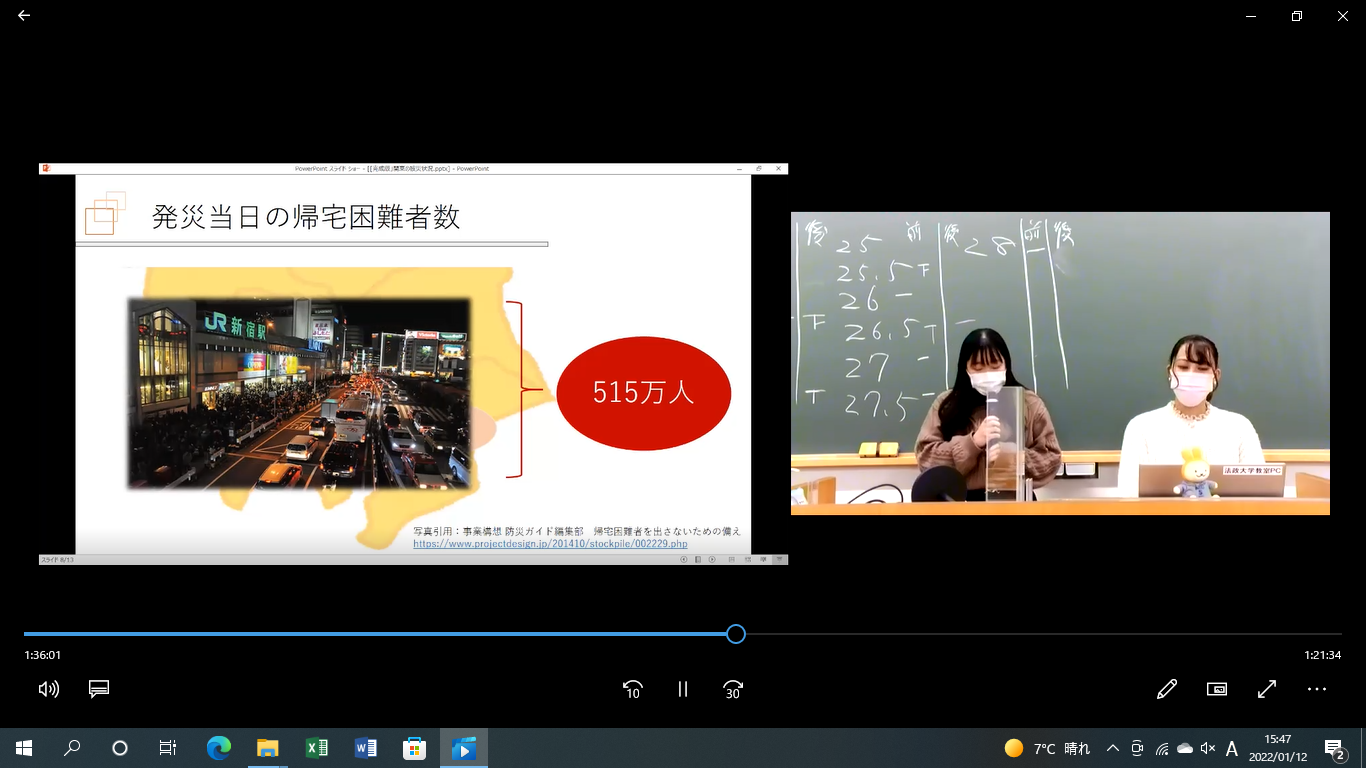
Team Orange explains the disaster situation in the Kanto area
-
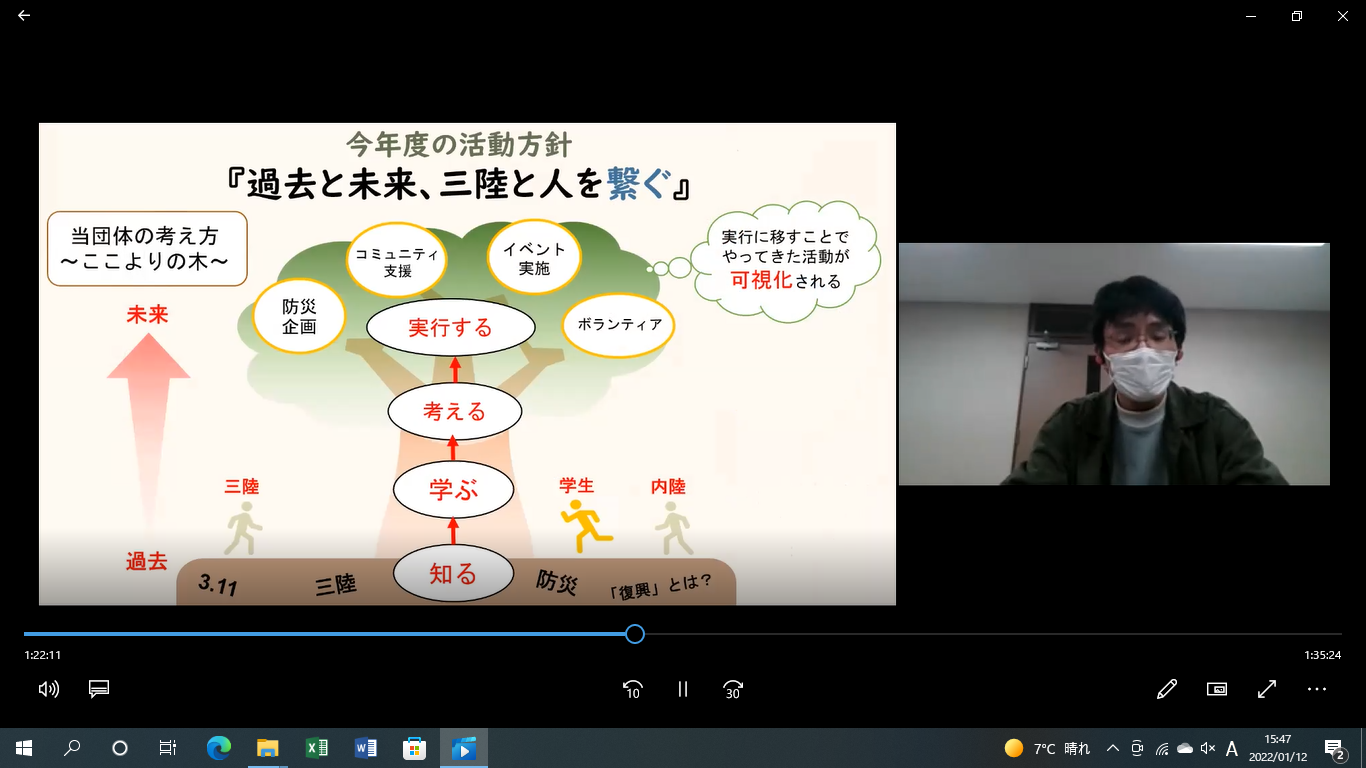
Students of "Sanriku Committee Koko Yori" explained the situation of the disaster area
-
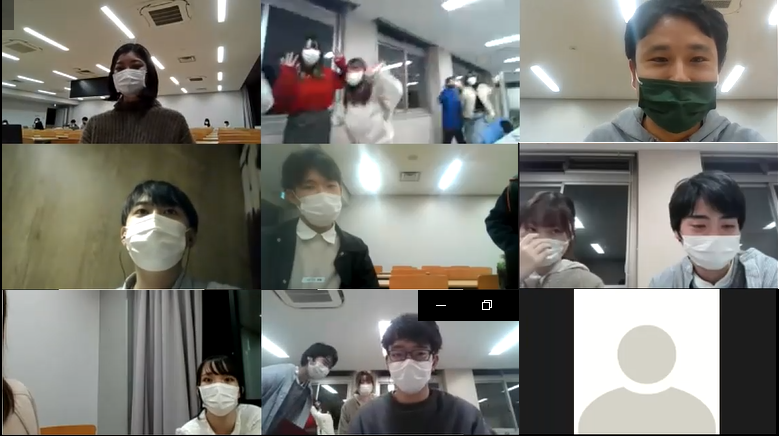
The event ended with a promise to continue exchange