

Notices
Lysapo] "Lysapo Interviews! Faculty of Economics, Professor Nobuko Hara
- Mar 09, 2022
- New Students
Whenever we visit the library, it is a treasure trove of books consisting of printed matter that can impart a great deal of knowledge. Spending a whole day cooped up in the library is also a fun way to spend time.
Nobuko Hara, Professor, Faculty of Economics
This is the final installment in a series of interviews by Library Supporters, volunteer library students, with professors from various Tama faculties about books and their relationship with the library. This time it is Professor Nobuko Hara of the Faculty of Economics. She is involved in gender issues, having served as the director of the Ohara Institute of Social Problems at Hosei University, and is a member of the International Association for Feminist Economics and the Japan Association for Feminist Economics.
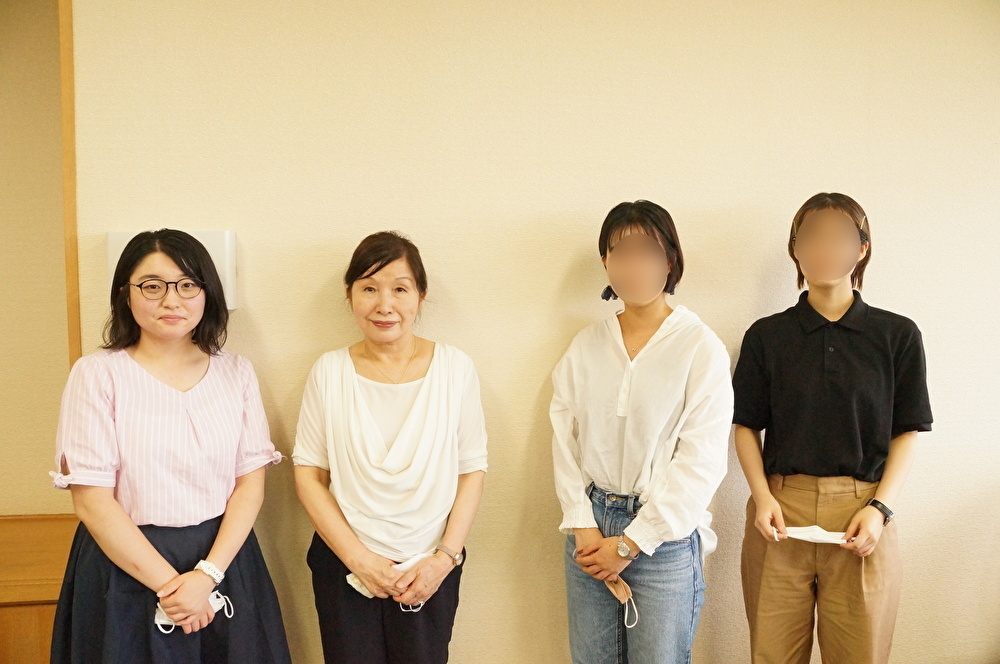
We spoke with him in the conference room of the general building.
1. his personal history
--Professor Hara, what kind of research have you been doing so far?
Hara: I have been studying the history of the formation of Marx's " Capitalism. Since the 2000s, I have also been researching the family and gender issues. Hearing about this interview project gave me a valuable opportunity to reflect on my own research life to date. Thank you very much. The first thing I thought I would share with you is why I decided to pursue my research on Marxian economics. I think my interest in Marx was influenced by the social situation when I was in high school, such as the struggle against the revision of the Security Treaty in 1970 and the opposition to the Vietnam War that began in 1965. It was also a time when society was in the midst of a civil movement against pollution, such as Minamata disease, and university conflicts. After that, I majored in Agricultural Economics at university and Marxian Economic Theory at graduate school, and in 1981 I came to Hosei University to teach Economic Originalism (Marxian Economics). This is my last year here, so it has already been 40 years. 1992 saw the collapse of the Soviet Union. In 1992, the Soviet Union collapsed, and there was a tendency to say that socialism and Marxism were finished, but I felt very liberated and wanted to relativize Marx's meaning once again. In the 90's, I did not make much progress in my research, but instead, I read many books. In the 1970s, there was the domestic labor debate in Marxian economics, and I reaffirmed its significance. From there, you went into gender issues. There is a very long history of research on gender issues in the history of women's labor, but I was conscious of the question of whether it is enough to focus only on the wage gap between men and women in the labor market. It is a question of how to socially position the care of children, the elderly, and the disabled as labor, or how to position unpaid work in the family.
People often say that Marx is gender blind or genderless, but I mean that I have adopted a way of engaging with gender issues in the sense of developing Marx's Theory of Capital.
2. My relationship with the library when I was a student
--Can you tell us how you used the library during your college life?
Hara: I entered university in 1970, right around the end of the period of rapid economic growth. Politics and society were in chaos, and the first thing I started doing in the 1970s was study and reading groups because there were not many classes. Classes started in the middle of the first year, but it was like "the library as a place to study for study groups. As a place to prepare.
I read " Under the Wheel" as a textbook in junior high school and fell in love with Hermann Hesse, so I decided to read all of his works when I entered university, but looking back, the works that made the biggest impression on me were Marx and Engels. At first, I started with Engels' " From Imagination to Science. The contents of Marx's "Capitalism" are said to be difficult to understand, but there are many quotations from literary works and descriptions of social conditions, including newspaper articles about deaths from overwork at that time. It is very interesting. So, although I found the theoretical part of "Capitalism" very difficult and time-consuming, I was rather fascinated by the historical part and continued reading it for a long time.
In the 1970s, after the Nixon Shock in 1971 and the oil crisis in 1973, I was in the midst of the war. When I graduated from university, it was the first postwar global recession, and it was such a chaotic time for me, so "Capitalism" left the biggest impression on me in terms of the alienating situation I was in and my critical eye toward society.
In that sense, the library was also a place for studying and preparing for study groups. I would always go to the library after class, have dinner at the Co-op, and then stay there for the rest of the evening....
In the 1970s, a new, or rather, a real collection of Marx and Engels, " Karl Marx, Friedrich Engels Gesamtausgabe (MEGA)," was published. Moscow, Berlin and Amsterdam in East Germany (at that time) were the centers of Marx studies at that time, and the complete works were first published from Moscow. The complete works were first published in Moscow, and then an introduction to the contents of the complete works was published in the then Soviet journals "Versions of Economics" and "Versions of Philosophy. Of course, they were in Russian. So I took a leap of faith and studied Russian, and even went so far as to take the graduate school entrance exam in Russian. I have forgotten a lot of it now (laughs). But I did my best to read all the Russian grammar books in one summer. So for me, it was a place to study, a place to read, and at the same time, a place to prepare to become a researcher.
I was also thinking about how I could continue to work as a woman, so I decided to become a researcher, but in case I could not become a researcher, I decided to get a teaching license at a commercial high school, and so on. It was also a place for me to study to determine what direction I would take in the future. In those days, I studied hard. If I didn't do that, I couldn't see what was ahead....
--I understand that the library was used as a place to study very much.
Hara That's right. And, unlike today, there is no such thing as the Internet. So, anyway, we just read books.
Also, there were study groups and seminar federations, so it was for joint research for those.
--Hara: So you have already read all the books on economics at the university?
Hara: Not at all. Of course, I read quite a bit on my own research topics. For example, I couldn't understand the theoretical part of Marx's "Capitalism" after reading 20 pages. I couldn't understand so much that I couldn't read the rest of the book, so I looked up words in a dictionary, read commentaries, and so on.
Once you enter graduate school, your specialty is already decided. I was allowed to freely enter the underground stacks, so I would lock myself in the library according to my specialty.
--HaraYes, I used the underground stacks a lot during my graduate school days.
Hara: Yes, I did. I became friends with the library staff at the graduate school, and sometimes I would get ice cream from them. I would go to the library after class, and afterwards I would go back to the library again. After class, we would go to the library. Then we would have dinner and go to the library again.
I felt very much at home in the library.
--HaraYes, I still use the library even after I became a researcher.
Hara: Yes, I still use them, but nowadays there is the Internet, isn't there? Especially for journals, A-to-Z (electronic journal management tool), I guess you would call it, has been extremely helpful. However, the Internet has been around since the beginning of the 1980s...maybe the end of the 1990s, I don't know. I also used microfilm in the library stacks. I still remember how happy I was when I found a microfilm of "Under the Marxist Banner," which I wanted to read, in the Ichigaya library right after I came to Hosei. I was very happy when I saw the microfilms.
Also, Hosei has a lot of valuable collections of various researchers, don't you think? I often use them. Just by touching such things, you can feel the history.
--I heard for the first time about a person who actually used microfilm in his research. I knew that microfilm existed, but I was surprised to hear that there are people who actually use it.
Hara: How about now? Microfilm is corroded somehow, isn't it?
--HaraI guess so. We are replacing microfilm with other formats where possible, and we are working on that.
Hara That's right. I was the director of the Ohara Institute of Social Research (Ohara Institute of Social Research) for four years, and it is really hard work to store materials at the Ohara Institute of Social Research. We have a lot of microfilm. The picture was not very good, but it was very exciting to see the old materials.
3. Modern society and "Capitalism
--When were you in your third year of university when you first came into contact with Marx's "Capitalism" or when you first encountered it?
Hara: No, I was in my first year of college. People in Tokyo and other urban areas, for example, seemed to have read Marx's "Capitalism" from the time they were in high school. For example, people in Tokyo and other urban areas seemed to have started reading the magazine when they were in high school, but I was in a rural area and hadn't read it yet. I was in my first year of college.
At that time, many of the university courses were based on Marx. Whether it was finance theory, social policy theory, or of course, economic theory. I think the situation was exactly the opposite of what it is today, where neoclassical economics has become the mainstay of the entire Faculty of Economics.
In the 1970s, there was a "Marxian Renaissance" in which the study of "Capitalism" flourished, but then it went into decline, and now there seems to be a new "Capitalism" boom. The first thing I would like you all to read is the preface to "Capitalism. I would like you to read first the preface to "Capitalism," which says, "Go thy way, and let others do as they say" (first edition, 1967), or "There is no smooth road to learning." (Preface to the French edition, 1872), young people are still encouraged. That was the case with me when I was a student.
--I'd like to read " Capitalism" because it is very famous, and I've been thinking about reading it, but it's quite a hurdle for me.
Hara: Well... There was a time when "Capitalism" disappeared from bookstore shelves. Now there is a "Capitalism" boom again, isn't there?
--Hara Yes, that is true.
Hara: Otsuki Shoten has long been popular for its complete works, and Shin Nihon Shuppansha's "Capitalism" is said to have an easy-to-understand translation. For a commentary, David Harvey's " Introduction to Capital Theory " is the one I am using in my graduate school classes this year. I used this book in my spring semester class, and in my fall semester class, I used the same book, Harvey's "The Mystery of Capital: The Global Financial Depression and 21st Century Capitalism. This Harvey is very clear as an introduction. I would highly recommend this book whether you are an undergraduate or a graduate student.
I was watching the TV news yesterday and heard that some bookstores now have a "Capitalism" section.
--Yes, there are. Even in places like "NewsPicks," which covers contemporary news, "Capitalism" is introduced, and it's on the list of books that you should definitely read. You mentioned that it disappeared once, but I wonder if the way "Capitalism" is treated has changed between now and in the past.
Hara Well, there is a long history of Marxian economics and "Capitalism" research in Japan, and it boomed in the 1970s with the publication of the complete works in German called "Karl Marx, Friedrich Engels Gesamtausgabe (MEGA)," which is still being published. In the 1970s, a German-language complete works collection called Karl Marx, Friedrich Engels Gesamtausgabe (MEGA) was published. However, from the 1980s onward, neoliberalism emerged. The Soviet Union (former Soviet Union) experienced a coup d'état in August 1992, and then collapsed decisively in December 1992. Under such circumstances, the capitalist economy was said to be the sole winner, and people began to turn away from Marx.
However, nowadays, young people like you are holding study groups on "Capitalism. This is a book I recommend, Kohei Saito 's " Capitalism in the New Age, " which won the New Book Award in 2021, and he is still in his early 30s. Through historical and draft studies of "Capitalism," you are trying to connect Marx's ecological thought with contemporary criticism of capitalism. To the problems of global warming and inequality.
Some time ago, Thomas Piketty's " Capital in the 21st Century " became a bestseller. In the book, he mentions that the level of inequality in the 1990s and 2000s in the United States is the same as in the 1920s. After World War II, inequality was reduced through income redistribution in the process of becoming a welfare state, but now it is rapidly growing again.
Also, environmental problems are very convincing as problems caused by modern capitalism. In Capitalism, the term "metabolic rift" refers to a "rift in the metabolism of matter. Metabolism is the metabolism of nature and human beings, whereby human beings work with nature, work with technology, and process nature and incorporate it into themselves. For example, in "Capitalism," Vol. 3, "Land Rent," and in Marx's "Excerpt No. 1," it is mentioned that the use of chemical fertilizers in agriculture may seem to increase productivity, but in fact, it may destroy the ecological system. In fact, in the 19th century, the British imported large quantities of "guano" bird droppings from Peru in South America as fertilizer. Looking at such environmental thoughts, it is not so simple to say that if we grow in terms of macro indicators such as the current GDP, it will make everyone richer. It is not only the expansion of wealth and poverty, but also the destruction of nature and human life, which are the premises of our society. I think there is a movement to re-read "Capitalism" from this point of view.
Kohei Saito won the internationally prestigious Deutscher Prize for his original English version of " Before the Flood: Marx and the Material Metabolism of the Planet," and "Capitalism in the Anthropocene" is based on that book. He also describes, with concrete examples, that what is called socialism or communism is actually an association (like a cooperative) based on common, which is very persuasive and a new way of reading "Capitalism".
As you can see from the Faculty of Economics at Hosei University, the influence of Marxian economics has decreased in society as a whole. But when I came to Hosei in 1980, we did a seminar on "Capitalism", and even in other professors' seminars on financial theory, we read the credit theory of "Capitalism".... It seems that everyone was reading in that way.
--As economic disparities widen, people are returning to the ideas of "Capitalism," and I see a society that is reexamining them as a basis for their ideas.
Hara: Inequality, environmental issues, and so on. There is a political scientist at the New School in New York named Nancy Fraser, whom I often discuss in class. He emphasizes that the economy is only one part of society, and that the family, the environment, and politics (norms) are peripheral to the market mechanism. Therefore, if the market economy runs at full speed, a "boundary struggle" will surely occur at the border with the market, which means that the family will not be able to reproduce its labor force. This is also the case with the declining birthrate. ...with low wages. That, and the environment will also be destroyed. Global warming will melt the ice in the Arctic Circle, for example.
Therefore, it is overly optimistic and market-oriented to think that if the pie increases through the market mechanism, everyone will receive a share. I think we can critique marketism by considering the parts that cannot be marketed.
From the perspective of gender and feminist economics, it is easy to understand that even if the socialization of care, childcare, child bearing and child rearing within the family, and care for those who have retired from the working age because they are too old to work, the labor in nursing homes and daycare centers is different from labor in factories and offices, and labor productivity is higher than that in factories and offices. However, the labor in nursing care facilities and daycare centers is different from that in factories and offices, and is labor that does not fit in with the concept of increasing labor productivity. For example, if we apply the labor productivity of a factory, which is the amount of output per hour, to childcare, we can see that if we increase the productivity of childcare labor from one childcare worker watching three children to six, the labor productivity will double, but childcare accidents are more likely to occur. Therefore, I want to criticize marketism by clarifying the parts of the market that do not fit in. Like the "metabolic rift" in Capitalism, there is a rift between the economy, the family, and the process of labor force reproduction. I believe that even Marx had a plan for the fissure between the movement of capital and the family. In fact, Marx had a plan. Marx's plan for a critical system of economics was "I. Capital, II. wage labor, III. land ownership, IV. the state, V. foreign trade, and VI. the world market. The family probably falls into II, wage labor.
Hara: I have been at Hosei University for the past 40 years, and I am glad that you have given me this opportunity to talk with students like you in my last year.
In the 1980s, the neoclassical movement became mainstream, In the 1980s, as the neoclassical movement became mainstream, they were pushed further and further to the margins. Nevertheless, I feel that we are once again reexamining capitalism in the 21st century, just as we did in the chaotic period of the 1970s.
Hara: A society that does not redistribute wealth to children and the elderly, who are considered the "non-working population" in economics, will not survive. This is not "Narayama Bushiyo," you know. I don't think it is possible for a society to survive. The "working population" is not the only component of society.
4. The problem of unpaid work
--Recently, there is the problem of young caregivers. I was an intern for a member of the Tokyo Metropolitan Assembly. I was an intern for a member of the Tokyo Metropolitan Assembly, and I was asked a general question, so I did a lot of research on young caregivers together with the assemblyman. But it doesn't become a form of labor, it doesn't become someone's money, and it doesn't create value. Unless everyone recognizes that there is value in it, it is non-work, and no one will call it labor. I wonder how that can be changed.
HaraThat 's really true. In our society, the concept of "labor" itself is not labor unless it becomes money, unless it is included in the GDP. But when it is done in the market, it is included in the GDP. That is how the system works, isn't it? I am doing research from the perspective of feminist economics, and I have no choice but to appeal to this critically. It's also connected to the 'movement. So, care is also labor, but that labor is different from market labor, which is extremely costly. Otherwise, it is impossible to reproduce the labor force. In the midst of informalization, young caregiver children have accompanied their wheelchair-bound mothers to the welfare office to apply for public assistance. There are a number of issues involved. I think it is necessary to continue to make the case in various ways that society cannot continue to exist under the labor-centered approach that results in capitalist money.
The starting point is to first look at the extent of unpaid work in society, using the capitalist monetary conversion. Then, since the work is not converted into money, the next step is to clarify what kind of work is care.
The same is true of medical care. The more carefully we look at it, the more money and time it takes. However, productivity will decrease. The number of patients seen per hour decreases. Therefore, if we compete with each other to increase productivity, we will not be able to provide proper medical care. Of course, it is also true that there is labor that can be made more efficient. There was once a small article in the newspaper about healthcare reform, in which a doctor argued against it. They said that if they did such things, they would not be able to fulfill their social mission as doctors. Nowadays, hospitals send patients home after two weeks of surgery. When my mother was hospitalized for surgery, after two weeks they said, "It's time to think about transferring her to a hospital." I said to the doctor, "No, if you transfer her now, she will get worse," and he admitted it with a laugh. He admitted that I would have to stay a little longer. That part is difficult, but I think it is important to be aware of this and to insist on it.
--It's important to use the money economy, which is invisible, to get people to recognize you.
Hara: That's right. So, we need to make people recognize that care is very expensive, or that it costs a lot of money, and then appeal to them about the importance of it and make it a policy.
--In one of my classes, I showed the students how much a housewife's work would cost if converted to an hourly wage, and I was quite surprised to learn that the response paper said something like, "It can't be that expensive. I was quite surprised to learn that the response paper said, "It can't be that expensive." It is a very difficult thing to do when you think about the effort you have to expend to persuade people who have never worked as housewives before. But it is really necessary, isn't it?
Hara: That's right. In fact, in 1993, the UN's new System of National Accounts (SNA), "93SNA," converted such things as volunteer work, picking up and dropping off husbands, childcare, etc. into monetary equivalents. In Japan, in 1998, the Economic Planning Agency issued a survey report titled "How much is the price of your housework? When cooking at home, is the food prepared in a restaurant or in a mass diner? When you drive your husband or children home, do you take a cab or a bus? There is a limitation in that there is a gender bias in that method of calculation as well....
Other countries, like the UK, or Canada, or Australia, have more advanced research on how to measure domestic work and care in the home. Even in the U.S., for example, it is said that a private company, not a public one, has estimated the annual free labor of housewives at about 10 million yen. Substituting and measuring by market labor would be a starting point to visualize care and link it to policy.
The issue of young carers also includes the question of "what is a child? It is not just a matter of converting it into money. Especially with single parents, there are several important issues involved at the same time.
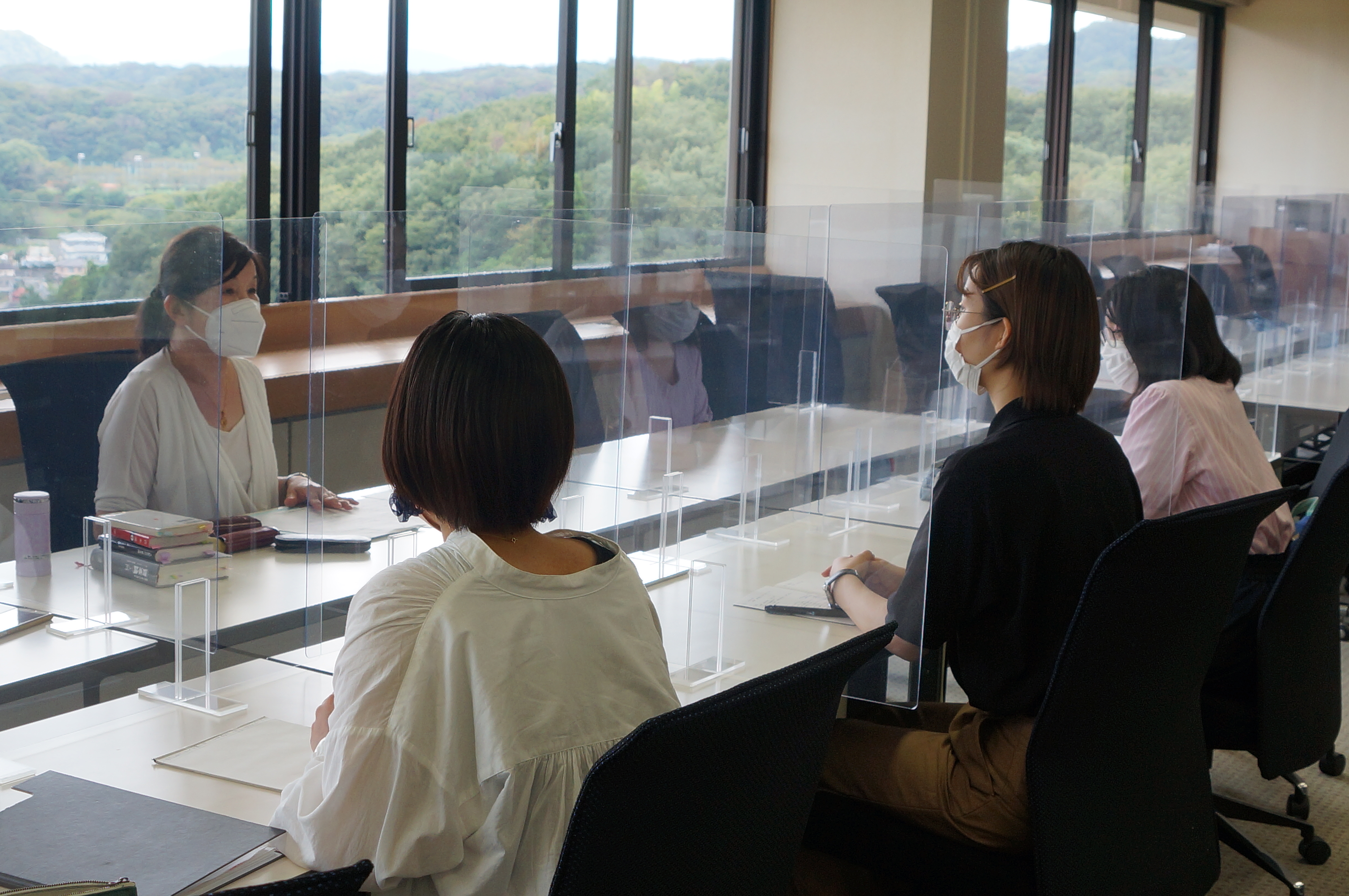
The conversation has spread to quite specialized social issues.
5. Rare Materials of Hosei University
--It was quite a dense discussion, wasn't it?
Hara Yes, yes, it goes beyond libraries. But, as I said at the beginning, I really want people to have access to the classics in the library. At Hosei's Tama Campus, there are many old materials and books not only in the library but also in the Ohara Institute of Social Science. The very valuable materials are in a special stack, but they are also available on the Internet.
--You spent time both in the days when there was no Internet and you studied only with books in the library, and in the days when the Internet was widespread and research was being conducted. How do you want young people like us who have grown up in the age of the Internet to position and use libraries?
HaraI have been using the Internet for a long time. I think it is very important to get off the Internet from time to time and pick up a book or a real book. The Internet is easy to use, and I use the Internet a lot to read journals. But while the Internet allows you to get information in a short time, it also eliminates the steps of picking up a paper publication, looking at it, reading it, and thinking about it. I sometimes feel as if I have finished with the information I have found and copied on the Internet. Therefore, I hope that the Internet generation will combine the Internet and print media. Libraries are a treasure trove of books consisting of printed matter that can give us a lot of knowledge whenever we visit there, aren't they? Spending a day holed up in the library is also an enjoyable way to spend time.
One of the first editions of "Capitalism" in the Ohara Institute of Social Research collection from 1867 has a dedication addressed to Kugelmann, so it is the only copy in the world. Besides that, there is also a first edition of Adam Smith's "The Wealth of Nations. There is also a copy of Mary Wollstonecraft's " In Defense of Women's Rights," a classic of feminism. When I hold such precious things in my hands, I feel, how can I put it in words, really excited. There are pencil writings on them. It may not be Marx's, because it must have passed through many hands, but there is an "X" written on it, so I wonder if it might be Marx....
So, I know this is a bit of a month-by-month thing, but I really want people to step away from the Internet and pick up an actual book and face the book.
--I think you might be able to feel the history of the book if you touch the actual book. On the Internet, you can find old things that are just popping up, and you can't feel the history of them. When you use modern tools, you already have a sense of "what is history? If you see the actual thing, you may feel that it has actually gone through historical changes and is here today.
Hara That's right. Also, I have been talking only about the classics, but in the case of books called "classics," you first buy a paperback book and ask a vendor to put a leather cover of your choice on it. That's why the covers are different even though they are the same book. Sometimes it's beautiful red leather, sometimes green. It's fun.
--I never thought about it. I just now thought, "Oh, they have books like that in their collection.
Hara: You know, the Ohara Institute of Social Science has a copy of Mary Wollstonecraft's "In Defense of Women's Rights" from the end of the 18th century, which I mentioned earlier, and the dedication is addressed to Georges Sand. The reason why Mary Wollstonecraft's book is dedicated to Georges Sand is because Mary Wollstonecraft died shortly after giving birth, and the book was given to Mary Wollstonecraft's daughter, whose name was, what was it? The book passed to MaryWollstonecraft 's daughter, who wrote the novel " Frankenstein " (→ Mary Shelley ), and the book was dedicated to Georges Sand. I feel the history of this book. This is also a rare book, though.
You are already reading a lot of things on the Internet, aren't you? But the Internet is mainly journals, isn't it? That is really convenient, though.
--Yes, nowadays, online journals are easily available. But most of what can be found on the Internet has only been available since the development of online journals, so it is possible that some of the information is converted from microfilm, but I think it is still true that the older material is the original.
Hara: I am reading journals from the 1870s and 1880s of the 19th century. I am a little impressed when I see them. I was surprised to see that online journals have come that far.
6. Recommended Books for Students
--You said that you read a lot of old books, so are the books you brought with you today your own?
Hara: Yes, that's right. This is a book that I would like to recommend to all of you, Kohei Saito's "Jinsei no 'Shihon-ron' ('Capitalism' in the New Age). It has been selling very well and won the New Book Award, and it is also a designated book for our class. I was very happy that he published it in this way, because he is the same person who is working on the history of the formation of "Capitalism" as I am, and he is really active in various fields.
Also, I have been using Hirofumi Uzawa' s " Social Common Capital " a lot in my introductory seminar. He was a professor of modern economics who has since passed away, and is said to have been the closest to winning a Nobel Prize in Japan. He wrote that the environment, water, education, finance, and medical care do not fit into the market economy, and that the impact of their breakdown would be too great. Even in the financial sector, the collapse of a single bank can have a tremendous impact on people's lives. Companies would also collapse, and employment would disappear.
So, Saito-san's argument is not entirely new, but what is new is the way he combines Marx's ecological thought with criticism of modern capitalism. Although Mr. Uzawa's book is not "Capitalism," I think you should read this book as well.

The Tama Library's collection of "Capitalism" in the Anthropocene
HaraI really want you to challenge "Capital Theory". I have a Faculty of Law student who is currently participating in my graduate school class, and he has started reading "Capital Theory," saying that he wants to challenge it.
It's interesting to read about the working day in about 1860. I think working hours are the most important thing. Time is the very essence of our lives, and it is also the way we live. In the 1860s, a woman who makes clothes for a court ball is forced to make a dress in a hurry, and about 50 people are working in a small room, but she dies of exhaustion after working all day. It is the same as today, isn't it? However, at the trial, the coroner's jury found that the cause of death was not due to overwork and being confined to a poorly ventilated room to do sewing work but due to a stroke. So the situation is exactly the same as it is now. When I read that it was all reported in the newspapers at the time, I think it is the same in 19th century England as it is today.
That is why I would like you to challenge "Capitalism" itself. Even if you skip over the parts you don't understand, the historical part alone is very interesting.
--Thank you very much for your time today.
Hara You are very welcome.