

100th Anniversary of the Faculty of Letters
Ichigaya Campus Today
100th Anniversary of the Faculty of Letters
In 1992, the Graduate School Building was completed following the renovation of the former Tamachi Campus building, which had been located along Sotobori-dori. Subsequently, the Graduate School Building in the Fujimi area was demolished, and the Boissonade Tower (completed in the spring of 2000) was constructed on the site. This marked the beginning of the Ichigaya redevelopment project.The Second 58th Anniversary Building, which stood next to the rear gate, was demolished and replaced by a ramp leading to the underground parking garage of the Boissonade Tower.In 2005, the Student Union Building was demolished, and the Sotobori Building was completed in the spring of 2007. The previous year, following the relocation of the adjacent Kaetsu Girls’ Junior and Senior High School to Ariake, the university acquired the school building and began using it as classrooms.Built in 1927 and having survived the air raids, the First School Building was the oldest building on campus and had been used as a library until the 80th Anniversary Building was constructed; however, it was demolished upon the completion of the Sotobori Building. The Gate Building was completed in the summer of 2016.Archaeological excavations were conducted each time a school building was demolished, uncovering artifacts dating from the Jomon period to the modern era. Subsequently, Classroom 511 in the ’55 Building was demolished, and the Ouchiyama Building was constructed on the south side of the ’55 and ’58 Buildings (completed in March 2019).Finally, the ’55 and ’58 Buildings were demolished, and with the completion of the Central Plaza, the Ichigaya Redevelopment Project finally came to an end in January 2021.
During this period, the Ichigaya Campus underwent significant changes in the 21st century, including the acquisition of neighboring buildings and the renovation of campus facilities. The current status of each building is summarized below, but first, please watch this video that showcases the new campus.

- Click on the numbers below to view details corresponding to the numbers on the map above (you can view all details by scrolling the screen).
① Ouchiyama Campus
The Ouchiyama Building is the newest campus building. It is an 8-story structure; while the upper floors house classrooms, the first floor contains the administrative offices for each faculty, and the third floor houses the administrative office for the School of Correspondence Education.The exterior design draws inspiration from the ’55 and ’58 Buildings. The wall featuring a passage from the Analects of Confucius—“If you study without thinking, you will be lost; if you think without studying, you will be in danger”—written in the hand of President Hyoe Ouchi at the time of the ’55 Building’s completion and originally located in front of Room 511 on the first floor of that building, has been relocated in its entirety to the first floor of this building.
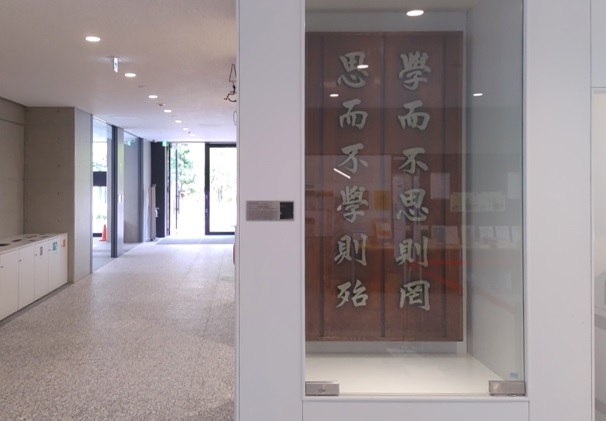
The relocated passage from the Analects
② Fujimi Gate
In addition to medium- and large-sized classrooms that can accommodate 250 to 500 people, the building houses “Tsudohi,” the largest cafeteria on the Ichigaya Campus with 502 seats, as well as a student hall, Orange Café (a snack bar), a convenience store, and Orange Hall (a multipurpose hall).
③ 80th Anniversary Building (Basement 4–2nd Floor: Library)
While many alumni likely used the building primarily as a library, the third floor and above are now occupied by research laboratories and conference rooms.Next to the rear gate facing Fujimi-zaka, a plaque inscribed by President Tetsu Nakamura at the time of the building’s completion has been installed. The plaque notes that the building was constructed on the site of the former residence of Ernest Satow, a British diplomat who was active in Japan during the late Edo and Meiji periods.
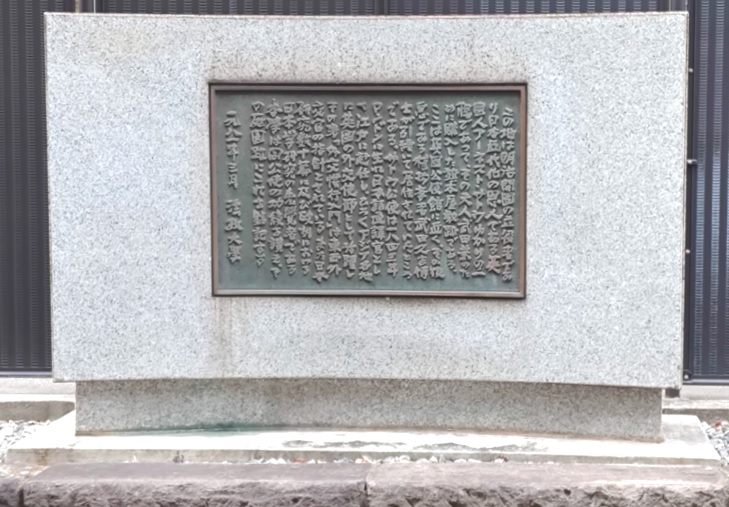
Plaque next to the 80th Anniversary Building
④ Sotobori Campus
Since it was built on the site of the former Student Union Building, in addition to classrooms, there are numerous facilities designed to support students’ extracurricular activities. In addition to music practice rooms, art studios, and a multipurpose hall, there are student lounges, study rooms, and Japanese-style rooms, as well as numerous meeting rooms available for student clubs.In addition to the Student Center and Career Center, the building houses “Satta Hall,” a large auditorium with a capacity of 870 people; medium- and large-sized classrooms that seat 200 to 400 people; seminar rooms for 30 people; and a convenience store.
⑤ Boissonade Tower
Rebuilt on the site of the former Graduate School Building and the Second 58th-Year Building, this structure has 27 stories above ground and 4 below. The lower levels house computer labs, the “Forest Garden” cafeteria,the “Helios” Student Hall; the upper floors house research laboratories and undergraduate reference rooms; and on the top floor, the 26th floor, there is the Sky Hall, which can accommodate a Noh stage.As part of this centennial celebration, a Noh performance by the Noh Research Institute—which has deep ties to the Faculty of Letters—will be held here in the Sky Hall. The Sky Hall faces east, offering panoramic views of the Tokyo Skytree, the Budokan, and the Tokyo Dome. Additionally, from the hall on the 26th floor facing west, visitors can see Mount Fuji beyond the Shinjuku Subcenter.
⑥ Guardhouse
It ensures the safety of undergraduate and graduate students, as well as faculty and staff, during the university’s operating hours.
⑦ Fujimi-zaka Campus
Acquired following the relocation of Kaetsu Girls’ Junior and Senior High School, this building has been in use since 2006. It consists of seven stories above ground and two below, and in addition to small classrooms, it houses a gymnasium, a cafeteria, and an information cafeteria. The French-style garden at the front of the building serves as a relaxing space for students.
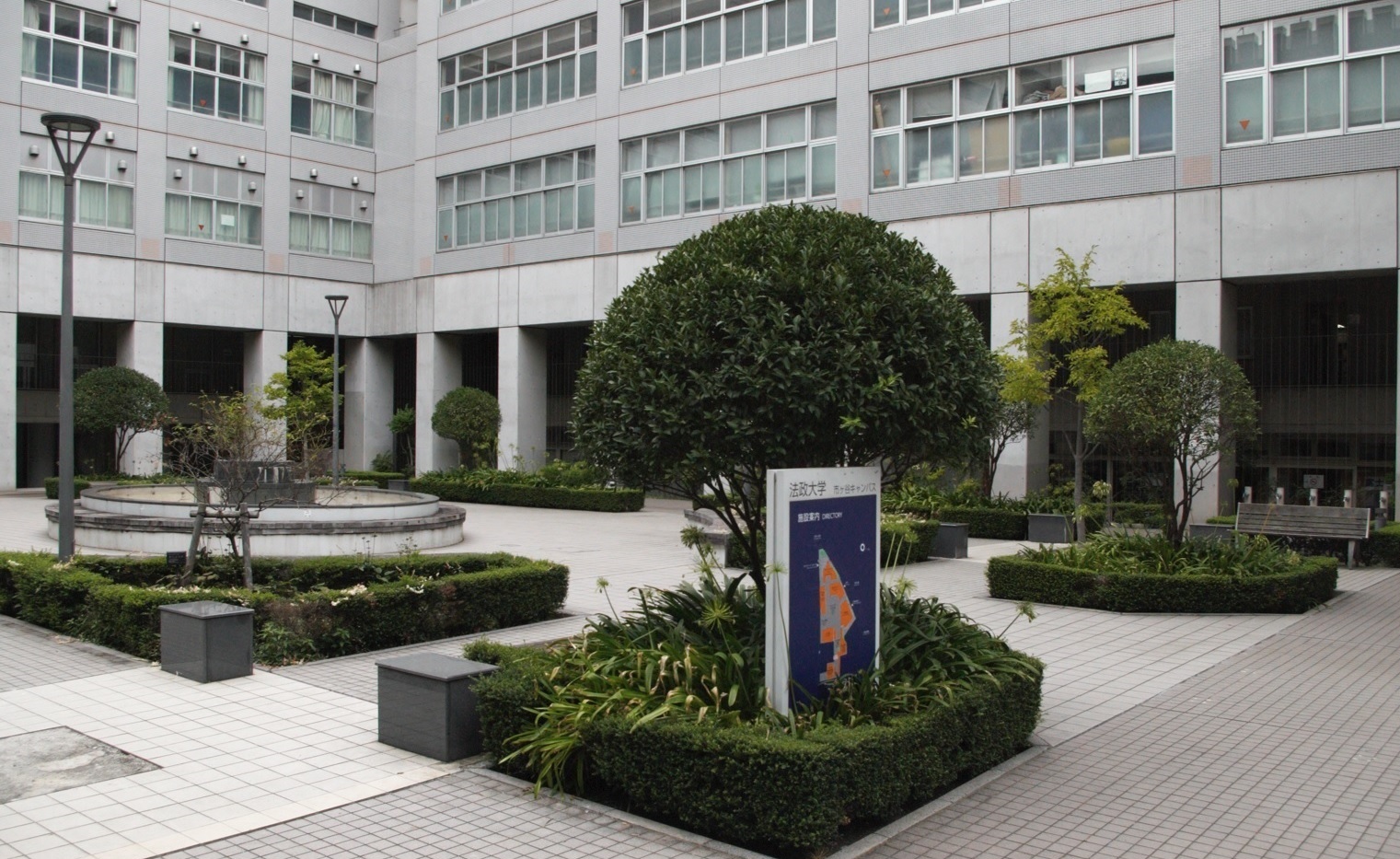
Fujimi-zaka Campus and Courtyard Garden
⑧ Ichigaya General Gymnasium
The gymnasium, built in 1975, has now become a long-standing landmark. When it comes to physical education, many alumni likely have fond memories of the Tama Campus; the Tama Campus was completed in the mid-1980s, and since then, physical education classes have been held there.Graduates from even earlier years likely recall physical education classes at Kizuki (Musashi-Kosugi, now Hosei Second High School). All students admitted since 2008 have taken physical education classes here on the Ichigaya Campus. With the acquisition of the Fujimizaka Building, the use of two gymnasiums has made it possible to offer physical education classes on the Ichigaya Campus.
⑨ Ichigaya-Tamachi Building
The Faculty of Engineering and Design currently occupies the former “62 Building,” which has been renovated. For those familiar with the old building, the interior has been completely transformed—it’s hard to believe it’s the same structure.
⑩ Center for Solidarity and Social Research and Exchange (5th Floor, Yaesu Ichigaya Building)
The Center for Research and Exchange on Solidarity Society works in close collaboration with the Joint Graduate School (Institute for Solidarity-based Society) to support its educational activities.
⑪ Niimi-tsuke Campus
Facing Sotobori-dori and located next to the Graduate School Building, the new Mitsuke Building has 10 stories above ground and 2 below. It is primarily used by the Graduate School of Engineering and Design, as well as for classrooms in the Japanese Language Education Program and as research offices for graduate students in the humanities.
⑫ Graduate School Building
Rebuilt on the site of the former Tamachi Building, it has 13 stories above ground and one below, was completed in 1992, and is used for graduate education and research.
⑬ Law School Building
Renovated from the former “69-nenkan” building, it is currently used as the Law School building.
⑭ Shin-Ikuchizaka Campus
It has six stories above ground and one below, and serves as the home of the Professional Graduate School of Innovation Management and the Graduate School of Policy Creation.
⑮ Ichiguchizaka Campus
Hosei University merchandise is sold on the first floor of this building. A variety of items are available, including books published by the Hosei University Press (
⑯ Kudan Campus, Kudan Campus Annex
The Kudan Campus, with 10 floors above ground and 2 below, houses the administrative offices for Hosei University as a whole. The Kudan Campus Annex, located behind the main building, is home to the Research Center for International Japanese Studies, among other facilities.
⑰ Kudan-Kita Campus
In April 2020, the “HOSEI Museum” opened on the first floor. The museum also has a website, so please be sure to visit it.
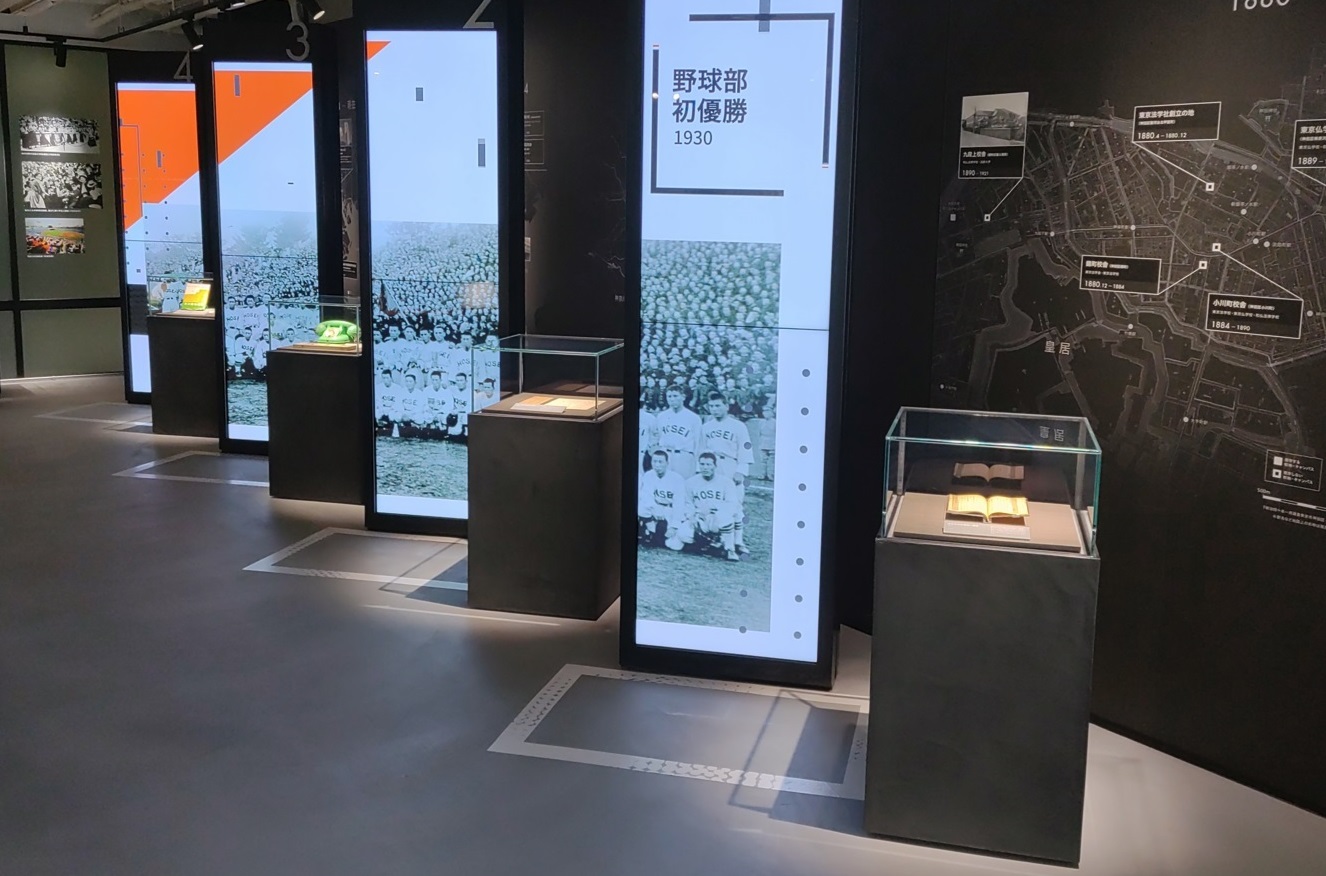
Hosei Museum First-Floor Exhibition Area
⑱ Memorial Corridor
This is the site of the 55 and 58 Buildings, which were once the iconic structures of the Ichigaya Campus.The paving stones are designed to replicate the floor pattern of the first floor of the ’58 Building. Additionally, concrete stools have been placed where the columns once stood. These serve as reminders that the ’55 and ’58 Buildings once stood on this site.You can also look out over the Ouchiyama Building—which incorporates the facades of the ’55 and ’58 Buildings—and the Ouchiyama Garden, which recreates the shape of the pond as it was when the ’58 Building was completed, making this a place that carries on the legacy of the Ichigaya Campus. In the evening, the stools and plantings are illuminated, creating an atmosphere different from that of the daytime.
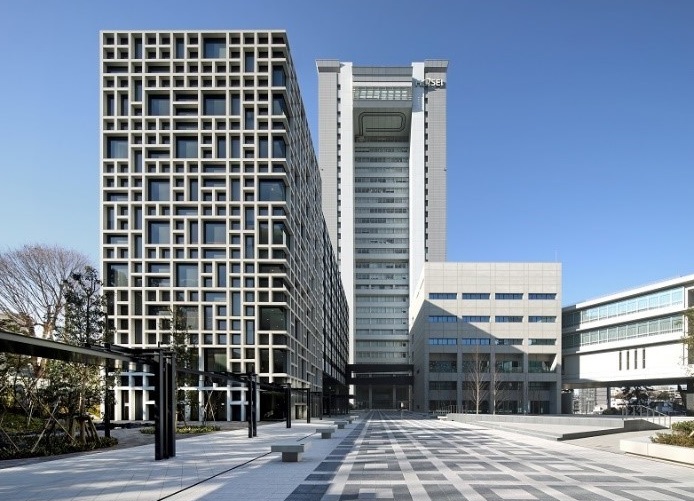
Memorial Corridor
Ouchiyama Garden
Although the Ouchiyama Garden was significantly reduced in size due to the Ichigaya redevelopment project, it still exists today. More plants have been added, and water springs from the top of the hill near the 80th Anniversary Building, flowing into the pond that surrounds the entire garden. Koi have also been released into the pond.Unfortunately, there are no benches inside the garden, but simply looking out over it provides a refreshing sense of calm. In addition, rooftop gardens have been created on the Sotobori Building and the Gate Building.
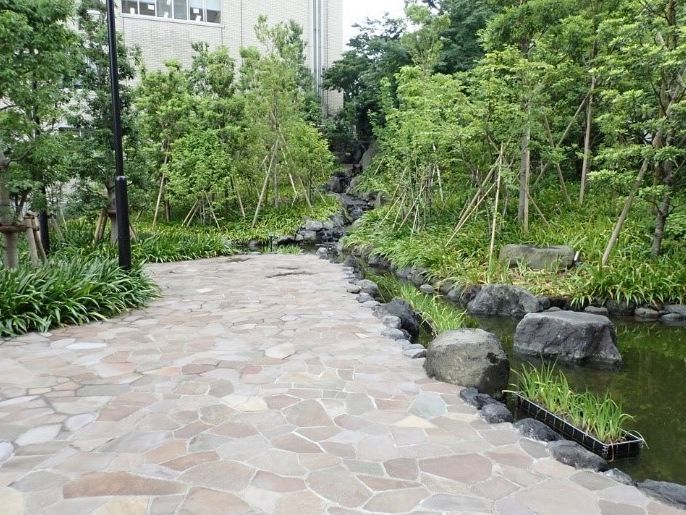
The Current Ōuchiyama Garden
- Return to the Faculty of Letters 100th Anniversary Project Homepage
Click to return to the previous page.
- Explore the “Past, Present, and Future” of the Faculty of Letters’ Six Departments Through Video
We present the distinctive features of each department from the perspectives of the past, present, and future. Please visit the links for each department on the top page.
- [Part 1] Lecture and Workshop by the Hosei University Noh Research Institute
The Hosei University Faculty of Letters 100th Anniversary Event, “The Past, Present, and Future of the Faculty of Letters—A Century of Treasures,” was streamed live on October 15, 2022. You can watch Part 1 of the archived video via the link below.
- [Part 2] Symposium: “The Past, Present, and Future of the Faculty of Letters—A Century of Treasures”
The Hosei University Faculty of Letters 100th Anniversary Event, “The Faculty of Letters: Past, Present, and Future—A Century of Treasures,” was streamed live on October 15, 2022. You can watch Part 2 of the archived video via this link.