

Profile.
Michiaki Ito
Born in Beijing, China in 1995, Mr. Michiaki Ito entered the Faculty of Science and Engineering and Department of Applied Informatics in 2014; completed his Master's degree in Graduate School of Science and Engineering (Major in Applied Informatics) in March 2020; received the Best Paper Award at IEEE CSPA 2018 in March 2018; and received the Best Paper Award at IEEE CSPA 2018. While in graduate school, he founded ChillStack Inc. with three classmates in November 2018.
I want to put cutting-edge AI technology to practical use and eliminate concerns about cyber-attacks.
Michiaki Ito is involved in the research and development of world-class AI security technology at ChillStack, which he founded with three lab mates while still in graduate school. He says that in order to accomplish what you love, you need to be willing to go through the trouble and pain.
Detecting Fraud with AI Technology and Pursuing AI Security
The traditional basis of cybersecurity was to "never get hit," but today it is a game of defense and attack, and it is now impossible to avoid attacks 100% of the time. Therefore, we are working on research and development of technologies to detect attacks and fraud at an early stage by utilizing AI (Artificial Intelligence) technology.
On the other hand, while AI technology has tremendous potential, it is also fraught with dangers. Conventional cyber-attacks are basically conducted via the Internet, but with AI, for example, a road sign could be used to influence the image captured by a camera to make the driver think that the speed limit of 30 km/h is 80 km/h. In addition, it would be inappropriate in the development stage to allow AI technology to learn. In addition, if inappropriate data is mixed in during the development stage, the AI may make unintended decisions.
In Japan, there are still few researchers and companies specializing in AI security, and each company is currently spending a lot of money and effort to take countermeasures. To provide safety and security to society, we provide "Stena," a system that uses AI technology to quickly detect users who are abusing online games and applications, and we also conduct research and educational activities related to AI security.
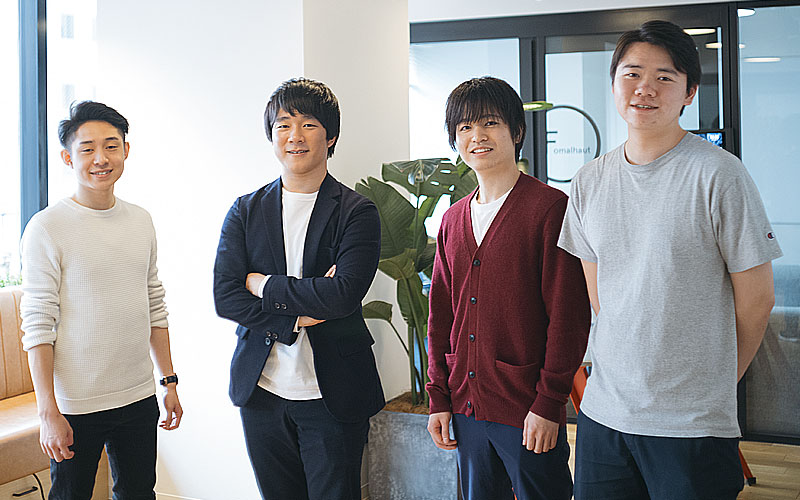
All founding members are classmates of Hitoshi Iyatomi's laboratory. From left to right: Hiroki Tani, Mr. Ito, Sasato Arai, and Yusuke Chayama.
The depth and interest in security that I learned at university
He has been familiar with online games since elementary school and vaguely wished he could program and make games. I agonized over whether to apply to the Faculty of Computer and Information Sciences or the Faculty of Science and Engineering, but I chose the Faculty of Science and Engineering because I had the impression that it had a strong connection with things like robots and machines.
After entering the school, I enjoyed the world of programming and networking so much that I was immersed in computers 24 hours a day, to the point of getting sick at one point. From my second year, I participated in the "Security Camp "*1 to broaden my horizons and increase my motivation, and also established an organization for students and young engineers called "Cpaw" together with students from other universities, and actively developed activities such as study groups and contests.
One of my most memorable experiences at the Koganei Campus is the Learning Commons, which was set up in the library in the fall of my second year. It is a convenient space for group work with whiteboards and screens, but there were still few users at that time, and I was able to take full advantage of it for studying, preparing for the development contest "Hack U "*2 , and considering the company name (Chill means relaxing).
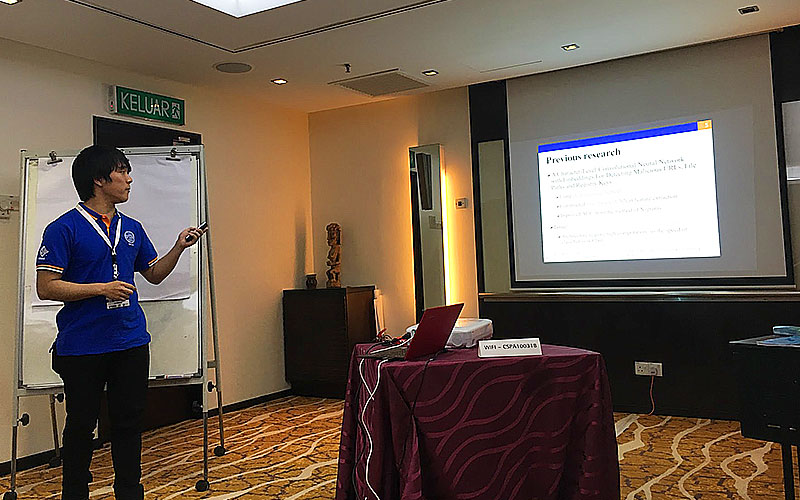
In my senior year, I presented my joint research with Dr. Yatomi at the international conference IEEE CSPA 2018 and won the Best Paper Award.
Combining two elements to create my strengths
Many people seek practicality in their university studies, but "academic studies" that serve as basic knowledge, such as mathematics or program theory, and "personal studies" that pursue personal interests and creativity, such as building websites or creating games, are two different things. I believe that the original university learning is to link these two types of learning and use them as one's sustenance.
In my third year, I decided to study other fields that can be combined with security, so I chose the Intellectual Information Processing Laboratory of Dr. Tomihito Yaiya, who specializes in medical + information engineering research. I was very interested in this laboratory because of the large number of international students in this laboratory.
This laboratory had a global atmosphere with many international students and a great machine environment, and I was able to spend an irreplaceable time there for a total of four years during my undergraduate and graduate studies. It is all thanks to this laboratory that I was able to establish my own theme of security + AI, received an award for my presentation at an international conference, and was able to start a business with my colleagues.
Determination and perseverance are needed to do what you love
Compared to the United States and China, Japan lags behind in the practical application of AI technology. Therefore, I chose to start my own business with my friends instead of finding a job, because I wanted to serve as a bridge between the research and industrial worlds and deliver a wide range of useful and interesting technologies to the world.
I am doing what I love, but just as athletes are forced to restrict their diet, there are many troublesome and painful things that come along with doing what you love. If there is something you want to do, I recommend that you devote yourself to it while you are still a student and see if you can say you "love" it, including the troublesome parts.
It is tough to keep up with cutting-edge technology while research is going on simultaneously all over the world, but I find it very rewarding to be able to anticipate changes in society. I will continue to do what I love in both research and business so that people in the world can focus on providing original services and manufacturing without being distracted by security measures.
(First published in the November/December 2020 issue of the public relations magazine "Hosei")