

Notices
Research team led by Assistant Professor Hiramori of Hosei University and Director Kamano of the National Institute of Population and Social Security Research releases the results of Japan's first nationwide random sampling survey on the living conditions of sexual minorities
- October 27, 2023
A research team led by Assistant Professor HIRAMORI Daiki of Hosei University's Faculty of Global and Interdisciplinary Studies (GIS) and Director Saori Kamano of the National Institute of Population and Social Security Research (NIPSSR)* conducted a nationwide random sampling survey of 18,000 people aged 18-69 living in Japan between February and March 2023 using the postal method (with web responses), "Family, Sex The survey was conducted by mail (with web-based responses) among 18,000 randomly selected respondents aged 18-69 living in Japan between February and March 2023. This is the first nationwide random sampling survey in Japan that estimates the percentage of the population of sexual minorities and compares the living conditions and attitudes of sexual minorities with those of non-sexual minorities (according to the research team). Prior to the survey report currently being prepared, the research team has released preliminary results on respondents' sexual orientation and gender identity, family and residential status, problems, interpersonal relationships, mental status (K6 score), and perceptions and attitudes toward family, sex, and institutions.
Members: Takeyoshi Iwamoto (Associate Professor, Kanazawa University), Yasuyo Koyama (Director, ICRS), Chi-Yen Shin (Full-time Lecturer, Showa Women's University), Kyoko Takeuchi (Project Assistant Professor, University of Tokyo), Yoshimi Chitose (Project Senior Researcher, ICRS), Hiromi Fujii (Professor, Otemae University), Kana Fuse (Director, ICRS), Masakazu Yamauchi (Professor, Waseda University)
Survey Objective
This survey was conducted with the aim of clarifying how diverse sexual orientations and gender identities, as well as dating and marriage experiences, are related to people's actual living conditions and attitudes, including their physical and mental health, economic situation, experience and desire to move residence, experience and desire to have children, and relationship with parents.
The challenges faced by sexual minorities, including lesbian, gay, bisexual, transgender, and asexual (LGBTA), in Japanese society are being clarified through quantitative surveys and interviews with sexual minorities. However, there have been limited survey studies that can estimate the proportion of sexual minorities in Japan and compare the living conditions and attitudes of sexual minorities with those of non-sexual minorities. Therefore, our research team conducted a survey ( https://www.osaka-chosa.jp/) in Osaka City in January and February 2019, where respondents were randomly selected from the Basic Resident Registers, to compare the distribution of the state of sexual orientation and gender identity of Osaka citizens and their state of mind.
The results of the 2019 survey were limited to the situation of Osaka citizens, but this time, in order to clarify the situation of Japan as a whole, we conducted this survey of 18,000 people aged 18-69 living nationwide to examine the relationship between sexual orientation, gender identity, and experiences of dating and marriage with the opposite or same sex, and people's actual living conditions and attitudes. The survey was conducted randomly throughout Japan.
Survey Methodology
- Title of the survey: National Questionnaire on Family, Sex and Diversity
- Survey period: February-March 2023
- Population and sampling: Residents aged 18-69 nationwide; 360 sites were selected from basic unit wards at the time of the 2020 census. The number of sampling points was allocated in proportion to the population of a cell combining 11 regional blocs and 5 city sizes. A total of 18,000 persons were selected at equal intervals from the basic resident register at each location (stratified two-stage random sampling method).
- Distribution and collection of questionnaires: Mail method (combined with web-based response); 17,855 subjects excluding non-deliveries, etc.; 5,339 valid responses; 29.9% valid collection rate
- Survey entity: Research team for "Constructing a Demography of Sexual Orientation and Gender Identity: Conducting a Nationwide Random Sampling Survey
- Survey consigning organization: New Information Center, Inc.
-
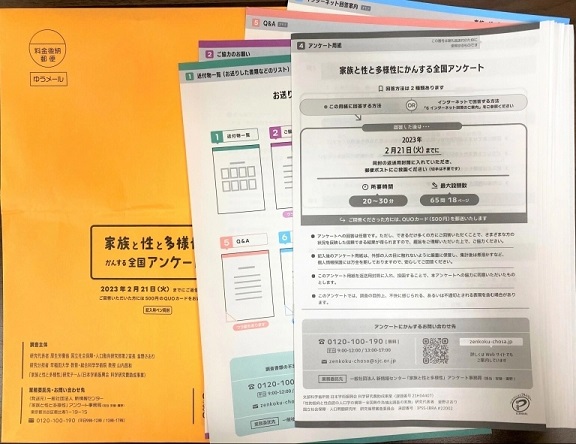
National random sampling survey "National Questionnaire on Family, Sexuality and Diversity
Main findings
- 3.5% of respondents fall into one of the following categories: "gay/lesbian," "bisexual," "asexual," [transgender].
- The percentage of those who want to have children was 33.3% for those who self-identify as "neither male nor female," 31.3% for "transgender," and 38.6% for "gay/bisexual," higher than the overall 23.4% rate.
- 66.7% of those who "do not apply to men or women," 65.6% of those who are "transgender," and 76.3% of those who are "homosexual or bisexual" want to move out, compared to 45.5% of the total respondents.
- Less than 10% (7.6%) of those who "may be experiencing serious psychological distress" (K6 score of 13 or higher) overall. 25.0% of those who "do not apply to men or women" and [transgender], and 21.1% of those who are "homosexual or bisexual" were in the 20% range
- 90% of respondents answered "no" or "don't think so" for those who have changed their gender close to them. Two out of three respondents who "do not apply to men or women" and "transgender" also answered "no" or "don't think so".
- 47.8% said they "don't want" or "somewhat don't want" their child to be homosexual, and 47.2% said they "don't want" or "somewhat don't want" their child to be a transgender person. Less than 20% responded that way if a co-worker or friend was gay or a person who changed gender
-
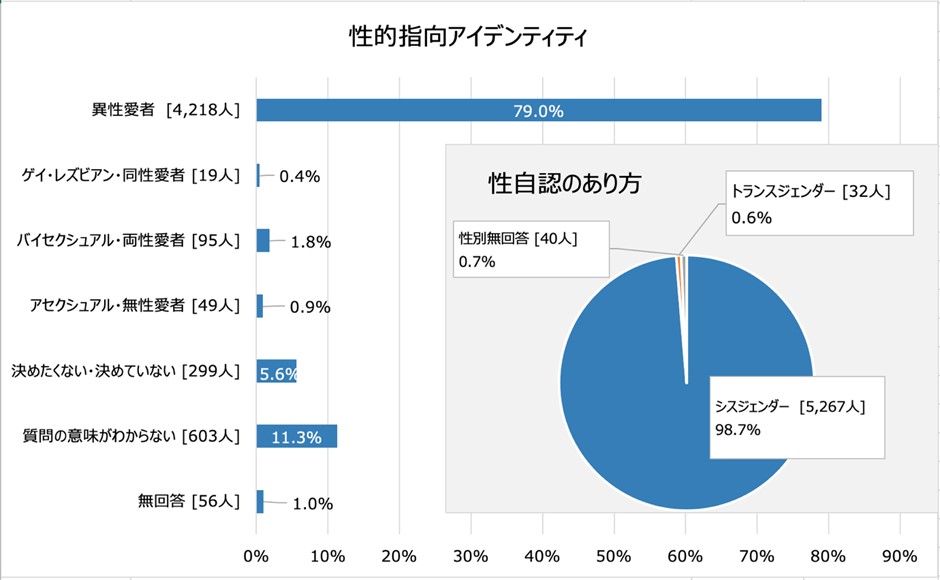
Figure 1: Respondents' sexual orientation identity and gender identity [n=5,339].
Ripple effects and social impact of the research
The survey asked a broad range of questions about sexuality and family, including romantic attraction, sexual attraction, gender of sexual partners, sexual orientation identity, and experiences of dating, cohabitation, and marriage, among people randomly selected throughout Japan, thus providing a picture of the diversity of sexuality and family in Japan today.
It has been said that questions about sexual orientation and gender identity should be avoided because they are sensitive issues, there are few opportunities to ask about sexual orientation and gender identity in Japan, and there is a concern that respondents may not be able to answer appropriately if these items are included, especially in a general survey that can be used to target anyone. It has been said that the inclusion of these items should be avoided because of concerns that respondents may not be able to respond appropriately, especially in general surveys that are open to everyone. However, the results of this survey showed that it is possible to include questions on sexual orientation and gender identity in a general survey, and that it is possible to disaggregate the results according to sexual orientation and gender identity.
Based on this experience and the results of the survey, we can provide data on differences and disparities that can lead to measures related to sexual orientation and gender identity in areas that have not received attention.
Comments from researchers
In 2023, we finally started to conduct a mail survey by random sampling from the Basic Resident Registers (BRR). In 2023, we were finally able to do so by means of a mail survey using random sampling from the Basic Resident Ledger. Due to budget constraints, we omitted the process of sending greetings and requests by postcard in advance, and we would like to take this opportunity to apologize that we had to ask for your cooperation when a set of survey documents suddenly arrived in your mailboxes. We would also like to express our sincere gratitude to the more than 5,000 people who responded to our survey in spite of this. Thanks to your responses, we were able to publish the data as national data without wasting any of the preparation and survey documents. We will continue to analyze this very valuable data from various angles, and the results will be used to examine how we can create a society in which people can live comfortably regardless of their family and sexual status.
* Here, results based on the questions of sexual orientation identity and currently perceived gender are indicated by adding " " to each option. The gender identity is classified as transgender or cisgender based on the answers to the question of gender reported at birth and currently perceived gender, and is denoted as [transgender] with [ ] to emphasize that it is not answered by the respondents themselves.
This survey was conducted with support from the Japan Society for the Promotion of Science (JSPS) Grant-in-Aid for Scientific Research (Project No. 21H04407), "Establishment of a Demography of Sexual Orientation and Gender Identity: Implementation of a Nationwide Random Sampling Survey.
This survey was approved by the Research Ethics Review Committee of the National Institute of Population and Social Security Research. (Approval number IPSS-IBRA#22002)
For more information on the "National Questionnaire on Family, Sexuality and Diversity," please refer to the following URL
https://zenkoku-chosa.jp/
For more information on previous studies, please refer to the following URL
https://www.ipss.go.jp/projects/j/SOGI/
https://www.ipss.go.jp/projects/j/SOGI2/
For inquiries regarding coverage, please contact
Public Relations Division, Office of the President, Hosei University
E-mail: pr@adm.hosei.ac.jp Tel: 03-3264-9240
For inquiries regarding the content of the survey, please contact
HIRAMORI Daiki, Assistant Professor, GIS (Faculty of Global and Interdisciplinary Studies), Hosei University
E-mail: daiki.hiramori.43@hosei.ac.jp