

Notices
Sewage x Agriculture: Smart Agriculture Demonstration Project Utilizing Sewage Resources in Yokohama City" visit "full of particulars" eco-tour was a great success! (Monday, March 4, 2024)
- Mar 08, 2024
- Events and Occasions
On Monday, March 4, 2024, Hosei University's Center for Environment held an eco-tour of the "Smart Agriculture Demonstration Project Utilizing Sewerage Resources in Yokohama City".
The first "eco-tour" was a visit to the Northern Sewerage Center (Northern Water Reclamation Center No. 2) located in Tsurumi Ward, Yokohama City, to see the sewage treatment facilities used in the "Yokohama City Smart Agriculture Demonstration Project Utilizing Sewage Resources".
In Yokohama City, apart from 18 administrative districts, sewage is divided into nine areas according to topography to facilitate collection of sewage, which are called sewerage treatment areas, and approximately 1.5 million m2 of sewage is treated each day. Sewerage facilities include sewage pipes with a slight slope, a water reclamation center that turns sewage into clean water, a sludge recycling center that converts sludge into resources, and pumping stations that relay sewage or discharge rainwater into rivers or the ocean.
Sewage is treated 24 hours a day by staff who remove organic matter, nitrogen, phosphorus, and other substances by utilizing the action of microorganisms in the activated sludge. Sludge generated after sewage treatment is used as fuel, etc., and recycled water is used as a heat source for air conditioning, toilet water, water for streams, etc. Demonstration projects for flower and vegetable cultivation are also being conducted.
The biotope at the site of the Northern Sewerage Center (Northern Water Reclamation Center No. 2) uses treated water from the Water Reclamation Center, and is a habitat for a variety of insects and birds, such as the red-faced tree, the white-fronted damselfly, and the yellow-breasted nuthatch.
Next, we visited the Northern Sludge Recycling Center, located on the same site, where experiments are being conducted to demonstrate the cultivation of pansies and cyclamen (PR house) and komatsuna (research house) using recycled sewage water rich in phosphorus and other fertilizer materials and sewage heat and other sewage resources, with temperature and humidity controlled using smart agricultural equipment. The tour included a visit to an agricultural greenhouse.
In the smart agricultural greenhouses that utilize sewage resources, treated sewage water and recycled water rich in nitrogen and phosphorus necessary for plant growth generated in the sewage treatment process, CO2-containing gas used for cultivation after treating the gas generated in the reaction tank, and air conditioning equipment using treated sewage water as a heat source were being utilized. In addition, an environmental control system was used to control the environment. Furthermore, an environmental control system remotely monitors the environment inside and outside the greenhouses and automatically controls agricultural equipment. By utilizing the environmental control system, equipment can be operated at the ideal timing for plants, optimizing the environment inside the agricultural greenhouses and reducing the number of times work is performed in the greenhouses, leading to labor savings.
In the "eco-tour," participants will visit the Northern Sewerage Center (Northern Water Reclamation Center No. 2) and the Northern Sludge Recycling Center located in Tsurumi Ward, Yokohama City, and learn about the "Smart Agriculture Demonstration Project Using Sewerage Resources" being implemented by the Yokohama City Environment and Creation Bureau. This was a valuable opportunity to hear directly from front-line practitioners about the "Smart Agriculture Demonstration Project Utilizing Sewerage Resources" being implemented by the Yokohama City Environment and Creation Bureau.
In Japan, the agricultural sector is facing serious issues such as an aging population and a lack of skilled farmers. However, by learning about Yokohama City's cutting-edge knowledge in the field of agriculture, which aims to discover and utilize the potential of sewage resources, participants were able to think about the future of agriculture on our "irreplaceable earth," which is difficult to divide into different categories based on economic rationality. The "eco-tour" organized by the Environmental Center was a great success.
Hosei University Environmental Center will continue to explore the mysteries of the irreplaceable earth we live on, being conscious of the connection between each of our actions and nature.
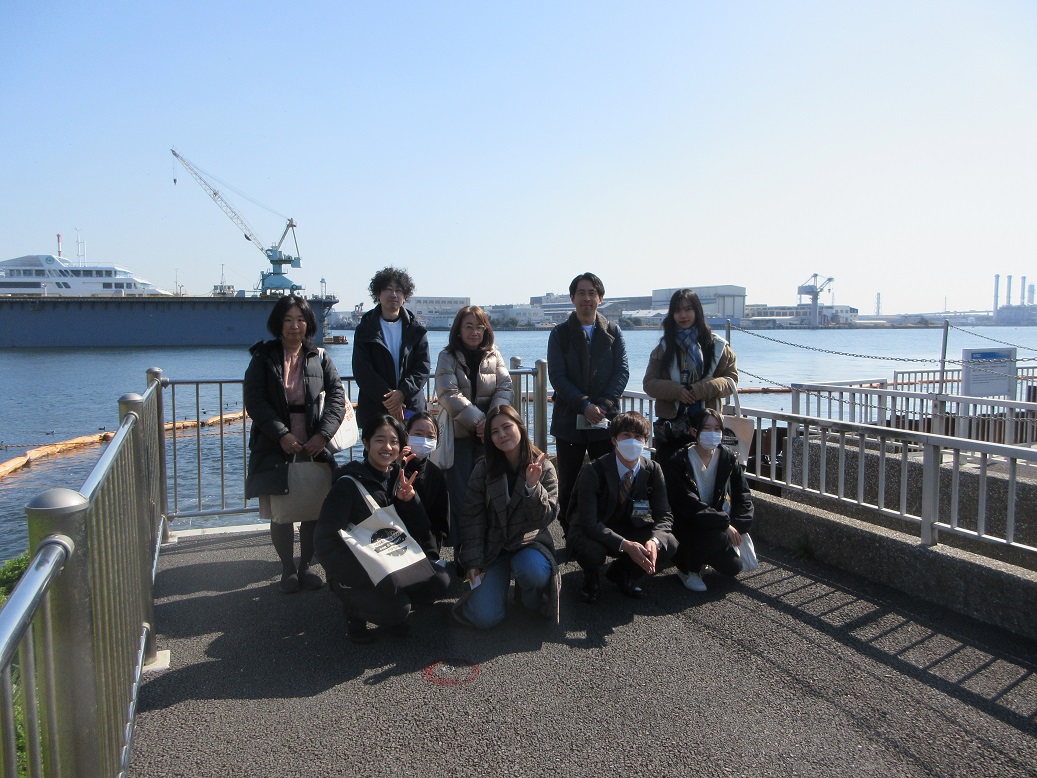
On the day of the event, we were given a special tour of the sewage treatment facilities by Mr. Taichi Yamamura, Policy Division, Policy Coordination Department, Bureau of Environment and Creation, followed by a commemorative photo at the discharge outlet where sewage treated at the chlorine disinfection facility is discharged. It is said that the spread of public sewage systems has reduced the concentration of BOD (Biochemical Oxygen Demand) and cleaned up the water in the rivers of Yokohama City. The outlet to Tokyo Bay is home to a variety of organisms. In the back row, left, is Ms. Naoko Enomoto of Hosei University's Environmental Center, who planned the "eco-tour" with "a lot of attention to detail.
-
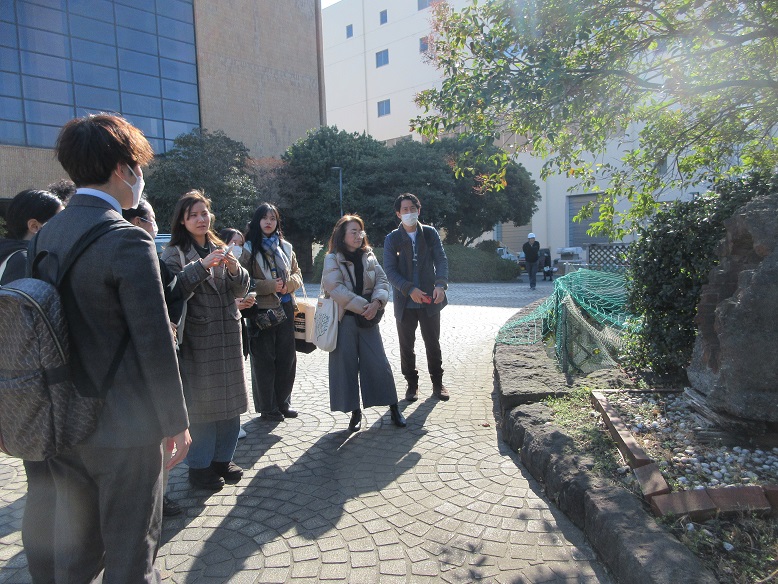
On the grounds of the Northern Sewerage Center (Hokubu No. 2 Water Reclamation Center), there was also a display of relics, including a sewage pipe (found in Yamashita-cho, Naka Ward, the city) that was modified into an egg-shaped brick pipe to prevent an epidemic that spread in the early Meiji period (1868-1912).
-
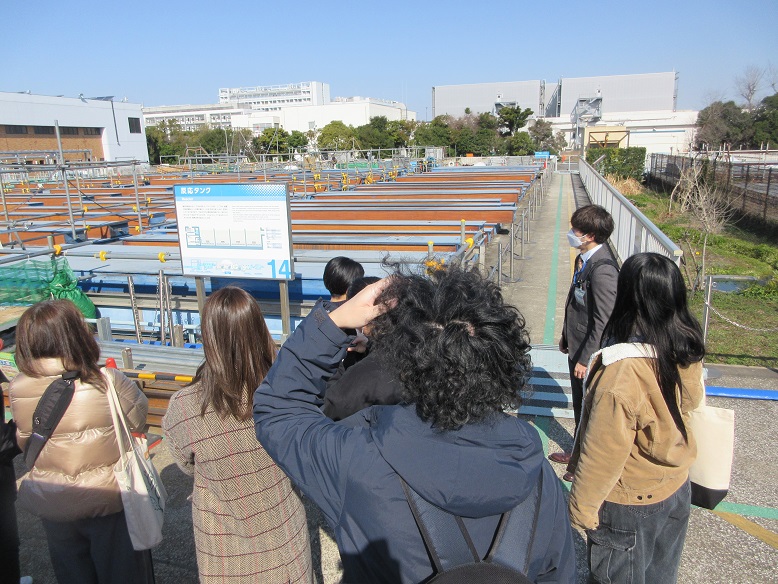
Suspended solids in the inflow water slowly sink, and the effluent is sent to the reaction tank, while the sludge that has sunk is sent to the sludge recycling center. In this reaction tank, the sludge is mixed with mud (activated sludge) containing microorganisms such as bacteria and protozoa and stirred with air. The sewage dirt becomes food for the microorganisms, and the mud clumps together and sinks easily.
-
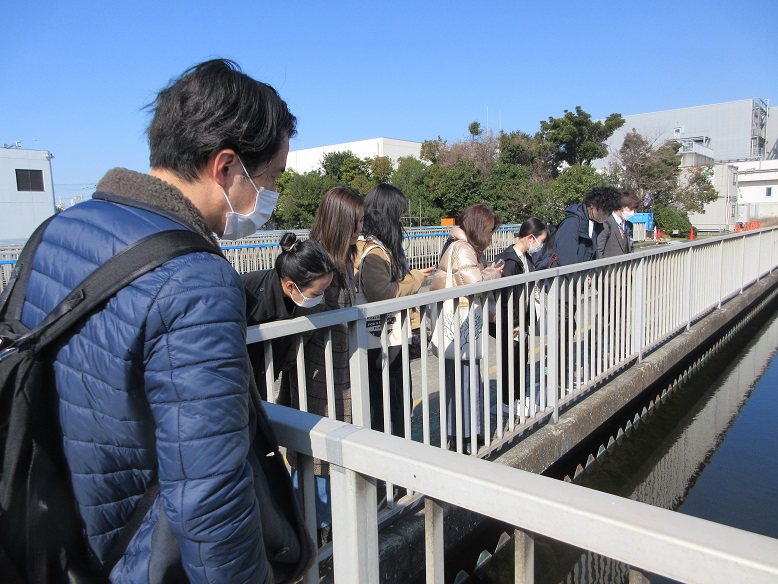
The participants eagerly look into the final sedimentation tank to see what the sewage looks like after it has been treated by the microorganisms. The sludge (activated sludge) created in the reaction tanks is submerged in this pond and collected by a sludge collector. The collected sludge is returned to the reaction tank, and the excess is sent to the sludge treatment facility. Lightly floating dirt on the surface of the water is removed by the equipment, and the clear water at the top is sent to the chlorination facility.
-
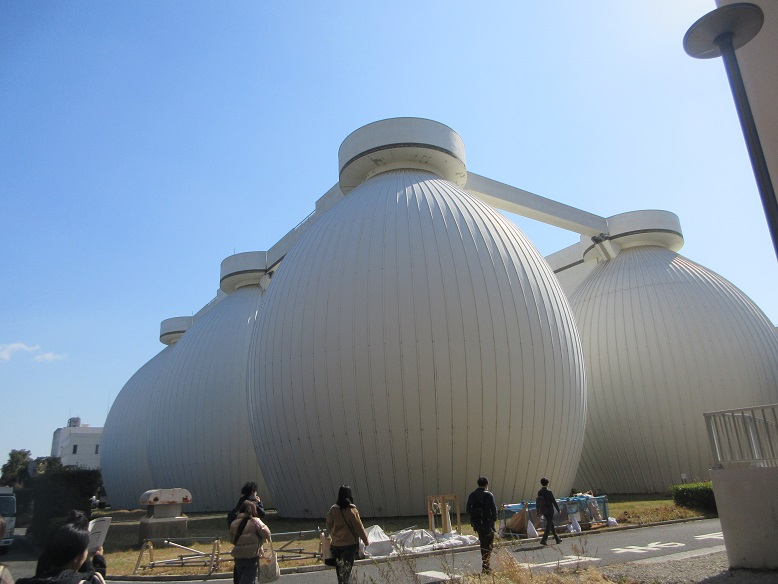
After the final sedimentation pond, we visited the chlorination and disinfection facility, the treated water reuse facility, and the discharge outlet, and finally arrived at the site of the Northern Sludge Recycle Center.
-
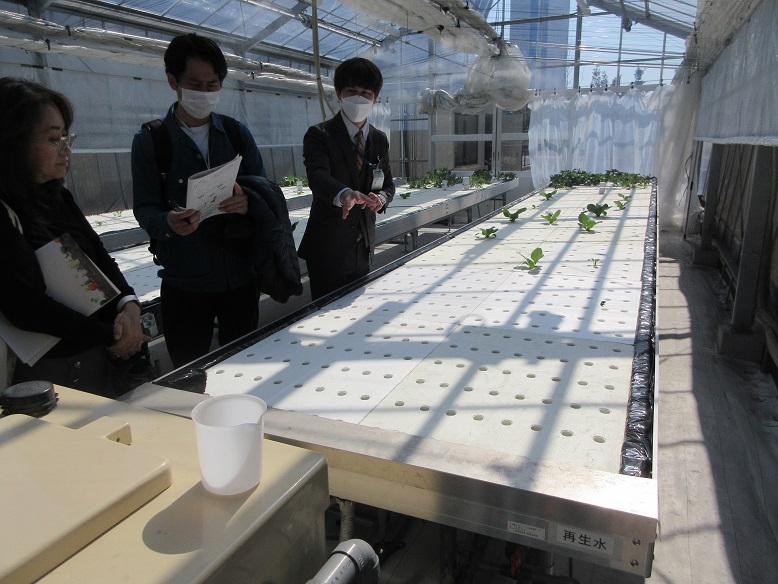
In the research house, comparative research is being conducted on vegetable cultivation using treated water, which is rich in nitrogen and phosphorus necessary for plant growth, and recycled water that has undergone advanced treatment such as chlorination and filtration to the treated water, and tap water. Students from Tokyo University of Agriculture, who are participating in the demonstration experiment in collaboration with the City of Yokohama, were also there on the day to maintain the facilities and conduct research.
-
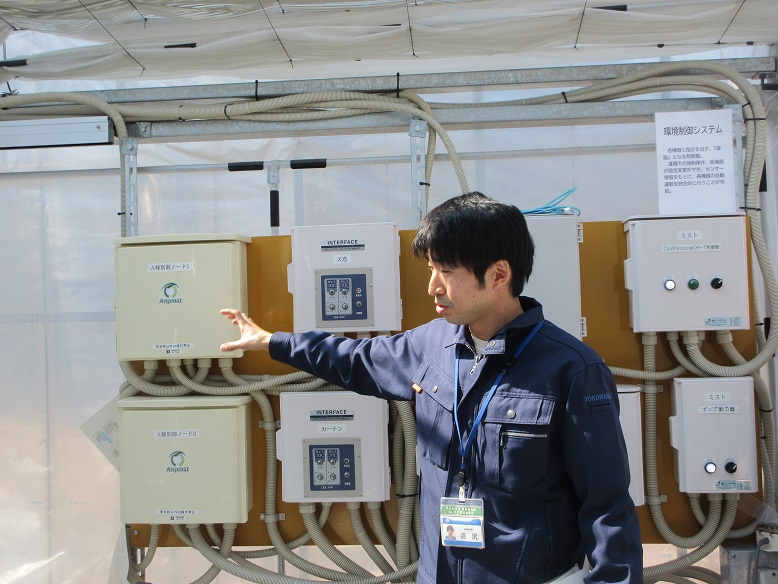
In the PR House, the cultivation of cyclamen, pansies, and other flowers is being demonstrated using a bottom irrigation bench that compares recycled water and tap water. On the day of the demonstration, Mr. Yuta Numajiri, Chief of Agricultural Promotion Division, Agricultural Policy Department, Environment and Creation Bureau, Yokohama City Government, spoke about the smart farming project using the environmental control system.
-
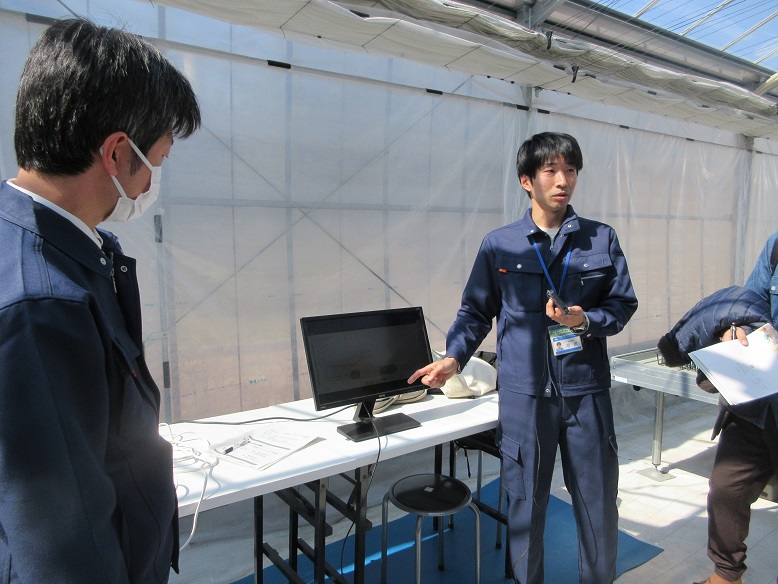
In the demonstration experiment, the environmental control system can be used to remotely operate the system using smartphones and other devices, change the settings of each device, and automatically operate each device based on sensor information.
-
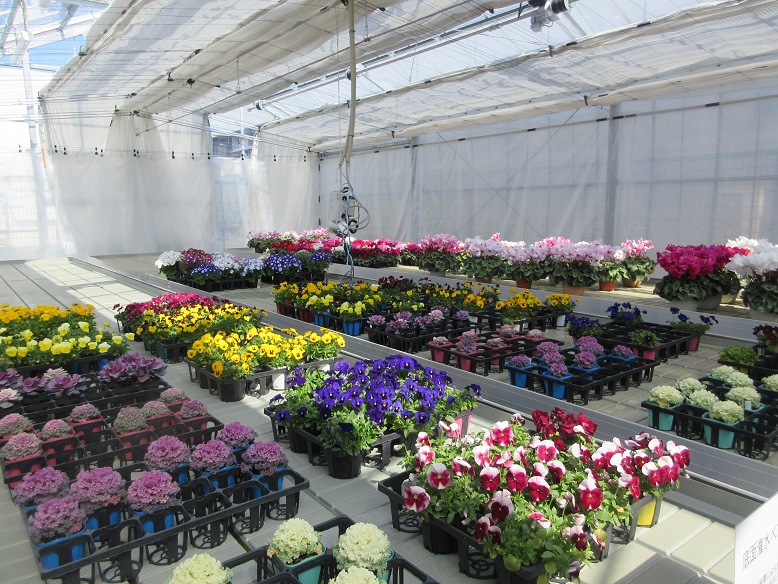
In the PR house, cyclamen, pansies, leaf buttons, etc. were being grown. By utilizing the automatic watering system, it is possible to water the plants more evenly than with normal watering, which leads to labor savings.