

Notices
The Triangle Port Canopy and Dejima Gate Bridge (Ryuichi Watanabe, Department of Civil and Environmental Engineering and Design, Faculty of Civil and Environmental Engineering and Design)
- October 23, 2020
The following is an introduction to the research and awards received by faculty members who received awards and recognitions in 2019.
Ryuichi Watanabe, tenured lecturer, received the following award.
- The 5th Aoba Kogyo Kai Incentive Award in 2008" (Aoba Kogyo Kai (Alumni Association of the Faculty of Engineering, Tohoku University))
Achievements "Design of Dejima Omote-mon Bridge and the process of bridge building" - The 5th Town Square Award, Incentive Prize" (The National Land Policy Research Institute, Public Space "Quality" Research Subcommittee)
Achievement "Triangle East Port Plaza Hazue no Koen (Umini no Koen) (Triangle Town, Ugi City, Kumamoto Prefecture, Japan) - Nagasaki City Urban Landscape Award 2019 Urban Landscape Prize in Public Facility Category" (Nagasaki City Urban Landscape Award Commendation Executive Committee)
Work "Dejima Omote-mon Bridge, Dejima Omote-mon Bridge Park (Edomachi, Edo Town)

Triangle Port Canopy (Town Square Award)
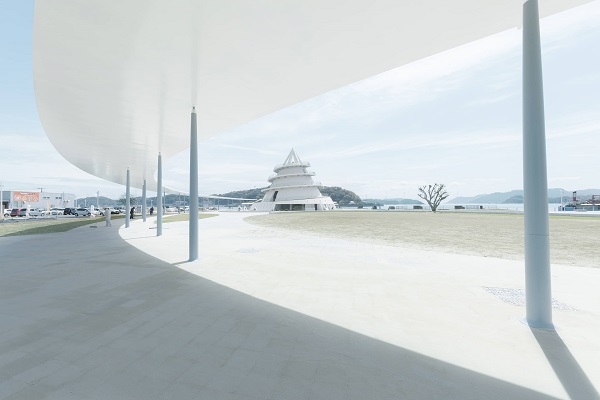
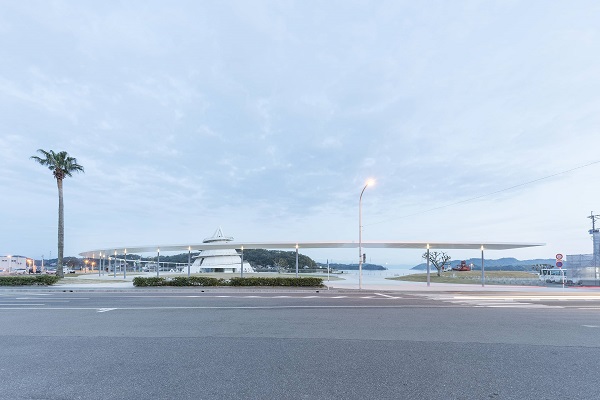
It takes about 40 minutes from JR Kumamoto Station to the terminus of the A train, a sightseeing train, at the Misumi Station. When I got off the train and arrived at the station, I saw a sea pyramid built in the 90's and a large parking lot before maintenance. The "Port of Triangle Port Seaside Space Creation Project" is a project to transform the station into a park and a space in front of the station where local residents can hold events and tourists can stay while waiting to transfer from the station to the ferry bound for Amakusa. This project is a canopy that guides visitors from Triangle Station to the ferry terminal. When we draw its plane, it naturally becomes a circular arc. We pursued how to design the canopy of the plane of the arc in a simple way.
The design conditions were free, except that the roof should be set at a height that would not block the view to the sea from Triangle Station, and that the ceiling height should be 4.5 m, considering the possibility of doubling as a roof for a future bus stop. The roof is simple and flat to balance the strong geometrical shape of the sea pyramid and the curving landscape of the organic Amakusa Shimanami, and the pillars are made of cast steel, with the upper part machined into a parabolic shape and the lower part blending in with the ground while retaining the cast surface. The upper part is machined into a parabolic shape, while the lower part blends in with the ground while leaving a cast surface. Optical glass lighting is installed at the top of the pillar, and cast steel is used for the support to create a harbor scene. The reason for this is that we imagined a quiet scene with a series of dots of lights on the pillars in the dark blue seaside landscape at night.
In the daytime, on the contrary, the pillars rise from the ground with a sense of massiveness, and the roof floats. The structural system is a ring girder-like structure that uses the tops of the columns as pins and utilizes the planar alignment of the arcs to eccentrically shift the columns inward, balancing the structure as a whole. From a distance, the regular columns and simple arc harmonize with the landscape of the harbor, which includes a pyramid of the sea. Conversely, as a walking space, the irregularity of the columns, with their eccentricity and the irregularity of the columns themselves, creates a diverse and varied space.
-
Triangular Port Canopy
-
Triangular Port Canopy
Dejima Omote-mon Bridge (Nagasaki City Urban Landscape Award)
Dejima, Nagasaki is located at the southern tip of the Japanese archipelago. During the period of national isolation, Dejima was the only small man-made island that was connected to the rest of the world. A small stone bridge with a length of 4.5m crossed the island. During the Meiji period (1868-1912), part of the fan shape was cut away due to the Nakajima River alteration work, the river widened to 30m, and the small stone bridge was removed.
As of 2017, the stone bridge itself could not be restored, so a new modern bridge, Dejima Omote-mon Bridge, was built at the location of the old bridge, which was identified based on excavation surveys. This year marks the 382nd anniversary of the construction of Dejima, and the first time in 130 years. Japan's first steel, concrete, and stone bridges all began in Nagasaki. Another bridge built with modern design and construction technology was born in the history of Nagasaki.
There are two design concepts. The first is to respect the landscape of Dejima, aiming for an appropriately scaled structure without any structure on top. It is important to design the structure to harmonize with the surrounding landscape and context in a modest way in the historical landscape.
Second, do not install piers in the river. According to the River Structure Ordinance, piers generally have an obstruction ratio of 5% or less, and the standard span length is determined by the planned high water volume (less than 500 m3 /sec) and river width (30 m or more). In the Nakajima River, where the project site is located, the standard span length is 15m, and one bridge pier could be planned in the river. However, we decided not to install piers because the river had suffered severe flood damage in the past and it would not be aesthetically pleasing in terms of river scenery. The Dejima Omotegate Bridge is a 38.5m long, 4.4m wide, two-diameter steel continuous plate girder bridge with a main span of 33m and side spans of 5.2m. Since abutments cannot be installed on the Dejima side, two fulcrums are installed on the Edomachi side on the opposite bank to counterweight the abutments and support the 33m span. The balance of forces enables the height of the girder to be reduced, and at the same time, the reaction force on the Dejima side can be suppressed by about 25% compared to the case of a simple girder. In order to further reduce the reaction force, a fabrication camber is also set.
Conceptually, the structural system changes from a cantilever girder under dead load to a two-diameter continuous girder under live load. To be precise, the load of about 50 kN is applied to the dejima side even during the dead load to prevent uplift when wind load is applied. The bridge was built using local Nagasaki shipbuilding technology, transported by sea on ships and overland to Dejima on multi-axle bogies, and erected in a single operation with more than several thousand people watching over the bridge. In order to respect the continuity of the pavement and the scale of the building with the urban axis of Nagasaki (Nagasaki Kaido) in mind, the scale of the bridge is finely divided by horizontal fins that function as stiffening materials while providing openings in the girders. In order to harmonize with the existing historical buildings, the bridge is painted in a silver-mouse color with a particulate luster.

Dejima Omote-mon Bridge
Department of Civil and Environmental Engineering and Design, Faculty of Engineering and Design, Hosei University
Ryuichi Watanabe, Specially Appointed and Tenured Lecturer (Ryuichi Watanabe)
Born in Yamanashi Prefecture in 1976, Ryuichi Watanabe graduated from the Department of Architecture, Tohoku University in March 1999, and received his Master's degree in Urban Major in Architecture from the Graduate School of Engineering, Tohoku University in March 2001.
2001-2008: Worked at Civil Engineering Design Office (Tokyo, Japan). 2008: Freelance - Exhibition "Hands" (exhibition planning and space design), Civil Engineering Institute. 2009-2012: Worked at Ney & Partners (Belgium). 2012- President of Ney & Partners Japan, Inc. 2017- Specially Appointed and Tenured Lecturer, Department of Civil and Environmental Engineering and Design, Faculty of Engineering and Design, Hosei University, Tokyo. He has been designing civil engineering structures, mainly bridges, and product design with private manufacturers, focusing on structural (technical) ideas, and proposing a fusion of design and structure from an incisive point of view. Projects in Japan include Sapporo Tram Stop, Triangle Port Canopy, Nagasaki Station Square, Dejima Omote-mon Bridge, Railway Station Building, Pedestrian Deck, product development (canopies, sign posts, street furniture), and Japan House London Staircase (structural design).
- Affiliation and position are current at the time of publication.