

Notices
Why are the flashy red mites we see on concrete walls in early spring so red? ~Hosei University and Kyoto University research group elucidates the cause of bright red body color
- December 23, 2022
A research group led by Professor SHIMANO Satoshi of Hosei University's Natural Science Center/ Faculty of Intercultural Communication and Associate Professor Masahiro Joube of Kyoto University's Graduate School of Agricultural Communication has now elucidated that the bright red body color of the cave mite is due to its accumulation of a large amount of antioxidants that protect the body from ultraviolet radiation in the early spring. Although humans may worry that the mites are easily spotted by natural enemies, most insects (ants, etc.) that are natural enemies do not see red light out of visible light, so it is thought that their flashy red color does not necessarily mean that they are easily spotted by natural enemies.
The key points of the announcement are as follows.
- The cave mite Balaustium murorum (Hermann), found on concrete walls in early spring, belongs to the genus Anatidae and feeds primarily on pollen at all developmental stages. This species is widely distributed in the Northern Hemisphere (mainly in Eurasia), but has never been scientifically investigated, despite the fact that many people around the world wonder why it has a conspicuous red color.
- It hatches and becomes active in March, lays eggs during the rainy season, and then lies dormant in its eggs until the following spring. One of the most important survival challenges is to withstand the strong ultraviolet rays in the early spring, the center of their survival activities, and a living environment that can reach over 40 degrees Celsius due to radiant heat.
- The red pigment of the caveated spider mite was determined by HPLC to be composed of the antioxidant ketocarotenoids astaxanthin and 3-hydroxyequinenone (60% and 38% of the major carotenoids, respectively) and a small amount of β-carotene (2%). The mandarin orange spider mite is one of the most abundant known mite species in terms of astaxanthin, but the astaxanthin concentration in the caveated spider mite was 127 times higher than that in the mandarin orange spider mite. This is why their body color was red.
- Insects that prey on the cave mite, such as ants and predatory stink bugs, do not normally have photoreceptor cells for red, so the showy red color of the cave mite is not likely to have affected the foraging behavior of predators as much as humans may be concerned.
The cave anata mite Balaustium murorum (Hermann) is a pollen-eating free-living mite with a flashy red body color, even though this and similar species are widely distributed in the Northern Hemisphere (mainly in Eurasia) and many people around the world wonder why it has a prominent red color, It has never been scientifically investigated before.
The genus Balaustium, to which this species belongs, differs significantly from other mites in the family Erythraeidae, which have (1) distinctive secretory organs (holes) called urnulnae, from which the Japanese name is derived, and (2) the characteristic that they do not parasitize insects in their larval stage but feed mainly on pollen in all generations. (2) It is not parasitized by insects in its larval stage, but feeds mainly on pollen in all generations. This species of cave anata mite occurs in early spring (mid-March in Tokyo), literally in sunny locations on concrete walls and other man-made structures, lays its eggs around the rainy season, and remains dormant in the eggs until the following spring. Therefore, the cave mite is exposed to oxidative stress caused by the production of reactive oxygen species (ROS) in the harsh environment of strong ultraviolet rays (UV-B) and radiant heat in early spring.
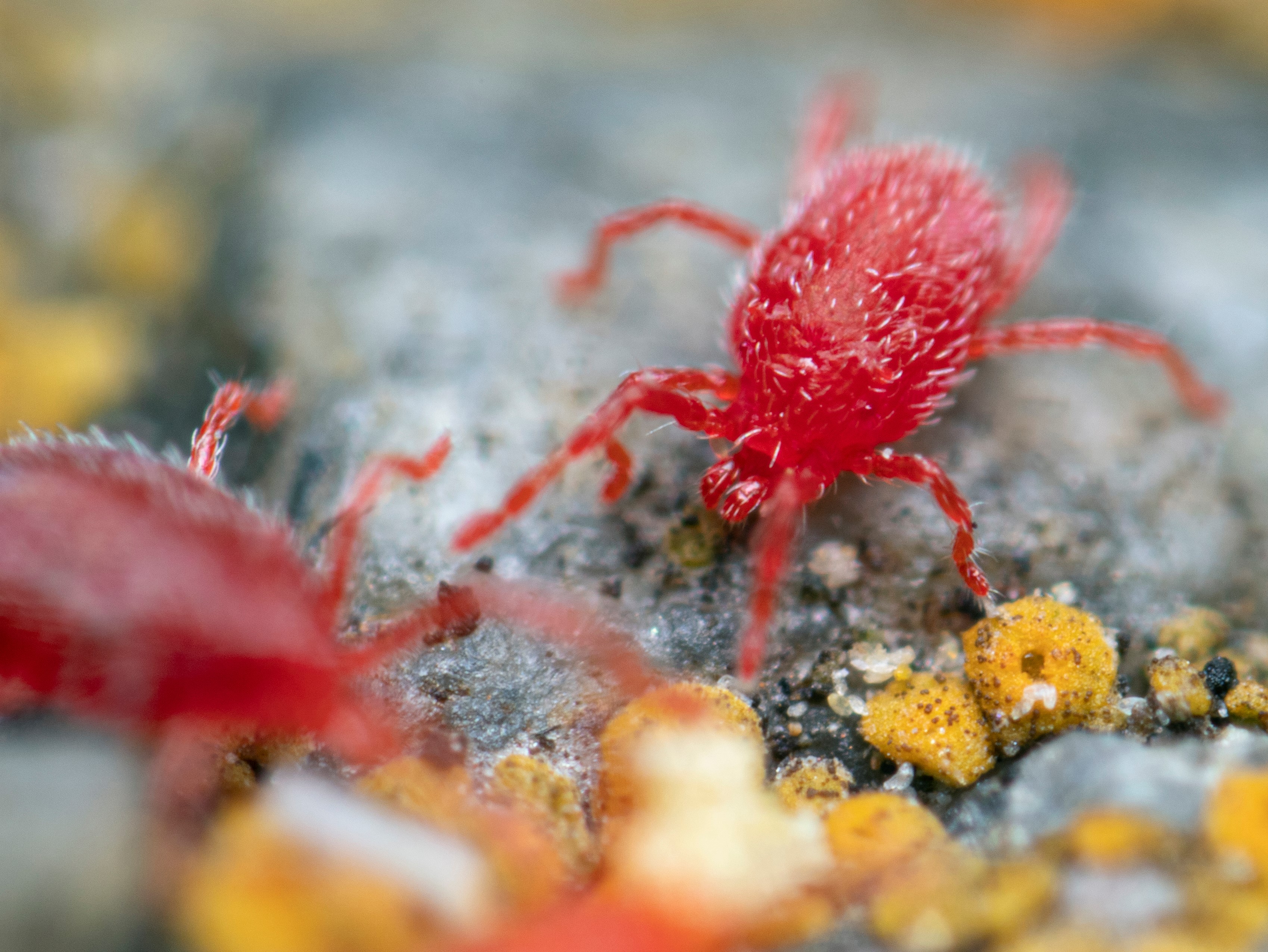
Cave Anata tick (Photo: courtesy of Mr. Takamasa Nemoto)
For example, the mandarin orange spider mite Panonychus citri, which lives on plant leaves and is exposed to strong sunlight, is known to synthesize and accumulate astaxanthin, which has antioxidant properties, to protect itself from oxidative stress. Therefore, we determined the carotenoid composition in the pigments of the caveolae spider mite Panonychus citri. To identify the major carotenoids, pigments in vivo and pigments de-esterified from female Caveana tabacara mites were analyzed by high-performance liquid chromatography (HPLC).
The results showed that the flamboyant red pigments of the cave anata spider mite were composed of the antioxidant ketocarotenoids astaxanthin and 3-hydroxyequinenone (60% and 38% of the major carotenoids, respectively) and a small amount of β-carotene (2%). The tangerine spider mite is one of the mite species known to have a significantly higher amount of astaxanthin (per protein), but the astaxanthin concentration in the cave mite (334.8 ng/µg protein) was 127 times higher than that in the tangerine spider mite (2.63 ng/µg protein). This amount was 127 times higher than that of the mandarin orange spider mite (2.63 ng/μg protein). This is the highest level among microarthropods such as crustaceans that have been reported.
The ketocarotenoids synthesized and accumulated by the mites from the pollen they feed on have high antioxidant activity and may help the mites survive under the harsh conditions of solar ultraviolet light and radiant heat in their habitat, such as concrete walls. Because of the high accumulation of ketocarotenoids with antioxidant activity, this mite species had a showy red body color. Since insects that prey on the cave mite, such as ants and predatory stink bugs, do not normally have photoreceptors for red (because they cannot distinguish red), the flashy red color of the cave mite is not likely to affect the foraging behavior of these predators as much as humans may be concerned.
Journal: Experimental and Applied Acarology, published Tuesday, December 13, 2022
Title of paper: The flashy red color of the red velvet mite Balaustium murorum (Prostigmata: Erythraeidae) is caused by a high abundance of the keto-carotenoids, astaxanthin and 3-hydroxyechinenone
Authors: Masahiro Osakabe & Satoshi Shimano* (*Responsible Author)
https://doi.org/10.1007/s10493-022-00766-z
For inquiries regarding this matter, please contact
SHIMANO Satoshi, Professor, Center for Natural Science and Technology and Faculty of Intercultural Communication, Hosei University
E-Mail: sim@hosei.ac.jp