

Notices
(Ichigaya Campus) Disaster Drill for the Fall Semester of FY2022 was held for the staff.
- December 19, 2022
- Events and Occasions
On November 25, 2022, the Ichigaya Campus conducted a disaster drill for employees up to the fifth year of employment.
Under an agreement with Chiyoda Ward, the Ichigaya Campus temporarily accepts Chiyoda Ward residents and workers who are unable to return home in the event of a large-scale disaster. The purpose of this training was to prepare for the eventuality of being involved in the operation of an evacuation facility, and to experience a pictorial training known as the "KUG (*) Game" (*), which simulates the actual gymnasium used by the university to receive people who have difficulty returning home, to prepare oneself in advance, respond quickly, and discover issues to be addressed in the operation. The purpose of the training was to discover issues that need to be addressed in advance and in the immediate response and operation of the facility.
We would like to thank the students who took the ILAC course "Problem-Solving Fieldwork for SDGs" (Faculty of Law: Prof. ITO Mamoru) in the fall semester of FY2022, Prof. Ito, and the Student Center for their great cooperation in conducting this drill. Among them, eight student staff members played an especially active role as facilitators, serving as moderators, explaining KUG, and facilitating group work. I believe that this was a valuable experience that led to "Practical wisdom education," in which what students learned in class was taught to staff members, and at the same time, new "insights" were discovered, such as the difference between the students' and staff members' perspectives.
In addition to our university staff, many people from the Fujimi 2-chome neighborhood association and people from neighboring universities participated in the event through cooperation with the Chiyoda-ku Consortium. Since mutual cooperation is essential in the event of an actual large-scale disaster, it was very meaningful for us to be able to share our awareness of the issues at this time.
*: A graphical training tool developed jointly by the University of Tokyo's Hiroi Laboratory and SOMPO RISCARE MANAGEMENT to enable a small number of people to experience how to respond to a stay at an office after a large-scale earthquake in a short period of time.
| Date and Time |
November 25, 2022 (Friday) 12:40-17:20 |
| Place | Sky Hall, 26th floor, Boissonade Tower |
| Participants | 43 employees in their first to fifth year of employment, 7 from other universities, 1 from Fujimi 2-chome Community Association, 8 student staff (SA) |
Contents
- Guidance
(1) Keynote Speech: Mr. Kenya Miyazaki (Coordinator of Disaster Support and Education)
(2) Sharing the crisis preparedness awareness gained from the KUG experience (Mr. Kozohara, 2nd year, Faculty of Sustainability Studies)
The purpose of this event was to help students acquire an awareness of crisis preparedness, and after stating that "crisis preparedness is to question I think. Please cherish the sense of bewilderment (doubt) that remains after this KUG experience". - Facility tour (disaster prevention warehouse, general gymnasium)
- Pre-KUG study
- KUG practice
We were divided into 8 groups and each group was joined by an SA to proceed with KUG. During the KUG, Mr. Kobayashi, the chief of the Student Center, gave the participants a quick and speedy briefing on the situation, and they were bewildered but responded to the situation through team discussion with a sense of urgency. - Reflection and exchange of opinions
Each group made a presentation on (1) the results of their responses to the event card and (2) the proposed improvements to the basic acceptance policy. Some participants also offered suggestions from experts such as public health nurses and dietitians. Through these presentations, the participants were able to share the difficulties faced by the management of the host institution and the issues faced by the University.
In addition, two SAs (Mr. Ebisawa, 2nd year student, Faculty of Sustainability Studies, and Mr. Yoneyama, 1st year student, Faculty of Sustainability Studies) gave a presentation on "Ten Articles for Hosts" as "Learning from the KUG Experience in Class. He also proposed that Hosei University should immediately (1) review its supplies and (2) provide lectures to enhance disaster preparedness. - General comments from the President
We heard two stories from Kumamoto University faculty and staff who experienced the Kumamoto earthquake.
(1) After a major earthquake, aftershocks continue. (2) Aftershocks are always followed by aftershocks, and as in the case of the Kumamoto earthquake, we experienced that later earthquakes are sometimes bigger. Many people were afraid to stay in buildings for a while after the earthquake. At Kumamoto University, many people evacuated by car after the earthquake, parked at the university, and spent the night in their own cars. In Tokyo, there will be massive traffic jams after the earthquake, so it is expected that many people will come to the city center by car and have difficulty returning home. It may be necessary to simulate in advance what can be done at the Ichigaya Campus, where space is limited.
(2) A facility for accepting people who have difficulty returning home is not a place like a resort hotel where we provide services and make our guests feel comfortable. It is a "community of fate" in which students, faculty, staff, and host families all share the same experience of disaster and work together to get through it. It is important to clearly communicate what the university can and cannot do from the time of acceptance, and to have a sense of mutual support as we provide limited space, stockpiles, and a maximum of three days to manage the situation together.
If today's training provided an opportunity to confirm that "we are not comfortable with the situation as it is," I believe that awareness will lead to the next step.
Impressions of participants
- This was the first time for us to conduct a disaster drill using KUG, and we were able to get a good idea of the specific problems that could occur and the current issues that need to be addressed. I would like to prepare for various things on a regular basis in case a disaster occurs.
- It was good to experience that haste slows down judgment.
- I thought the training would have been better if we had received feedback from each team so that we could look back on it more.
- From the role assignments and detailed explanations, the training was quite fast-paced, and I was not able to respond at all in the beginning. Imagining that we would be forced to respond immediately under more tense circumstances in the event of an actual disaster, I strongly felt that we should definitely make assumptions and understand the campus in advance.
- I believe that the corporate perspective, such as budget and stockpile space constraints, was missing from the recommendations from the students and the team-by-team reflections. Even if the students and the student center were to take the lead, I felt that more realistic proposals would have come out if there had been time to explain the importance of budget and space management in the middle or at the front.
Impressions of SAs
- This time, because it was a desktop simulation, we were able to treat people who had difficulty returning home as "frames," but in reality, it is the people who face them in front of us. Once a disaster occurs, every second counts. I felt that the harshness of disasters lies in the fact that we are forced to focus on efficiency and act as if we are "judging" each person who arrives at the facility (Hiroki Abe, 3rd year Faculty of Business Administration).
- In a university disaster, we students are the ones who can move the most. I am sure that our disaster preparedness will be enhanced if our students participate in disaster drills. (Sari Ebisawa, 2nd year, Faculty of Sustainability Studies)
- Although the participants differed between students and faculty members, both were bewildered by the speed of decision-making required in emergency disaster situations and the need to respond to events that occur one after another, and felt the need to repeat this type of practical simulation more often. On the other hand, it was also striking that there were differences between students and faculty members in the progression of the number of people accepted and how they responded to the situation, due to differences in their understanding of the assumptions made about university facilities and their awareness of how seriously to take the situation. As both students and faculty members are in a position to work as staff members in the event of damage, I felt that there should be an opportunity to unify awareness and inform everyone about the policies and facilities presented by the university in order to respond promptly (Junya Kamo, 4th year, Faculty of Engineering and Design).
- Probably, many of the participating staff members did not understand the situation they were currently in, even though they knew it in their heads. By confronting them with various problems, they were able to visualize the situation on the day of a disaster and realize the problems that Hosei University's Disaster Response Manual faces. I felt that we must continue to provide opportunities for such "awareness" in the future and make preparations now so that no one will lose their lives on the day of the disaster (Shunsuke Kozohara, 2nd year Faculty of Sustainability Studies).
- Participating in the disaster drill with the staff members made me realize once again that I could be in the position of both a disaster victim and an operator of a facility that accepts people who have difficulty returning home. No matter how thorough a manual is prepared, there will be situations that fall outside of its assumptions in the event of a disaster. I feel that this opportunity to experience the decisions that each of us must make at such times was a valuable experience (Yuki Kanga, first-year master's student, Graduate School of Engineering and Design).
- I felt the difficulty of thinking about "on-site responses" that cannot be seen only in manuals, such as flow lines in the gymnasium, evacuees coming by car, shoes, toilets, etc. I would be very happy if we could have an image of accepting specific "people" rather than just responding to manuals in a one-size-fits-all manner (Yuuki Kawai, 3rd year, Faculty of Law). (Yuki Kawai, 3rd year, Faculty of Law).
- In order to be able to act promptly in an emergency, we thought that we should urgently prepare an electronic manual or other booklet that allows each individual to check his or her actions at any time during a disaster. In addition, I believe that many students are still unaware of the fact that they will stay at the university for three days during a disaster. In order to prevent confusion at the time of a disaster, I think it is necessary to let students know the correct behavior in an emergency through KUGs and disaster drills like this one (Hoka Tamiya, 1st year, Faculty of Sustainability Studies).
- In order to respond quickly, it is necessary to know the situation of the facilities and surroundings as a prerequisite, and to determine the appropriate action based on that knowledge. I felt that it was very difficult and courageous to come up with my own answers and take action, even though I knew there was no right answer, and that I would like many people to experience KUG so that they can think of disasters as their own personal matters. (Misaki Yoneyama, freshman, Faculty of Human Environment).
-
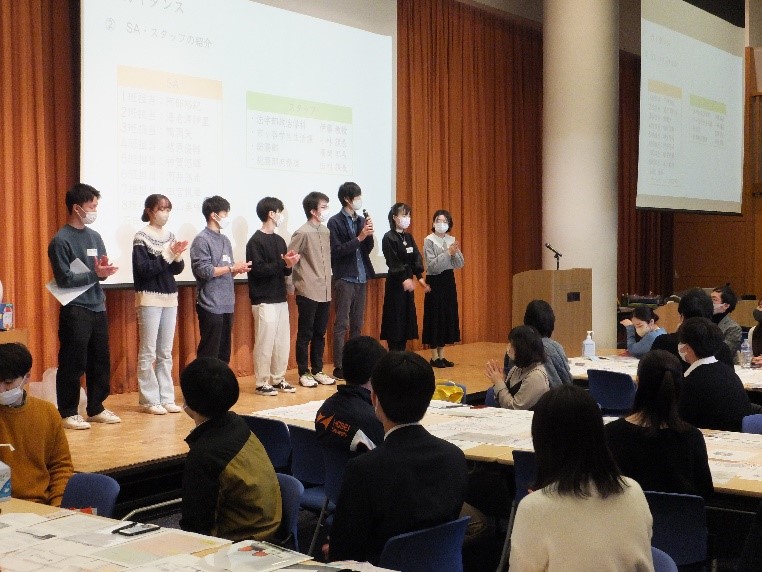
The eight SAs who helped with the operation (from left to right: Mr. Abe, 3rd year, Faculty of Business Administration; Ms. Ebisawa, 2nd year, Faculty of Science and Engineering; Mr. Kamo, 4th year, Faculty of Science and Engineering; Mr. Kozohara, 2nd year, Faculty of Sustainability Studies; Ms. Kanga, 1st year, Master's Program, Graduate School of Engineering and Design; Mr. Kawai, 3rd year, Faculty of Law; Ms. Tamiya, 1st year, Faculty of Sustainability Studies; Ms. Yoneyama, 1st year, Faculty of Sustainability Studies)
-
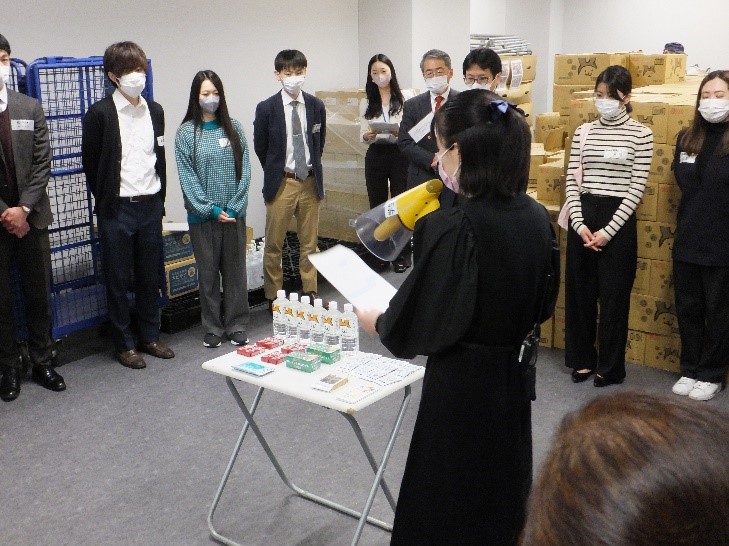
During the tour of the disaster prevention warehouse, explanations were given about the 3-day stockpile that will be distributed.
-
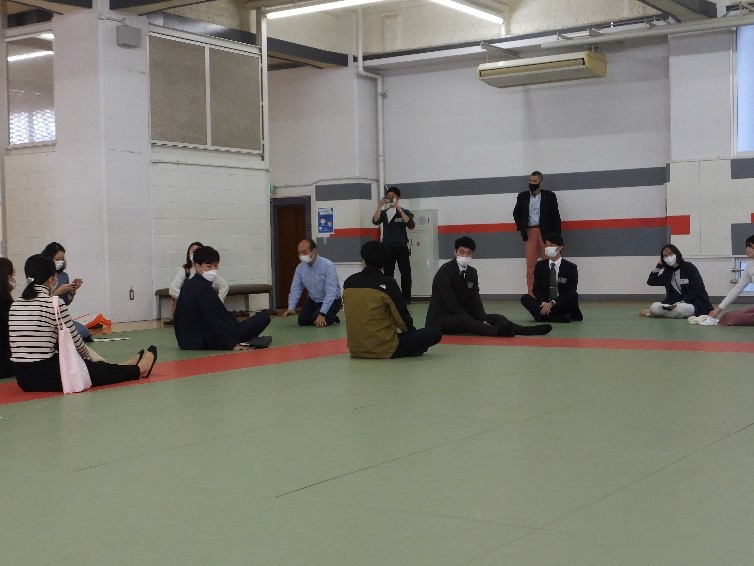
During the gymnasium tour, the students were given a sense of the actual expected space per person (1 tatami mat).
-
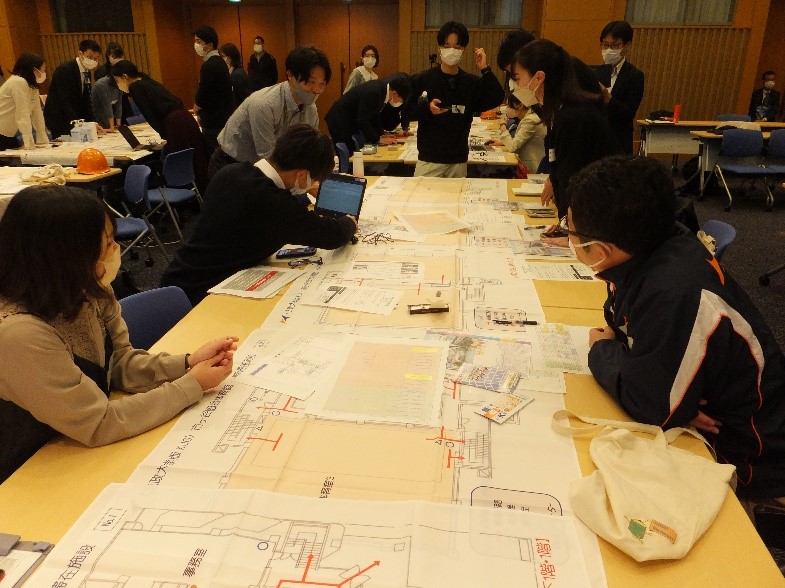
Practice of KUG (1)
-
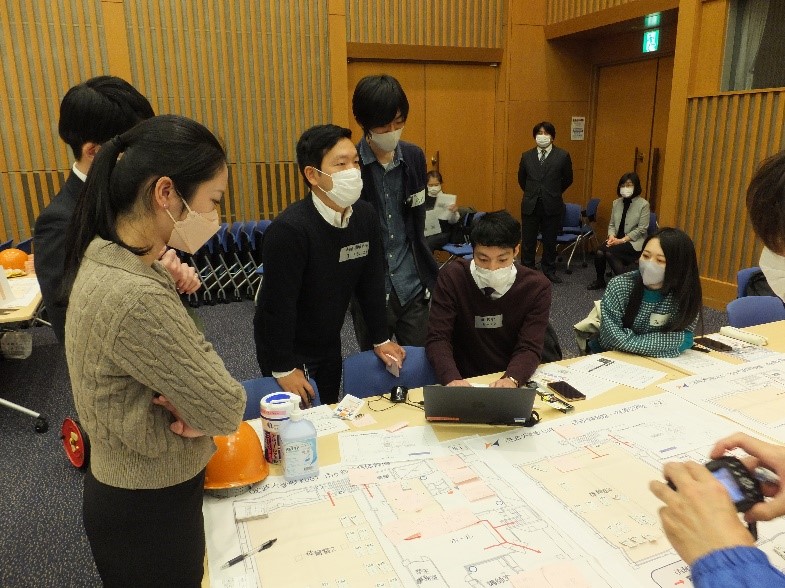
Practice of KUG (2)
-
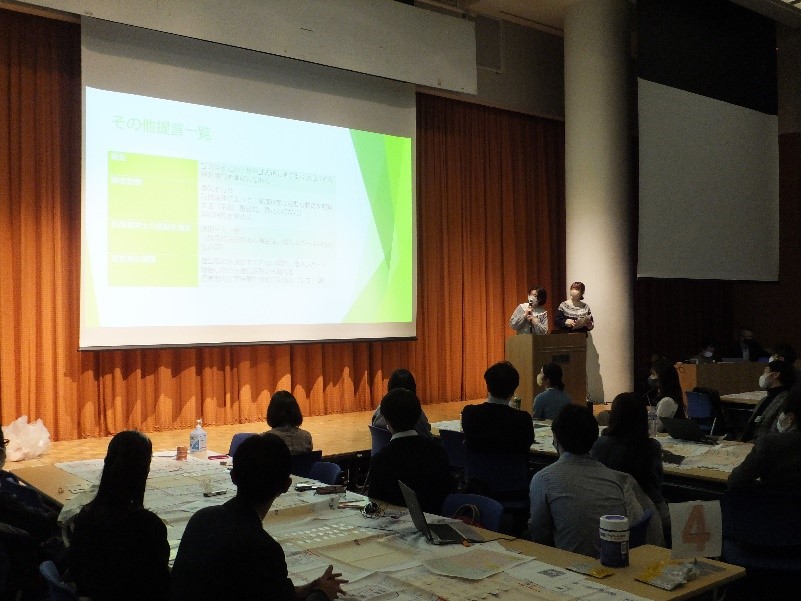
Two SAs gave their suggestions for the university.
-
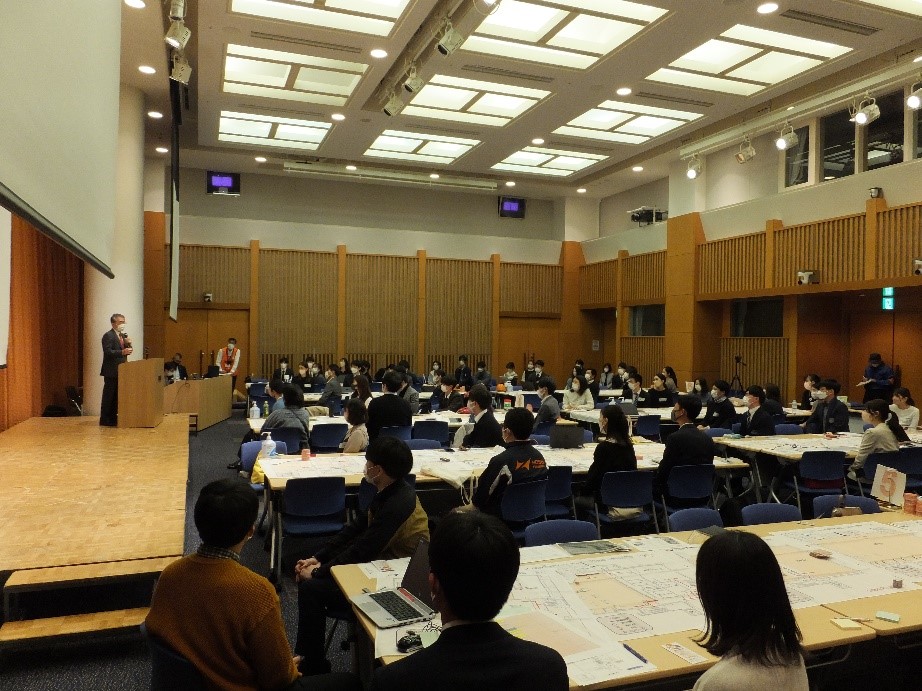
Finally, the President gave a general comment.
-
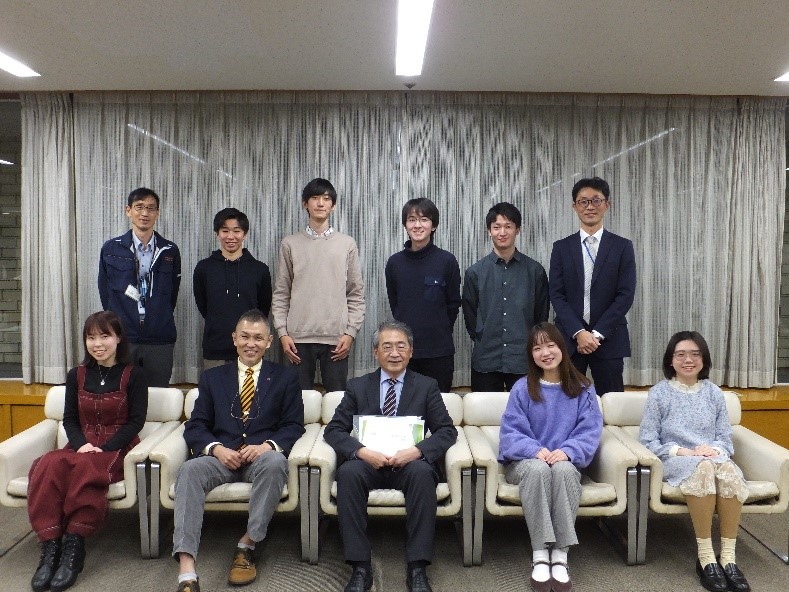
On December 16, the facilitator students paid a courtesy visit to President Hirose to report on the implementation of the program.