

Notices
Alumni Interview: Yuichi Hattori, Public Relations Department Leader, Seibu Lions Co.
- Mar. 29, 2022
Profile.
Yuichi Hattori was born in Chiba Prefecture in 1988.
Born in Chiba, Japan in 1988, she entered the Department of Media and Communication Studies in the Faculty of Social Sciences in 2007, and joined Kagoshima Yomiuri Television (KYT) Inc. as an announcer in 2011. in March 2013, she won the NNS Announcing Grand Prize for Rookie of the Year. She then worked for PR companies before joining Seibu Lions Inc. in October 2019.
Career Search Continues After Graduation: Change is Necessary for Growth
After studying media at university, she found a job as an announcer, which she had longed for. Through his work at the TV station, Tomokazu Hattori learned that there are various forms of media transmission, and he wanted to test his abilities in a different way. He says that finding a job is not the goal, and that there are things you can see and understand while working.
Communicating the baseball team's strategies and initiatives as a business entity
Since October 2019, he has been in charge of public relations for the Seibu Lions. You may have a strong image of team public relations as handling interviews with the team and players, but I am in charge of business public relations, and I promote the company's strategy and the appeal of the team through the dissemination of information about events and business activities.
Before the start of the 2021 season, three years of renovation work was completed on the new dome stadium. The season before that, due to the Corona disaster, the opening of the season was postponed and held without spectators, so we really wanted fans to watch the games, so we reached out to the sports media as well as information and news programs to attract coverage. It was just at the time when the availability of spectators for the Olympics was being discussed, and we were able to get many newspapers and TV programs to report on the infection control measures and safety of the dome. I enjoyed a great sense of accomplishment in fulfilling my public relations responsibility to disseminate information in a timely and extensive manner and to convey it to the world in the context I intended.
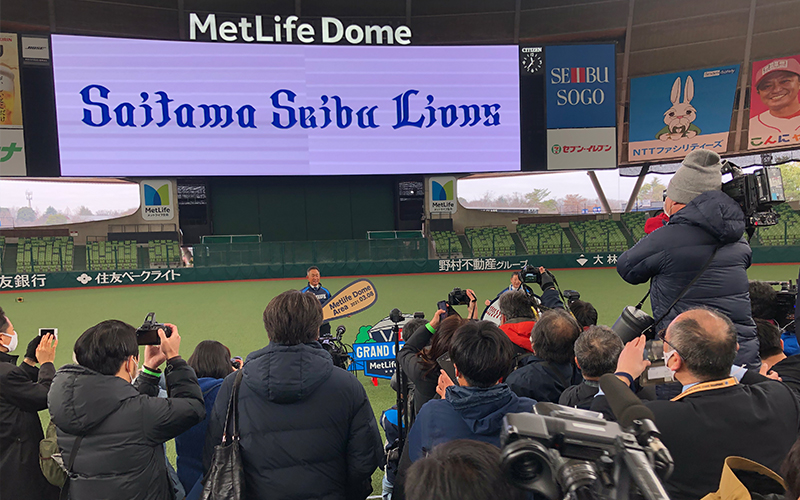
Media preview after the dome renovation was completed. Mr. Hattori was in charge of handling 150 members of the press.
Professional baseball teams are now at a turning point in their business policies, as ticket sales, concession stand sales, and other sales related to game entertainment, which used to be the main source of revenue, are slowing down. The Seibu Lions are also developing new strategies in the areas of gourmet foods and merchandise, such as inviting concerts and exhibitions, producing player-produced box lunches, and developing restaurant menus using local vegetables. This requires a different form of PR than baseball and to a different audience, so I believe this is a good opportunity to show off our public relations skills.
Attending the Faculty of Social Sciences at Hosei University and Voluntary Mass Communication to become an announcer
When I was a sophomore in high school, I had the opportunity to participate in the recording of a high school baseball cheerleading show at a local TV station, and it was cool to watch the host take charge of the proceedings, so I decided that I wanted to become an announcer. For this reason, I decided to study media in college and enrolled in the Faculty of Social Sciences at Hosei University.
From my first year, I participated in a voluntary mass communication course that helped me find a job in the mass media, and even outside of the weekly class days, I practiced vocalization, news reading, and interviewing with my friends during lunch breaks at the Tama Campus.
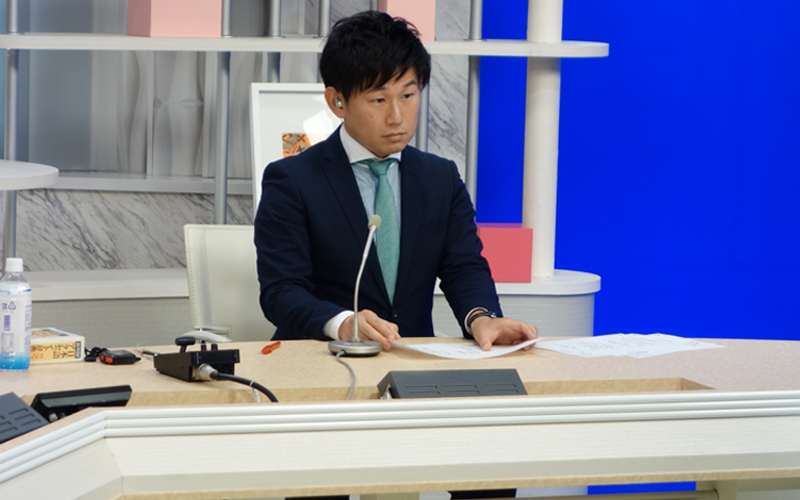
During her announcer days, she was in charge of the noon news and evening information programs Courtesy of Kagoshima Yomiuri Television Co.
In my classes at the Faculty of Social Sciences, I was able to learn about the cutting edge of media, such as social networking services (SNS), which were not yet very popular, so I was able to respond smoothly when they emerged in the workforce. I was also exposed to Edo culture in a seminar led by Professor TANAKA Yuko (now Professor Emeritus). During my time at the TV station, I had many opportunities to visit historical sites, and the knowledge I had acquired about history during my university years came in handy.
During my job hunting activities, I continued to apply for jobs at TV stations, and finally received an offer from almost 100 companies. I still remember how happy I was at that moment.
Through announcing, I learned about media work outside of the mass media.
In my fourth year as an announcer, I was put in charge of an information program and had more opportunities to do interviews. I was very impressed by a public relations manager of a shochu manufacturer who enthusiastically told me that his dream was to spread the company's shochu throughout Japan. As I came into daily contact with the passionate thoughts of the people I interviewed, my desire to do work directly related to business grew stronger. I wanted to increase what I could do and grow for my career over the next few decades, and after much deliberation, I chose the path of transmitting information not as a third party but as a concerned party and quit my job at the TV station.
Later, after working in marketing and public relations for a shopping mall and in consulting sales for a PR firm, I became convinced that this was what I wanted to do, and I decided to become a public relations professional if I was going to do it.
Finding something that connects to your own axis without being confined to the boundaries of an industry or business
Although I have worked in different industries, including a TV station, a shopping mall, a PR firm, and a professional baseball team, I have a core belief in me because I studied media in college and have worked in media in the mass media and in corporations. We don't live in an era of "one company for life," and as long as my own axis is not shaken, I don't see any problem with changing jobs or industries as many times as I want.
Sports is a treasure trove of new business seeds because it can be connected to any industry. I myself have many opportunities to come into contact with the latest knowledge and knowledge that is not directly related to sports, such as measures and products that make use of technology, as well as staging in the new dome that makes use of video, sound, and lighting, and I would like to expand the variation of my output by making use of this knowledge. Currently, I am mainly in charge of the output part as a public relations person, but I would like to increase my opportunities to be involved from the planning stage and management strategy planning stage before that, aiming to reflect my involvement from the upstream process in the output.
When you go out into the world and start working, you will find things that you could not see or notice when you were a student. Society is changing bigger and faster, and the barriers between industries and operations are disappearing. Please do not settle for employment as your goal, but challenge yourself in a variety of ways to broaden your horizons. I am sure that you will find something that will lead to your own axis in the process.
(First published in the March 2022 issue of Hosei, a public relations magazine)