

Notices
Thinking about how to build a society where no one is left behind (Associate Professor Eiko SAEKI Eiko, Department of Sustainability Studies, Faculty of Sustainability Studies)
- November 22, 2021
Department of Sustainability Studies, Faculty of Sustainability Studies
SAEKI Eiko Associate Professor
Associate Professor Eiko Saeki, who experienced cultural and ideological diversity during her study abroad experience in the United States, continues her research focusing on reproductive rights. She is working on issues of gender and the body.

I want to capture the aspect of how society is moved by the power of public opinion.
My specialty is sociology. How is the "beginning of life" perceived in society? Based on the concept of reproductive rights, I continue to conduct research related to gender, the body, and medicine from an interdisciplinary perspective.
My current focus is the situation in Ireland. Until recently, Ireland, with its large population of strict Catholics, has taken a strict stance against same-sex marriage and abortion. In 2015, however, Ireland became the first country in the world to legalize same-sex marriage in a referendum, and in a 2018 referendum, abortion, which had previously been effectively banned in recognition of the "right to life of the unborn," was legalized in a reversal.
In a country with strong conservative tendencies, how did public opinion move society to the point of making a historical shift? I am interested in these questions and analyze them by conducting on-site surveys to ascertain the thoughts and feelings of those who are in the middle of the situation.
The SDGs (Sustainable Development Goals) that Hosei University is working on include the important principle of "leaving no one behind. However, the reality is that many people are probably being left out when it comes to gender. Disparities and prejudices exist in Japan, and the Gender Gap Index* is lower than in other countries.
Nevertheless, the example of Ireland has taught us that even a seemingly conservative society that does not seem to want to change can change at the drop of a hat. Although we cannot compare the two countries as they are because of their different histories, situations, and backgrounds, I am hopeful that we will be able to see more of Japan by backlighting.
Creating an environment in which people can freely express their ideas
In addition to acquiring knowledge, it is important to nurture the ability to think for oneself when studying at university. Therefore, in our classes, we try to present the way social issues are discussed and portrayed in the media, as well as data and theories, in an easy-to-understand manner, and first ask students what they feel about the issues. I am conscious of creating a space where people can openly speak up about even the most outlandish ideas without imposing a single answer.
This commitment has been cultivated through my own learning experience.
After attending a university in the United States (Hawaii), I lived and studied in the United States for 10 years. When people of different nationalities, languages, and cultural backgrounds gather together, what is "natural" to them may not always be "right. Because differences are natural, I would like students to have the courage to speak up without fearing differences of opinion, and to listen to everyone's ideas without denying them.
Another thing I became passionate about while studying abroad was music. I was fascinated by gamelan, the traditional folk music of Indonesia, and was so absorbed in it that I would take time out of my research to join ensembles. I have not been able to find the time to participate in ensembles at the moment, but I would like to resume when circumstances permit.
A lot of music is filled with feelings and has a very important place in social movements because it stirs emotions and thoughts. The messages contained in the lyrics, such as resentment toward politics and society, can be a force that moves society. I am developing an idea to give a lecture while playing music related to the day's theme so that the audience can feel a part of such power.

Practicing gamelan, an ensemble of various large, medium, and small gongs and keyboard percussion instruments such as an iron fiddle. Photo taken during his time at the University of Hawaii.
Developing one's own "Practical wisdom" while connecting theory and practice
The establishment of SCOPE (Sustainable Society Co-creation Program offered in English) in the Faculty of Sustainability Studies in 2016 led me to become a specially appointed faculty member at Hosei University, and I have been serving as a full-time faculty member since 2019.
In sociology, it is important to accumulate such off-campus experiences, such as listening to the thoughts of the people concerned and investigating to see what is actually happening. Fortunately, the Faculty of Sustainability Studies has its own field study course, which allows students to not only learn theory on the desk, but also to put it into practice. The students are very positive in their approach to group work and other activities, so much so that even the seminar students were planning field work such as volunteering at a food pantry (a facility that provides food aid).
It is unfortunate that the new coronavirus infection has put us on hold, but we are grateful for the environment in which we can deepen our studies in the interdisciplinary Faculty of Sustainability Studies. I hope that students will also acquire a multifaceted perspective as they accumulate experience and develop their own "Practical wisdom.
-
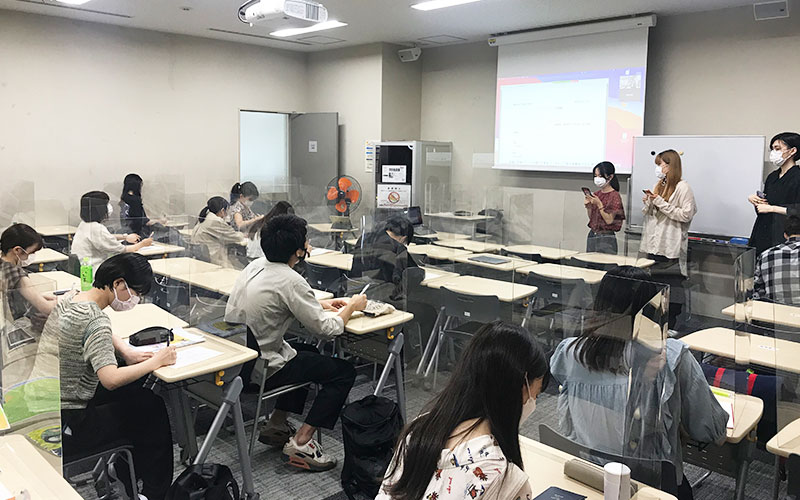
Photo 1
-
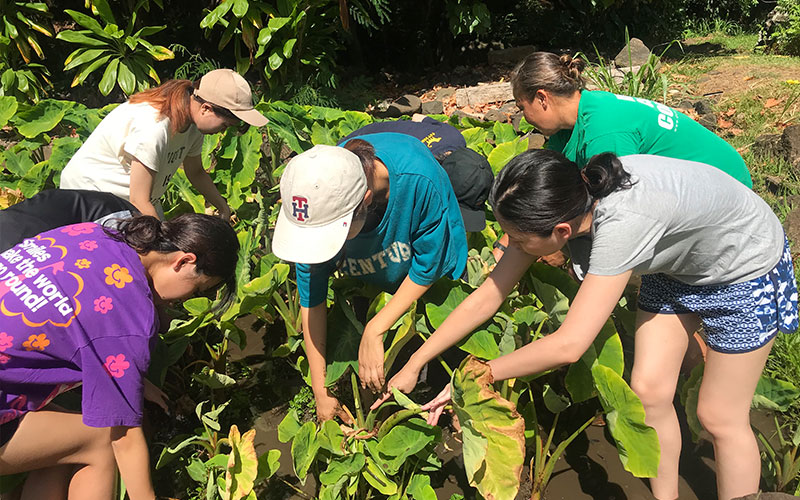
Photo 2
- Photo 1: Presentation at a seminar. Since the resumption of face-to-face classes, classes are being conducted using acrylic boards to prevent infection.
- Photo 2: During a field study conducted in 2019, students learned about traditional farming in a taro field owned by the University of Hawaii.
-
Gender Gap Index: An index published in "The Global Gender Gap Report" that shows the imbalance between men and women in countries around the world. The larger the gender gap, the lower the index.
(First published in the October 2021 issue of Hosei, a public relations magazine)
Department of Sustainability Studies, Faculty of Sustainability Studies
SAEKI Eiko Associate Professor(Saeki Eiko)
B.A. in Anthropology, University of Hawaii at Manoa, M.A. in Sociology, University of Hawaii at Manoa, Ph. D. in Sociology. After working as a lecturer in the Department of Sociology at Rutgers University and as a researcher at the Graduate School of Asia-Pacific Studies, Waseda University, he joined the Faculty of Social Sciences at Hosei University as a specially appointed Associate Professor in 2016 and became an Associate Professor in 2019.