

Notices
Giving new perspectives on social issues and phenomena through animation research (Associate Professor Stevie Suan, GIS)
- Feb 09, 2024
Hosei's Research Brand" Series
At Hosei University, fascinating and stimulating research is being produced every day that will be the frontrunners in the future of society and the world.
This series of articles and videos will tell the story of Hosei's brand of research.
The "aesthetics arising from repetition" felt in the classical performing art of Noh plays led to my later research on animation

My areas of specialization are "media theory" and "performance theory," and I use these theories to research animation works. I was born in Sri Lanka and spent my childhood in New York City, U.S.A. I have loved animation since childhood, but it was not until my senior year of college that I became interested in it as a research subject. I was studying at the State University of New York, majoring in film and culture, when I went to Kyoto for a year to study abroad and learned that Kyoto Seika University, which was nearby, had a department that studied anime and manga. After returning to Japan, I asked my advisor for permission to research an anime film called "Perfect Blue" and wrote my first research paper on the subject of anime, since anime was not well known as a research subject in the U.S. at the time.
In college, I chose Japanese studies as my minor. While taking a variety of classes, I was particularly interested in Asian theater, especially the Japanese "Noh play. After graduating from the university, I once found a job, but when I found time, I read books on Noh plays and Japanese culture. As a result of this ever-growing interest in Noh, I decided to quit my job and spend a year and a half as a research student at Kyoto Seika University, studying traditional Japanese theater and contemporary media. I then went on to a master's program at the University of Hawaii, where I had a prominent professor on Noh theater.
What interested me about Noh performance was the "aesthetics arising from repetition" of Noh movements. There is a strict "pattern" of Noh movements, and one must never deviate from that pattern, not even by a millimeter. Noh is practiced in great detail, over and over again, and one improves by following the pattern. This is where I feel the aesthetics. But in the midst of this, I can also sense individuality in the performances that result from the temporary combination of several rigorous roles in each performance. I also find this paradox interesting. These interests led me to research "Medieval Aesthetics, Performance and Gender in Noh" in my master's program.
In the doctoral program, I was not sure whether to continue my research on the same topic or return to animation, but when my advisor retired and I was also offered a Japanese MEXT scholarship in the field of animation research, I transferred to the doctoral program at Kyoto Seika University, where I spent time as a research student, and concentrated on animation research.
Analyzing "late-night anime" by "coding" animation
When I conduct anime research, my target is so-called "late-night anime. Since the term "anime" covers a wide range of genres, I pay particular attention to animation that is popular overseas and is recognized as the current "Anime" of Japan, targeting high-teens and for commercial purposes. When we began our research, there were no video distribution services, and many of these animations were literally broadcast in the late-night slot, hence the term "late-night anime.
The elements that make each animation work "anime-like" differ depending on the person, place, and time period. In the past, many people called it "moe-kei" and felt that characters with big eyes were anime-like. There are also those who see Sazae-san and Chibimaruko-chan and feel that they are anime-like. In this context, the general domestic and international fan base feels that late-night anime is more anime-like, which is why it is the subject of our research.
As I explained that Noh has a strict pattern, there are common elements that are repeated in late-night anime, such as character design, narrative, facial expressions during joy, anger, sorrow, and joy, and the main character's personality. These elements are the elements that make up late-night animation and are recognized as such.
Focusing on these elements that make up an anime is called "coding" or "symbolizing. For example, if we try to code multiple late-night anime, we can find commonalities in the characters' hairstyles, facial expressions, and so on. You might call it a guide or a "promise" when creating an anime. The movements of characters in animation are also such coded expressions, and I believe it is very interesting to pay attention to gestures.
Deepening the significance of research by analyzing animation from a global perspective

In 2021, I published a book entitled Anime's Identity: Performativity and Form Beyond Japan. Fortunately, I received a certain amount of recognition for my research to date, and the book was awarded the "Japan Society for Animation Studies Award 2023". Simply put, it discusses the globalization of animation.
The globalization of animation is first of all about gaining recognition and popularity overseas, and "Oni no Shiba" is a perfect example of this. Oni-no-Baishi" is a perfect example of this. It became a huge hit in Japan, and outside of Japan, it is seen as a representative work of contemporary Japanese culture. In this way, anime is recognized as "Japanese culture" throughout the world. However, can anime be easily interpreted as Japanese culture? If you look closely at the end credits of an anime, you will see that the names of not only Japanese but also many foreigners are listed there. As this shows, the production of anime is becoming globalized in today's society. The genesis of my research was the idea that anime research could be conducted from a global perspective as well.
As an example, I would like to cite "Tensei Tareta Slyumu Datta Netto", a very popular genre of "Isekai Anime" today. This work has Tokyo as its central starting point, with the parts produced in Japan, including those produced in Seoul (Korea), Manila (Philippines), Ho Chi Minh City (Vietnam), Shanghai (China), etc., divided and completed in Tokyo for management.
In this work, the Japanese protagonist is reborn as a slime named Limuru in a fantasy world, makes friends from other ethnic groups during his adventures, and builds a town with them. As the story progresses, characters from various countries create a multinational town in the city of Rimuru. It also reads like a reimagining of a part of Japan, with the creation of traditional Japanese inns. The city functions as a central node for negotiating peace treaties with other countries, and can be thought of as a globalization of anime production that is also practiced within the story.
Conditions surrounding animation production in Japan are extremely harsh, with low wages and long working hours. On the other hand, in the Philippines, for example, the working environment may be better than in Japan because of the price difference. Furthermore, there is a shortage of human resources in Japan to produce the planned animations, and staff from outside of Japan are increasingly needed. Thus, the globalization of animation is a complex phenomenon.
Coding and analyzing animation contributes to the globalization of animation. Because it is coded, anime can be produced in many different places by adhering to that code. In fact, this is not a recent phenomenon, but has been going on since the 1960s. The quality of so-called Japanese animation is highly regarded and its bearers are often thought to be Japanese, but for example, one of the directors of the popular animation "Jutsu Kaisen" is Korean. Therefore, the concept of transnational or trans-national cultural production is considered important for animation research.
New Perspectives on Social Issues Revealed by Analyzing Animation

When we hear the word "animation," we tend to think of it as content on TV or in movies, but it could also be said that our lives themselves are animated. Many of the world's hit movies are in fact animated (e.g., "AVATAR") or animated productions (e.g., Disney productions). Furthermore, animated characters are explaining things on our smartphones and on the control panels of banks and other institutions. We are living in such a media environment.
In my seminar, we consider media in a broad sense and how they are animated. Some students study the phenomenon of why in this day and age, people are performing like the anime characters that can be seen on TikTok and other sites.
Although animation research does not have a long history, we believe it has many possibilities. As one such example, I would like to mention a new perspective that animation can give to environmental issues. I have already mentioned that we are paying attention to the performance of characters, but to mention it further, in animation, a character's performance, or in other words, its characterization or personality, changes depending on its movements.
From the standpoint of anthropocentric individualism, we see the environmental destruction and pollution created by humans as "things" outside of us humans. From this perspective, only humans are actors and can hardly act with things. Therefore, we tend to separate ourselves from environmental problems, which are things.
However, in anime, for example, in the world of "Pokemon," the main character Satoshi and the Pokemon Pikachu are depicted with the same code (the same expression, such as the arching smile in both of their eyes). Thereby, humans and non-human objects (Pokémon, animals, robots, etc.) are made up of similar elemental combinations of ego. In other words, it is thought that the connection of humans with Pokémon and other non-human objects makes the ego broader.
In the animated story "Children of the Sea Beast," the subject of our research, the protagonist, an individualistic girl, meets boys from the sea and then participates in a mysterious event with sea creatures. The experience is analyzed as depicting the protagonist's growth process in pursuit of a more ecological ego, in which the protagonist embraces the new incorporation of outside objects as well as her own repetition of outside codes through the highly symbolic performance of the cartoon. In this way, we, too, hope to help solve environmental problems by allowing ourselves to mix with the things outside and our inner selves.
-
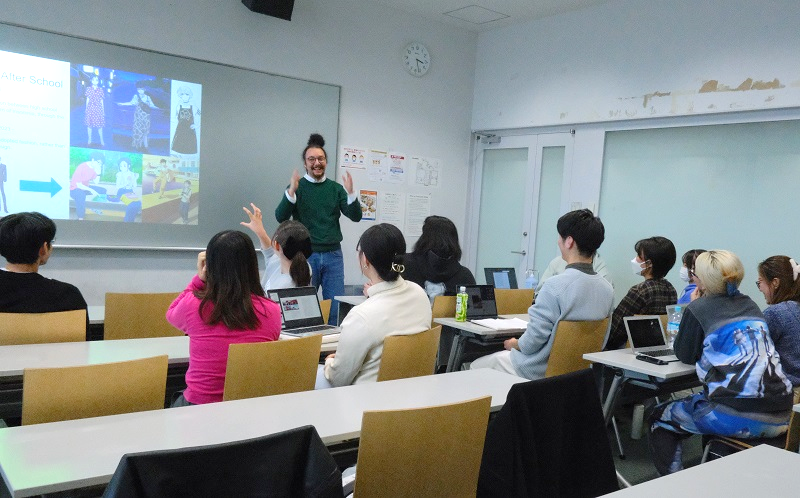
Scene of the seminar
-
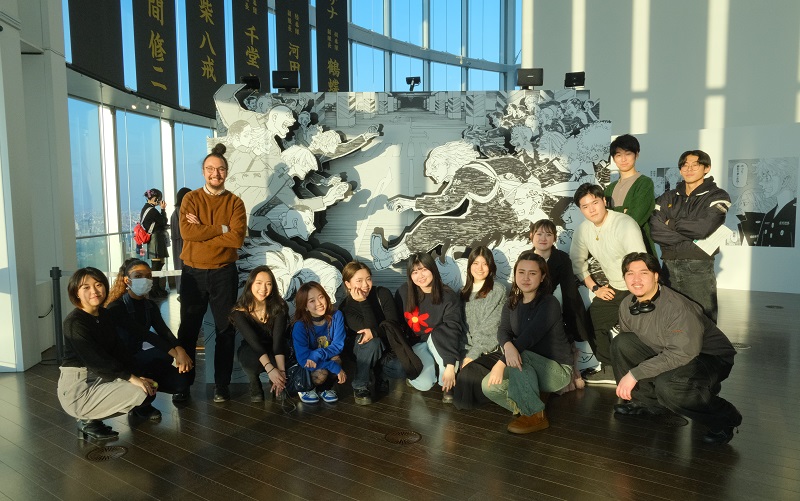
Group photo at the exhibition "Tokyo Manji Revengers: New Experience Drawing Exhibition, The Last World Line," which we visited as a seminar.
Stevie SUAN, Associate Professor, Department of Global and Interdisciplinary Studies, GIS (Faculty of Global and Interdisciplinary Studies)
M.A., Asian Studies Japan, University of Hawaii at Manoa; Ph.D., Manga Studies, Kyoto Seika University; current position from 2019. She specializes in performance and media theory. His main research interests include "Aesthetics and Globality in Television Animation. His major publications include Anime's Identity: Performativity and Form Beyond Japan (University of Minnesota Press), Anime's 'Actors': Embodied/Intangible in Animation. In 2023, he received the Japan Society for Animation Studies Award.